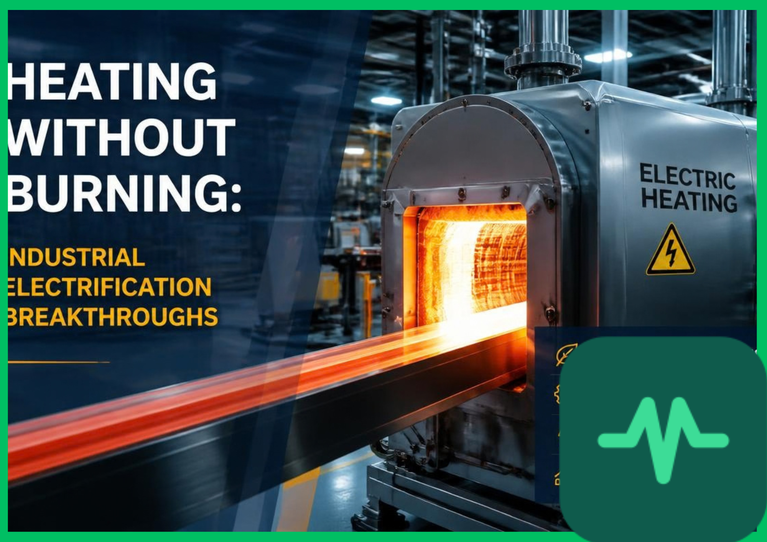
Inside those cavernous buildings, massive industrial furnaces roar at blistering temperatures.
For generations, making the core materials of our modern world required burning massive amounts of coal, oil, and natural gas.
Steel beams, concrete foundations, glass windows, and chemical products all share a hidden origin. They were born from combustion.
That reliance on burning fossil fuels makes heavy industry one of the largest sources of global greenhouse gas emissions.
Cleaning up this sector felt nearly impossible for decades because high-heat manufacturing demands incredible amounts of thermal energy.
A quiet technological revolution is changing that reality.
According to transition roadmaps from the International Energy Agency (IEA), environmental findings from the United Nations Environment Programme (UNEP), and academic clean tech studies, industrial electrification innovations are replacing combustion with clean electricity.
Here is how advanced electric technologies are transforming heavy industry and heating our world without burning a single drop of fossil fuel.
The Hard Challenge of High-Heat Manufacturing
To understand why industrial electrification is such a breakthrough, you have to look at the physics of heavy manufacturing.
Heating a residential home requires raising indoor air by a few degrees. That is a relatively simple task for standard heat pumps.
Manufacturing steel, cement, and glass, however, requires extreme thermal energy.
Blast furnaces used to process iron ore reach temperatures exceeding 1,500 degrees Celsius (approx. 2,730 degrees Fahrenheit). Cement kilns operate at similarly roaring heat levels to trigger complex chemical transformations in limestone.
Historically, engineers argued that electricity could never deliver the concentrated heat power required for these heavy industrial processes.
Fossil fuels provided a convenient, high-intensity flame.
The byproduct of that convenience was a massive global carbon footprint.
As climate research and IEA assessments emphasize, achieving true global climate targets requires finding a way to generate extreme industrial heat using zero-emission electricity.
Electric Arc Furnaces and Induction Heating
The breakthrough in heavy industry decarbonization comes from advanced electrical engineering.
Instead of burning coal to melt raw materials, modern manufacturing facilities are deploying high-capacity electric arc furnaces and induction heating systems.
Electric arc furnaces use massive electrical currents to generate powerful arcs of electricity between large carbon or graphite electrodes.
The resulting electrical arc creates intense, direct thermal energy that melts scrap metal and raw iron efficiently, bypassing coal-fired combustion entirely.
Similarly, induction heating systems use high-frequency electromagnetic fields to heat metals rapidly from the inside out with surgical precision.
These electric technologies do not just eliminate smokestack emissions; they offer superior operational control.
Operators can dial in exact temperatures instantly, reducing energy waste and improving the metallurgical quality of the final product.
Scaling Up Clean Electrical Thermal Systems
Transitioning heavy industry from combustion to electricity requires rethinking plant infrastructure from the ground up.
Academic clean tech studies show that industrial electrification works best when paired with a reliable, expanding supply of clean renewable electricity from wind, solar, and modern grid networks.
When heavy manufacturing plants plug into clean electricity grids, their carbon emissions drop to near zero.
Furthermore, industrial electrification projects are scaling up across multiple sectors:
- Electric Steam Boilers: Replacing fossil-fuel boilers in chemical and food processing plants with high-efficiency electric steam generators.
- Resistance and Plasma Heating: Utilizing advanced plasma torches to supply clean thermal energy for specialty glass and mineral processing.
- Electrified Kilns: Redesigning industrial kilns to run on clean electric resistance elements rather than burning natural gas.
As IEA tracking data confirms, the operational efficiency of electric industrial heating makes it an increasingly attractive economic choice for manufacturers looking to protect themselves against volatile fossil fuel prices.
Overcoming Infrastructure and Grid Bottlenecks
Every major technological transition faces hurdles, and industrial electrification is no exception.
Heavy manufacturing plants consume staggering amounts of electrical power.
Connecting a single large steel mill or chemical facility to clean electric heating requires massive upgrades to local high-voltage transmission lines and regional substations.
Governments and utility companies must coordinate infrastructure planning to ensure that clean power grids can handle the massive surge in industrial electricity demand.
Despite these infrastructure challenges, the economic and environmental momentum is undeniable.
Global manufacturers recognize that long-term business survival depends on shedding carbon liabilities.
Redefining the Industrial Landscape
Heating without burning is no longer a theoretical laboratory concept. It is an active, scaling industrial reality.
By embracing industrial electrification innovations, heavy manufacturing is breaking free from its centuries-old dependence on fossil fuel combustion.
We are transforming how we build our cities, manufacture our materials, and power our global economy.
Clean electricity is proving that we can produce the foundational goods of modern society without sacrificing the health of our atmosphere.


Comments (0)
Login to leave a comment.
No comments yet. Be the first to share your thoughts!