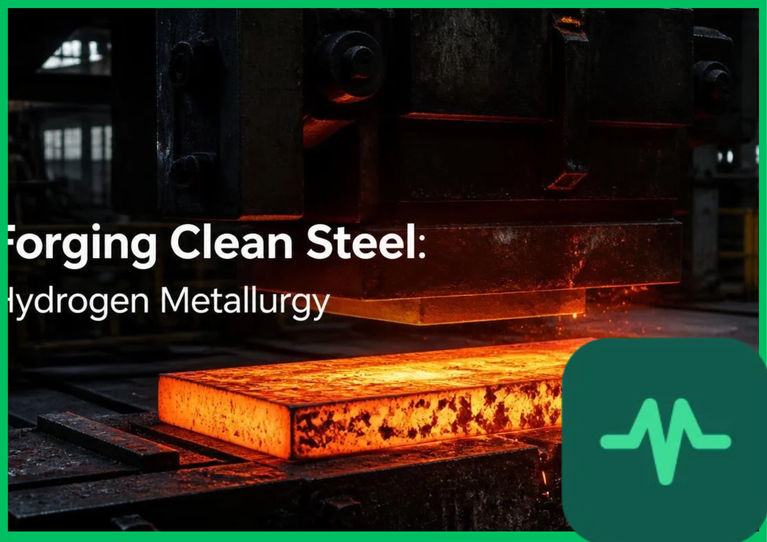
You feel the roaring wall of intense heat radiating against your face.
Towering blast furnaces glow with blinding orange light as molten iron pours into casting molds.
All around you, heavy machinery pounds rhythmically, shaping raw metal into the beams, bridges, and vehicles that hold our modern world together.
Steel is the skeleton of our civilization.
Without steel, we would have no high-rise buildings, no railway tracks, and no machinery to build our clean energy future.
Yet making steel carries a devastating dark secret.
For over a century, traditional steelmaking operated on a heavy, carbon-intensive bargain.
To turn raw iron ore into strong metal, massive blast furnaces burned millions of tons of coking coal every single day.
That coal did two jobs.
It generated intense heat, and it stripped oxygen away from the iron ore.
In exchange, those fiery smelters pumped massive volumes of carbon dioxide straight into our shared atmosphere.
Steel production alone accounts for roughly 7% to 9% of all global greenhouse gas emissions.
We cannot build a truly clean energy future while using fossil coal to forge the metal that builds our green infrastructure.
What if we replaced coal in the furnace with the cleanest element in the universe?
What if we used hydrogen gas to strip oxygen from iron ore, leaving behind pure, zero-emission metal?
A quiet, brilliant metallurgical revolution is transforming heavy industry across the globe.
According to global industrial reports from the International Energy Agency (IEA), resource protection frameworks from the United Nations Environment Programme (UNEP), efficiency benchmarks from ENERGY STAR, and academic metallurgy research, green hydrogen steel manufacturing is changing our industrial horizon.
By using green hydrogen direct reduction instead of coking coal to forge iron, we eliminate industrial carbon emissions entirely.
Here is how hydrogen metallurgy works, why fossil-free steel changes heavy manufacturing economics, and how forging clean steel secures our sustainable future.
The Smoky Legacy of Coal-Powered Blast Furnaces
To understand why green hydrogen steel manufacturing matters so much, you have to look at the chemistry of traditional metallurgy.
Iron ore mined from the earth is not pure metal.
It is iron oxide—meaning iron atoms are chemically locked tightly together with oxygen atoms.
To get pure iron, you have to strip that oxygen away.
For centuries, humanity used carbon in the form of coal and coke to do that stripping job.
When you heat iron ore inside a giant blast furnace with coal, the carbon grabs the oxygen atoms from the ore and escapes into the sky as massive plumes of carbon dioxide gas.
Skeptics once argued that cleaning up steelmaking was impossible.
They claimed that heavy industry required carbon to provide the chemical reaction needed to make structural steel strong enough for skyscrapers and bridges.
Metallurgists and materials scientists refused to accept that limit.
They looked at the periodic table and found a better chemical partner.
Hydrogen.
What Is Green Hydrogen Steel Manufacturing?
Green hydrogen steel manufacturing—often called hydrogen direct reduction—is an advanced metallurgical process that replaces polluting coking coal with clean green hydrogen gas to strip oxygen from iron ore, producing high-grade sponge iron without releasing a single gram of carbon dioxide.
Instead of feeding a fiery blast furnace with coal, engineers feed iron ore pellets into a tall vertical reduction shaft.
Pure green hydrogen gas, produced using renewable electricity to split water molecules, rushes up through the shaft.
As the hydrogen gas contacts the hot iron ore, its molecules pull the oxygen atoms away from the iron.
Water vapor forms as the only byproduct, venting safely out the top of the stack as clean steam.
The resulting product is direct reduced iron—a porous, high-purity metal sponge.
That clean sponge iron is then melted down in an electric arc furnace powered by renewable electricity, turning it into top-grade structural steel ready for the global market.
The Science of Chemical Reduction and Electric Arc Melting
How does replacing coal with hydrogen gas change the structural strength and thermal dynamics of forged steel?
It comes down to atomic reduction chemistry and electric arc efficiency.
Academic metallurgy research shows that hydrogen direct reduction operates at lower temperatures than traditional coal blast furnaces, reducing thermal stress on industrial equipment.
Furthermore, because hydrogen gas reacts cleanly with iron oxide to form simple water vapor instead of toxic carbon gases, the internal metallurgy of the steel remains exceptionally pure and durable.
When that clean sponge iron is melted in an electric arc furnace, operators can add precise alloy elements to forge high-strength steel that meets every international construction and safety code.
According to ENERGY STAR and international industrial efficiency evaluations, switching from coal-based blast furnaces to hydrogen-based direct reduction cuts primary energy losses by up to 25% when integrated with modern heat recovery loops.
Heavy industry runs cleaner, cooler, and smarter.
Environmental Integrity and Global Industrial Decarbonization
The environmental benefits of green hydrogen steel manufacturing extend far beyond eliminating carbon emissions from smelting plants.
They provide a vital transformation for industrial port cities and manufacturing regions.
Traditional steel mills choke local communities with heavy particulate pollution, sulfur dioxide, and toxic smog.
When a steel mill switches to green hydrogen and electric arc melting, local air pollution drops to near zero instantly.
According to UNEP resource governance frameworks, fossil-free metallurgy protects regional watersheds from the toxic chemical runoff associated with coal washing and coke production.
According to IEA clean industrial roadmaps, scaling up hydrogen direct reduction is an absolute necessity to achieve global net-zero targets, because heavy manufacturing cannot rely on lithium batteries alone.
When steel is forged using clean hydrogen, the backbone of our civilization becomes sustainable.
Overcoming Infrastructure and Economic Realties
Scaling green hydrogen steel manufacturing from pioneering pilot plants into global industrial production involves navigating real-world infrastructure hurdles.
Producing millions of tons of green hydrogen requires massive renewable energy parks and gigawatt-scale water electrolyzers located right beside steel mills or connected by high-pressure pipeline networks.
Governments, industrial conglomerates, and academic research institutions are investing heavily in regional hydrogen hubs, building dedicated supply chains and upgrading port facilities to handle green iron exports.
As carbon pricing penalties make coal-based steel increasingly expensive to operate, hydrogen metallurgy is transitioning successfully from experimental factory trials into commercial mass production worldwide.
Forging Our Clean Steel Toward a Sustainable Future
Green hydrogen steel manufacturing proves that human ingenuity can clean up even the heaviest, most stubborn industrial sectors on Earth.
We no longer have to accept that building our civilization requires burning millions of tons of polluting coal and choking our atmosphere with carbon.
By using green hydrogen gas to strip oxygen from iron ore, we forge strong, durable steel with zero emissions.
We step away from fossil fuel dependence, embracing a clean, advanced, and enduring standard of heavy manufacturing.
Through brilliant metallurgy, rigorous academic research, and a deep respect for our planetary climate, forging clean steel secures a strong, bright, and sustainable future for every community on Earth.

Comments (0)
Login to leave a comment.
No comments yet. Be the first to share your thoughts!