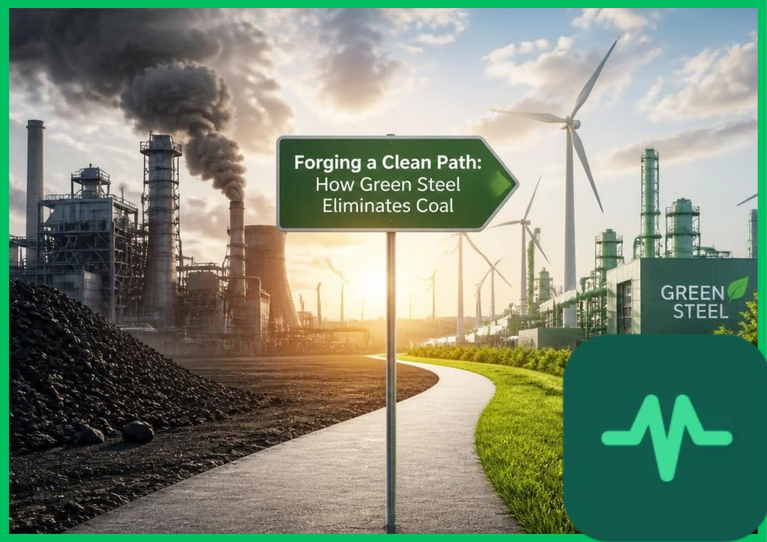
Steel forms the physical backbone of our modern world. It holds up our skyscrapers, bridges our rivers, reinforces our homes, and frames our vehicles.
Every single modern city rests on a foundation of steel.
That strength came with a devastating ecological cost.
For over a century, traditional steel manufacturing relied entirely on burning coal. Industrial plants used metallurgical coal not just for heat, but as a chemical agent to strip oxygen away from raw iron ore.
That chemical reaction pumps billions of metric tons of carbon dioxide into our shared atmosphere, making steelmaking one of the heaviest polluting sectors on Earth.
We cannot build a sustainable future out of dirty metal.
A quiet, fiery revolution is sweeping across global metallurgy laboratories and industrial plants.
According to heavy industry reports from the International Energy Agency (IEA), resource governance frameworks from the United Nations Environment Programme (UNEP), energy efficiency guidelines from ENERGY STAR, and academic materials research, green steel manufacturing is transforming how we build our world.
By replacing coal with green hydrogen and utilizing electric arc furnaces, industrial innovators are forging a clean path forward.
Here is how green steel manufacturing works, why hydrogen-based reduction changes the chemical math of metal, and how zero-emission heavy industry protects our global atmosphere.
Bruised skies and choking pollution tell the story of a heavy industrial legacy.
To understand why green steel is so revolutionary, you have to look closely inside a traditional blast furnace.
Raw iron ore dug out of the earth does not arrive as shiny metal. It arrives as an iron oxide—meaning iron atoms are tightly bound to oxygen atoms.
To turn that ore into usable iron, you have to strip the oxygen away.
For generations, humanity used carbon-rich metallurgical coal to do that stripping. When you heat coal inside a blast furnace, carbon atoms bond with the oxygen in the iron ore, floating away as carbon dioxide gas and leaving liquid iron behind.
That process consumes enormous amounts of energy and releases immense carbon emissions.
For every single metric ton (approx. 2,205 pounds) of traditional steel produced, roughly two metric tons of carbon dioxide enter the atmosphere.
As global demand for infrastructure grows, we cannot keep burning coal to build our cities.
We had to change the fundamental chemistry of metal production.
What Is Green Steel Manufacturing?
Green steel manufacturing replaces polluting coal with clean, renewable solutions.
The entire process pivots on two revolutionary technological steps: hydrogen-based reduction and electric arc melting.
Instead of throwing metallurgical coal into a roaring blast furnace, engineers feed purified green hydrogen gas into a direct reduction shaft.
Hydrogen acts as a chemical reducing agent.
When hydrogen gas flows over hot iron ore pellets, its atoms bond with the oxygen trapped inside the ore.
Instead of creating carbon dioxide, the chemical reaction produces harmless water vapor.
You pull pure, reduced iron out of the chamber, and the only exhaust leaving the stack is clean steam.
That clean iron is then transferred to an electric arc furnace powered by renewable electricity, where scrap metal and clean iron are melted down and forged into high-grade structural steel.
The Power of Hydrogen-Based Reduction
The magic of green steel lies in its atomic chemistry.
Water vapor ( ) replaces carbon dioxide (
 ) as the byproduct of reduction.
Academic materials research shows that direct reduction using hydrogen operates at lower thermal temperatures than traditional coal-fired blast furnaces, conserving industrial energy while eliminating emissions entirely.
When that green hydrogen is produced through water electrolysis powered by wind and solar electricity, the entire supply chain becomes completely clean.
Industrial engineers no longer need to burn fossil fuels to achieve the extreme heat required for metallurgy.
Electric arc furnaces utilize powerful magnetic fields and electric currents to melt metal scrap and hydrogen-reduced iron with absolute precision.
According to IEA industrial transition assessments, scaling up hydrogen-based reduction is the single most effective way to eliminate emissions from heavy manufacturing.
Overcoming Industrial and Economic Hurdles
Transforming a multi-trillion-dollar global industry does not happen overnight.
Green steel manufacturing faces real-world hurdles on the path to mass adoption.
The primary challenge is infrastructure and clean energy supply. Producing massive quantities of green hydrogen requires dedicated access to cheap, abundant renewable electricity and large-scale water electrolysis facilities.
Furthermore, retrofitting existing steel mills or building brand-new direct reduction plants requires billions of dollars in upfront capital.
UNEP industrial governance frameworks highlight that international policy support, carbon pricing mechanisms, and green public procurement standards are essential to help early adopters bridge the transition gap.
When governments and global builders commit to buying zero-emission steel for public infrastructure projects, market demand soars, driving down production costs and accelerating factory conversions worldwide.
Forging a Sustainable Industrial Era
Green steel manufacturing proves that human engineering can clean up even the heaviest industrial sectors.
We no longer have to accept that building our cities, bridges, and transport networks requires poisoning our global atmosphere with coal smoke and carbon emissions.
By combining hydrogen-based reduction, metallurgical coal elimination, and electric arc steel furnaces, we unlock a clean, circular foundation for modern architecture.
We step away from dirty fossil combustion, harnessing the clean physics of hydrogen to forge a sustainable world.
Through scientific innovation, industrial commitment, and visionary manufacturing design, green steel secures a durable, breathable, and thriving future for our planet.

Comments (0)
Login to leave a comment.
No comments yet. Be the first to share your thoughts!