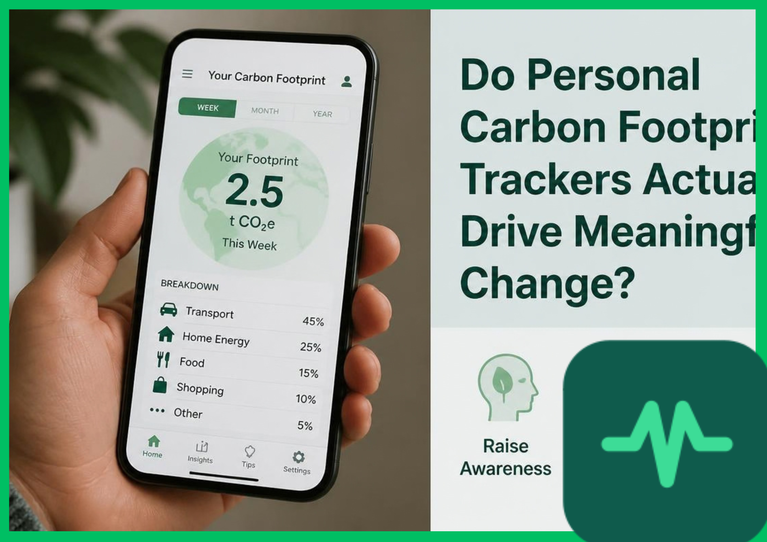
The screen flashes a colorful summary. It tells you your exact carbon footprint for the day.
You feel a slight pang of guilt about that meat-based lunch or that long car ride. You resolve to do better tomorrow.
Carbon footprint tracking apps have exploded in popularity. Conscious consumers everywhere download them to monitor their lifestyle emissions and track their personal environmental impact.
Yet a lingering question remains: do these digital tools actually drive meaningful change, or are they just digital pacifiers that make us feel good while the planet warms?
The Rise of Personal Carbon Accounting
To understand these apps, you have to look at how they work.
Personal carbon footprint calculators sync with your credit card purchases, track your GPS movement, or ask you to manually input your daily habits. They translate your flights, meals, and utility bills into kilograms of carbon dioxide equivalent.
This data brings transparency to an invisible problem.
For decades, greenhouse gas emissions felt abstract and distant. Smoke pouring from industrial smokestacks or melting ice caps in the Arctic felt disconnected from everyday life.
Carbon tracking apps connect the dots. They show you that your daily commute or your weekly grocery haul carries a tangible environmental cost.
The Psychology of Awareness and Guilt
Awareness is a powerful psychological tool.
When people see their carbon numbers quantified on a bright smartphone screen, their behavior often shifts in small ways. They might turn off lights more diligently, reduce food waste, or choose public transit once a week.
Yet psychology also reveals a trap. It is called moral licensing.
When someone uses a carbon tracker and makes a small eco-friendly choice—like bringing a reusable coffee cup—their brain registers a moral victory. That tiny win often licenses them to indulge in a high-carbon activity later, like booking a long-haul flight.
The app makes people feel like they are actively saving the planet, even when their overall annual emissions remain virtually unchanged.
The Trap of Individualizing Systemic Problems
There is a deeper, structural flaw at the heart of personal carbon tracking.
The entire concept of a personal carbon footprint was heavily popularized decades ago by major fossil fuel corporations as a brilliant public relations strategy.
By shifting the focus onto individual lifestyle choices, energy giants successfully deflected attention away from systemic industrial pollution.
If you focus all your energy on recycling plastic bottles, riding a bicycle, and tracking your daily coffee consumption, you ignore the massive systemic systems that govern our world.
No amount of personal footprint tracking will fix a power grid powered by coal, or a transportation network built exclusively for gas-guzzling cars.
When apps tell you that your individual choices are the primary battleground against climate change, they point the finger at the wrong target.
When Tracking Actually Works
Despite these heavy limitations, carbon tracking tools are not entirely useless.
They work best when they move beyond superficial guilt and spark structural lifestyle changes.
Tracking your home energy consumption can reveal phantom power drains and inspire you to insulate your home or switch to efficient appliances. Monitoring your travel habits can help you permanently replace frequent short-drive car trips with walking or cycling.
Furthermore, aggregate data from millions of users gives researchers valuable insights into consumer behavior trends, helping cities design better public transit networks and green infrastructure.
Moving Beyond Digital Eco-Guilt
Do personal carbon footprint trackers drive meaningful change? The answer is complicated.
On their own, they rarely trigger massive environmental transformations. They risk trapping users in a cycle of digital eco-guilt while ignoring the systemic reforms we desperately need.
Yet, as a starting point for self-awareness, they can help ground our daily choices in reality.
True sustainability requires more than logging your meals into an app. It requires combining personal mindfulness with collective political action, demanding clean energy grids, and holding major industrial polluters accountable.
Use the apps if they help you stay mindful. But never mistake tracking your personal emissions for solving the global climate crisis.



Comments (0)
Login to leave a comment.
No comments yet. Be the first to share your thoughts!