
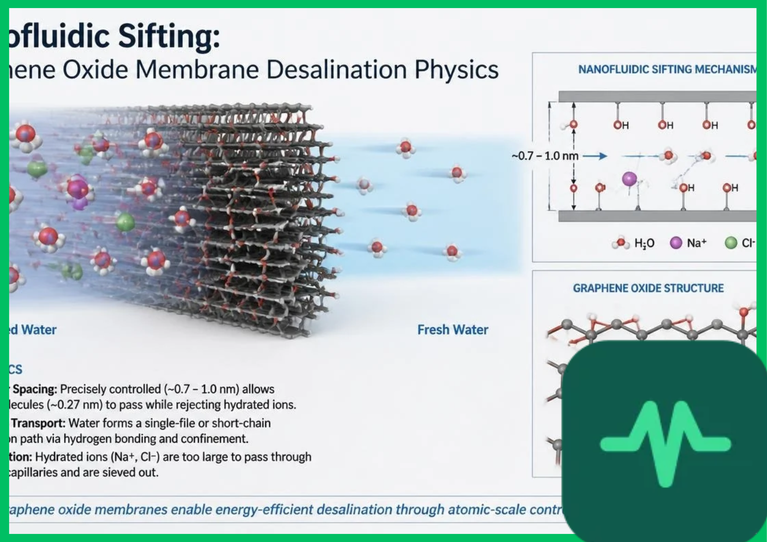
Sub-Nano Fluidic Channels and Molecular Sieve Mechanics
The foundational physical mechanism governing graphene oxide desalination is the precise tuning of sub-nano fluidic channels formed between stacked 2D GO nanosheets. Graphene oxide sheets are synthesized via chemical exfoliation of natural graphite, introducing abundant oxygen-containing functional groups—including epoxide, hydroxyl, and carboxyl groups—onto the basal planes and sheet edges. When vacuum-filtered or spin-coated into thin laminar membranes, these functionalized sheets stack vertically, creating parallel nano-capillaries with controlled interlayer spacings ( -spacing) ranging from
 to
 (
 ).
These restricted interlayer galleries function as molecular sieves. Water molecules, possessing a kinetic diameter of approximately  (
 ), enter and migrate through the sub-nano channels via frictionless capillary flow. Conversely, hydrated solute ions are physically excluded or sterically hindered from entering the channel network, preventing salt passage while maintaining high volumetric water flux.
Salt Rejection Selectivity and Ion Hydration Shells
Achieving high salt rejection selectivity in graphene oxide membranes requires analyzing ion hydration shell thermodynamics. In aqueous saline environments, sodium ( ), chloride (
 ), magnesium (
 ), and sulfate (
 ) ions do not exist as bare atomic species; instead, they are surrounded by tightly bound hydration shells composed of coordinated water molecules.
The hydrated radius of a sodium ion is approximately  (
 ), while chloride possesses a hydrated radius of
 (
 ). When hydrated ions approach the entrance of a sub-nano GO channel configured with an interlayer spacing restricted to
 , the energetic penalty required to strip or distort these hydration shells creates a severe steric and electrostatic energy barrier.
Electrostatic repulsion also governs selectivity. Negatively charged oxygen functional groups lining the GO sheets create a negative surface charge potential ( -potential), repelling anions like chloride while attracting cations. However, unmitigated GO membranes in aqueous solutions tend to swell as water molecules intercalate between hydrophilic basal planes, expanding the
 -spacing and compromising salt rejection. Industrial fabrication protocols resolve this swelling instability by chemical cross-linking with divalent cations (such as
 or
 ) or covalent cross-linking agents like ethylenediamine, locking interlayer spacing at stable dimensions and achieving sodium chloride (
 ) salt rejections exceeding 95% to 99%.
Technical Data Specifications of Graphene Oxide Desalination Membranes
| Graphene Oxide Membrane Parameter | Engineering & Materials Specification Standard |
|---|---|
Interlayer Nano-Channel Spacing ( -spacing) |  to  (  ) |
| Water Molecule Kinetic Diameter |  (  ) |
Hydrated Sodium Ion Radius ( ) |  (  ) |
Sodium Chloride ( ) Salt Rejection | 95% to 99% via cross-linked laminar control |
| Water Permeability Coefficient |  flux performance |
| Operating Hydraulic Pressure Range | 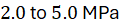 ( 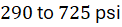 ) differential pressure |
| Membrane Substrate Support Material | Porous polyethersulfone (PES) or ceramic ultrafiltration |
Hydraulic Pressure Differential and Permeation Flux
Traditional polymeric reverse osmosis membranes require immense hydraulic pressure differentials ( [
 ]) to overcome osmotic pressure and drive water molecules through dense, non-porous polymer matrices via diffusion-solution mechanisms. Graphene oxide membranes alter this hydrodynamic paradigm by enabling frictionless slip-flow transport through atomically smooth carbon-picket nano-channels.
Because water molecules flow across the pristine graphene basal planes with negligible atomic friction resistance, water permeation flux rates scale significantly higher than conventional polyamide membranes under equivalent hydraulic pressure gradients. The liquid velocity profile through the sub-nano channel deviates from standard Hagen-Poiseuille parabolic flow, exhibiting plug-flow characteristics due to atomic-scale wall slip. This enhanced hydrodynamic transport enables high water permeability coefficients, reducing specific energy consumption per cubic meter of desalinated water.
Fouling Resistance and Chemical Durability
Membrane fouling and chemical degradation represent major operational costs in industrial desalination plants. Polyamide thin-film composite membranes are chemically sensitive to chlorine disinfection agents, requiring rigorous chemical pre-treatment and dechlorination steps to prevent polymer chain oxidation. Furthermore, organic foulants, colloidal particles, and microorganisms adhere readily to hydrophobic polyamide surfaces, inducing biofilm accumulation and severe flux decline.
Graphene oxide membranes offer enhanced chemical durability and fouling resistance. The hydrophilic nature of oxygen-containing functional groups creates a hydration barrier that repels hydrophobic organic foulants and biological proteins. Moreover, carbon-based GO nanosheets exhibit high tolerance to oxidizing chlorine disinfectants, eliminating chemical degradation pathways during chlorination cycles. However, long-term structural stability under continuous high-pressure cross-flow filtration requires robust mechanical substrate support—such as porous polyethersulfone (PES) or ceramic ultrafiltration backings—to prevent membrane delamination and structural rupture.

Comments (0)
Login to leave a comment.
No comments yet. Be the first to share your thoughts!