You see towering stacks venting steam into the sky. You smell the heavy, acrid tang of industrial processing in the air.
These factories form the beating heart of our global economy. They manufacture the steel for our bridges, the fertilizer for our crops, and the fuel for cargo ships crossing the oceans.
They also consume a staggering amount of energy.
For over a century, heavy industry relied on fossil fuels to drive those processes. When industrial sectors needed heat or chemical feedstock, they burned coal, oil, or natural gas.
That reliance pumps billions of metric tons of carbon pollution into our shared atmosphere every single year.
Cleaning up electricity with wind and solar power solves half the challenge. What about heavy industry, aviation, and long-haul shipping? You cannot easily fly a transoceanic cargo plane on a lithium-ion battery.
We need a clean chemical fuel to power what batteries cannot reach.
That missing piece is hydrogen.
Not just any hydrogen, however. The method of production changes everything.
According to global energy reports from the International Energy Agency (IEA), resource governance frameworks from the United Nations Environment Programme (UNEP), efficiency benchmarks from ENERGY STAR, and academic electrochemical research, green hydrogen production physics offers a revolutionary way forward.
By splitting water molecules using 100% renewable electricity, we can create a clean industrial feedstock without burning a single drop of fossil fuel.
Here is how green hydrogen production works, why water electrolysis efficiency matters, and how proton exchange membrane electrolyzers transform our industrial future.
The Dirty Secret of Traditional Hydrogen
To understand why green hydrogen is a breakthrough, you have to look at how the world currently makes hydrogen.
Hydrogen is the most abundant element in the universe. On Earth, however, it rarely floats around freely as a pure gas. It is locked tightly into molecules like water ( ) and hydrocarbons like methane (
 ).
To use hydrogen as an industrial gas or fuel, humans must extract it.
Today, over 95% of the world's hydrogen is produced using a process called steam methane reforming.
Industrial plants take fossil natural gas, mix it with high-temperature steam (ranging from 700°C to 1,000°C / approx. 1,292°F to 1,832°F), and run a chemical reaction that strips hydrogen atoms away from carbon atoms.
The result is known as grey hydrogen.
For every single ton of grey hydrogen produced, the process releases roughly 9 to 10 metric tons of carbon dioxide directly into the atmosphere.
It is a carbon-intensive loop masquerading as a clean fuel.
If we want hydrogen to help solve climate change, we have to stop burning natural gas to make it. We need green hydrogen.
The Physics of Water Electrolysis
Green hydrogen production takes a completely different path. It bypasses fossil fuels entirely, turning instead to pure physics and chemistry.
The core process is called water electrolysis.
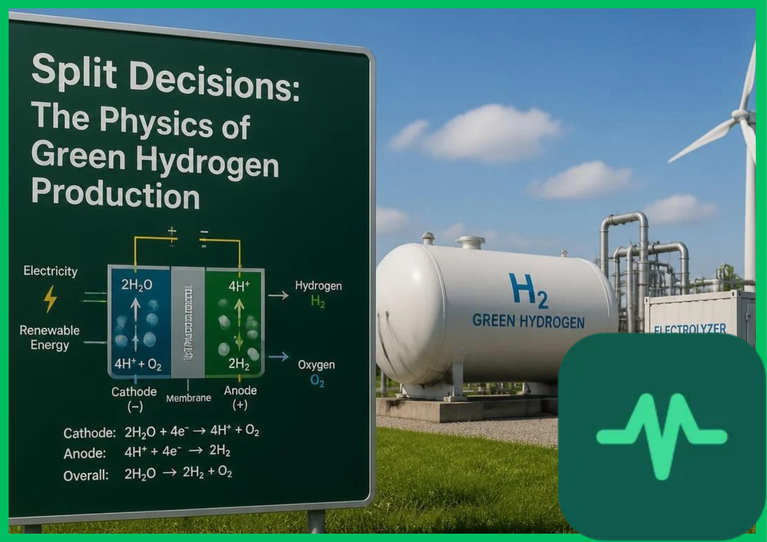
Instead of stripping hydrogen from fossil gas, an electrolyzer splits liquid water molecules apart into their two base components: hydrogen gas ( ) and oxygen gas (
 ).
The physics governing this split are straightforward.
Water molecules are tightly bound by strong polar covalent bonds. To tear those bonds apart, you have to input energy.
In a green hydrogen system, that energy does not come from burning coal or gas. It comes from clean electricity generated by wind turbines or solar farms.
When direct current (DC) electricity flows through an electrolyzer submerged in pure water, electrons drive a forced oxidation-reduction reaction.
At the negatively charged cathode, water molecules accept electrons, splitting into hydrogen gas bubbles and hydroxide ions.
At the positively charged anode, those ions release oxygen gas and water.
You put water and clean electricity in. You pull pure renewable hydrogen fuel and pure oxygen out.
It is a closed, elegant loop with zero carbon emissions.
Inside Proton Exchange Membrane Electrolyzers
Executing this chemical split efficiently at industrial scale requires advanced engineering.
Older alkaline electrolyzers worked well, but they were bulky and slow to respond to fluctuating power inputs.
Modern green hydrogen production relies heavily on proton exchange membrane (PEM) electrolyzers.
A PEM electrolyzer uses a specialized solid polymer electrolyte membrane that conducts protons while blocking gases.
Water flows across the anode catalyst—often made of precious metals like iridium—where it splits into oxygen, electrons, and protons.
The protons migrate swiftly across the solid membrane to the cathode side. There, they combine with electrons to form pure hydrogen gas.
Academic electrochemical research shows that PEM electrolyzers operate at much higher current densities than older systems.
This high-speed reaction makes water electrolysis efficiency remarkably high.
Furthermore, PEM systems respond to power fluctuations in milliseconds.
That lightning-fast response is critical. It means an electrolyzer can plug directly into a variable wind or solar farm, ramping production up or down instantly as sunny or windy weather shifts throughout the day.
Providing a Clean Industrial Feedstock
Why do we need massive volumes of green hydrogen in the first place?
Hydrogen is not just a fuel for combustion engines. It is an indispensable chemical feedstock for heavy industry.
Take global steel manufacturing. Traditional steel mills burn massive amounts of metallurgical coal inside giant blast furnaces to strip oxygen from iron ore.
By replacing coal with green hydrogen as a reducing agent, steel mills release water vapor instead of carbon dioxide.
Chemical refineries use hydrogen to process petroleum products and manufacture synthetic fertilizers. Replacing grey hydrogen with clean renewable hydrogen fuel eliminates millions of tons of industrial emissions instantly.
According to IEA clean energy roadmaps, green hydrogen is the single most effective tool we have to decarbonize heavy sectors that cannot be electrified directly by batteries.
Powering a Sustainable Industrial Era
Green hydrogen production proves that human science can untangle our industrial dependencies on fossil fuels.
We no longer have to accept that making steel, fertilizer, or shipping fuel requires poisoning our global atmosphere.
By combining advanced proton exchange membrane electrolyzers, high water electrolysis efficiency, and 100% renewable electricity, we unlock a clean chemical foundation for heavy industry.
We step away from dirty fossil processing, harnessing the fundamental physics of water to power our world sustainably.
Through innovation and clean energy integration, green hydrogen anchors a truly resilient industrial future for our planet.


Comments (0)
Login to leave a comment.
No comments yet. Be the first to share your thoughts!