You pick up a fresh head of organic lettuce.
You turn it over in your hands, and your heart sinks a little.
Wrapped tightly around the crisp green leaves is a thick layer of single-use petroleum plastic.
You peel it off when you get home, toss it into the trash can, and watch it disappear out of sight.
Out of sight, but never out of mind.
That plastic wrapper will sit in a crowded municipal landfill or float in the open ocean for hundreds of years. It will slowly break down into tiny, toxic fragments, polluting our waterways and poisoning marine life.
Every single day, humanity wraps billions of products in indestructible plastic packaging that lingers on our planet forever.
We buy items for five minutes, and the packaging stays on Earth for five centuries.
That broken linear habit chokes our oceans, litters our landscapes, and breaks the heart of anyone who loves the natural world.
We cannot build a truly sustainable global economy while burying our planet under mountains of synthetic packaging waste.
What if our packaging materials acted more like fruit peels and fallen leaves?
What if every single box, wrapper, and bag dissolved harmlessly back into the earth after use, leaving zero toxic traces behind?
A quiet, brilliant biochemical revolution is sweeping through research laboratories across the globe.
According to global resource protection reports from the International Energy Agency (IEA), environmental governance frameworks from the United Nations Environment Programme (UNEP), efficiency standards from ENERGY STAR, and academic polymer research, biodegradable packaging polymers are changing our consumer landscape.
By replacing petroleum plastics with plant-based materials derived from cornstarch, seaweed, and agricultural waste, we create wrappers that return safely to the soil.
Here is how biodegradable polymers work, why plant-based packaging changes industrial manufacturing, and how nature's wrap secures our sustainable future.
The Endless Crisis of Synthetic Plastics
To understand why biodegradable packaging matters so much, you have to look at the staggering scale of our global plastic addiction.
For nearly a century, petrochemical companies pumped oil from the ground and spun it into cheap, durable, indestructible synthetic polymers.
Plastics changed modern life. They kept food fresh, sterilized medical supplies, and protected fragile goods during long shipping journeys across the globe.
They also created a planetary catastrophe.
Because synthetic plastics do not decompose naturally, every single ton of plastic ever manufactured still exists on Earth in some shape or form.
Rivers carry millions of tons of plastic waste straight into the oceans, forming giant swirling gyres of trash that choke seabirds and suffocate marine mammals.
Recycling programs capture only a tiny fraction of that waste, because mixed plastic films and food-contaminated wrappers are almost impossible to separate and reprocess economically.
We needed a completely different material architecture.
We needed packaging designed by biology, not petrochemistry.
What Is a Biodegradable Packaging Polymer?
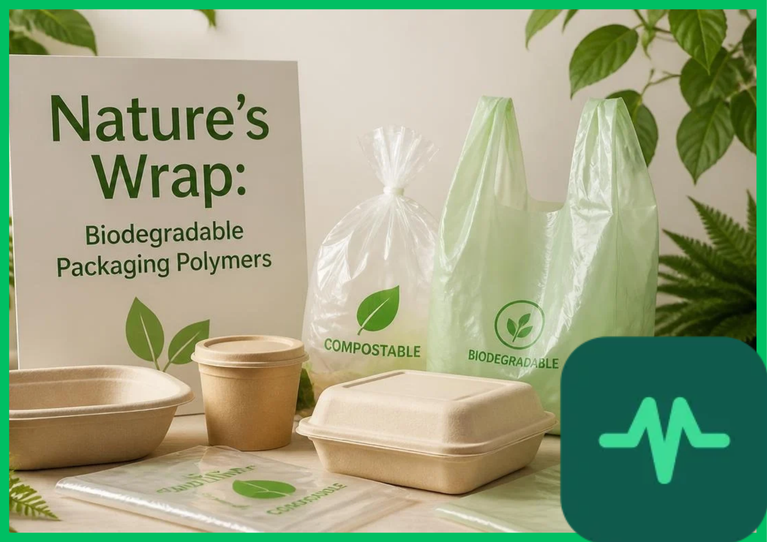
A biodegradable packaging polymer is a modern, eco-friendly material made from organic plant sources—such as corn starch, sugarcane, cellulose fibers, and marine seaweed—that breaks down safely into harmless natural elements when exposed to soil, water, or microbial composting environments.
Instead of extracting crude oil from deep rock deposits, biochemical engineers extract natural sugars and starches from fast-growing plants.
They process those natural starches into flexible polymer chains that look, feel, and perform just like traditional petroleum plastic films.
You can use them to wrap fresh produce, cushion fragile electronics, or seal dry goods on store shelves.
The profound difference happens after you throw the package away.
When a biodegradable polymer wrapper ends up in a commercial compost facility or healthy garden soil, soil bacteria and microorganisms recognize the organic plant chains as food.
Microbes consume the polymer, breaking it down completely into water, carbon dioxide, and rich organic humus within weeks or months.
It leaves zero microplastics behind.
It becomes food for the earth.
The Science of Molecular Chains and Microbial Digestion
How can a plant-based polymer protect a product from moisture on a store shelf while dissolving completely when buried in garden soil?
It comes down to clever molecular engineering and hydrolytic breakdown.
Academic polymer research shows that plant-based plastics—such as polylactic acid (PLA) and polyhydroxyalkanoates (PHA)—rely on ester bonds within their molecular backbones.
In dry, normal indoor conditions, those chemical bonds remain strong and stable, protecting your food just like a conventional plastic wrap.
The moment the material comes into direct contact with moisture-rich soil populated by hungry soil microbes, enzymes secreted by the bacteria attack the ester bonds, snapping the polymer chains apart link by link.
The material loses its structural integrity, softens, and degrades rapidly.
According to ENERGY STAR and international industrial efficiency evaluations, manufacturing plant-based polymers consumes significantly less fossil energy and emits a fraction of the greenhouse gases associated with traditional petrochemical plastics.
The production cycle operates as a closed loop, because the plants used to make the packaging absorb carbon dioxide from the atmosphere as they grow.
Environmental Integrity and Marine Protection
The environmental benefits of biodegradable packaging polymers extend far beyond reducing landfill volume.
They offer a vital safety net for our oceans and wildlife.
If a plant-based seaweed wrapper accidentally blows out of a trash bin and lands in the sea, marine bacteria and aquatic organisms break it down naturally in a matter of weeks, preventing the permanent entanglement and ingestion hazards caused by petroleum plastics.
According to UNEP resource circularity frameworks, replacing single-use synthetic plastics with compostable biomaterials is an essential step toward eliminating marine litter and restoring global ecosystem health.
According to IEA clean manufacturing roadmaps, scaling up bio-based polymer production decouples the packaging industry from volatile fossil fuel markets, anchoring supply chains in renewable annual agriculture instead of oil drilling.
When packaging returns safely to the soil as organic compost, we close the loop on modern consumer waste.
Overcoming Performance and Cost Realties
Designing and scaling biodegradable packaging involves navigating real-world commercial hurdles.
Historically, plant-based plastics were more expensive to manufacture than cheap petroleum films, and some early biopolymers melted too easily when exposed to hot summer temperatures.
Chemical engineers solved those weaknesses by blending different plant starches and introducing microbial fermentation techniques that produce ultra-durable, heat-resistant polymers.
As agricultural yields improve and global production facilities scale up, the cost of biodegradable packaging continues to drop, rivaling traditional plastics on store shelves across every continent.
Wrapping Our World in Sustainability
Biodegradable packaging polymers prove that human ingenuity can learn profound lessons from the natural world.
We no longer have to accept that keeping food fresh requires polluting our planet with indestructible synthetic waste.
By harnessing plant starches, seaweed extracts, and microbial fermentation, we create wrappers that protect our goods and return safely to the soil when their job is done.
We step away from a linear throwaway culture, embracing a smart, circular, and regenerative standard of living.
Through brilliant biochemical research, sustainable polymer engineering, and deep respect for our planetary ecosystem, nature's wrap secures a clean, thriving, and sustainable future for our world.


Comments (0)
Login to leave a comment.
No comments yet. Be the first to share your thoughts!