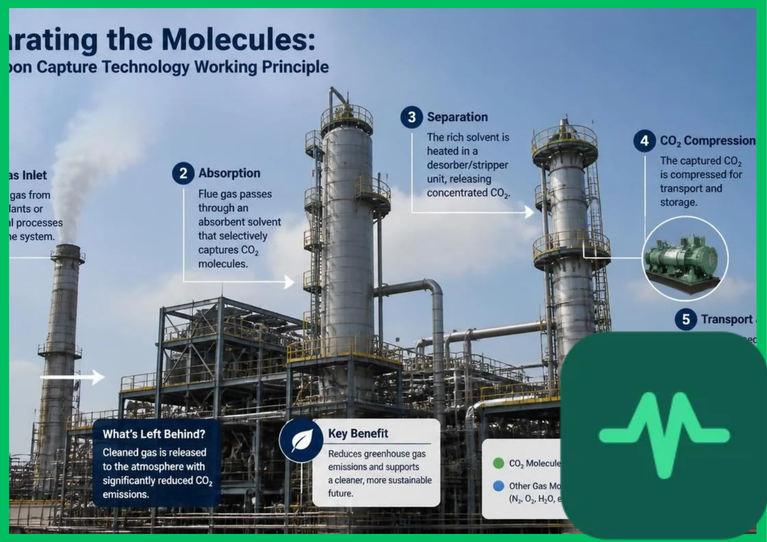
 ) from industrial flue gas streams or ambient air through distinct thermodynamic, chemical, and physical mechanisms. According to International Energy Agency (IEA) industrial decarbonization reports, gigaton-scale carbon capture deployment requires scaling facilities that operate across four primary separation modalities: liquid chemical absorption, solid-state physical adsorption, selective membrane filtration, and cryogenic phase separation. Engineering these separation processes demands precise control over partial pressure gradients, chemical reaction kinetics, and thermal regeneration energies to minimize parasitic load penalties on host industrial plants.
Liquid Chemical Absorption Mechanisms with Amine Solvents
The most mature commercial carbon capture technology relies on chemical absorption using aqueous amine solutions, predominantly monoethanolamine (MEA), diethanolamine (DEA), or methyldiethanolamine (MDEA). Flue gas entering an absorption column from the bottom contacts a counter-current spray of liquid amine solvent descending from the top.
Inside the absorption column operating at ambient pressure and temperatures between  and
 (
 to
 ),
 molecules undergo an exothermic reversible chemical reaction with primary or secondary amines. For monoethanolamine, the primary reaction forms water-soluble carbamates:


The rich amine solution containing chemically bound  is pumped into a separate regeneration stripper column. Inside the stripper, thermal energy supplied via low-pressure steam heats the liquid solvent to temperatures between
 and
 (
 to
 ). This thermal input reverses the chemical reaction, breaking the amine-
 bonds and releasing a high-purity
 gas stream from the top of the column while lean amine solvent is recycled back to the absorber.
Despite high capture efficiencies exceeding 90%, liquid amine systems suffer from high thermal regeneration energy penalties, typically consuming  to
 of thermal energy per metric ton of
 captured (
 to
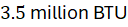 per short ton). Furthermore, oxidative degradation of amine compounds and equipment corrosion caused by acid gas accumulation necessitate continuous chemical reclamation and corrosion inhibitor dosing.
Solid Adsorption Technology: Pressure and Temperature Swing Systems
To circumvent the intensive water-boiling energy penalties of liquid amine stripping, solid-state adsorption systems utilize porous sorbent materials coated onto structured ceramic honeybeds or packed particle beds. These solid sorbents include zeolites, silica gels, carbon molecular sieves, and advanced metal-organic frameworks (MOFs) engineered with high internal surface areas exceeding  (
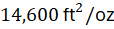 ).
Solid adsorption separation operates via weak van der Waals forces or chemisorption on active surface sites. Regeneration occurs through two primary cyclic protocols:
| Pressure Swing Adsorption (PSA) |  molecules adsorb onto solid surfaces under high partial pressure. Desorption is triggered by rapidly lowering system pressure, releasing the captured gas without excessive thermal input. |
| Temperature Swing Adsorption (TSA) | Sorbent beds capture  at ambient outdoor temperatures and release the gas when heated via electrical resistance, low-grade waste heat, or microwave radiation to  to  (  to  ). |
Solid sorbents exhibit significantly lower heat capacities than aqueous amine solutions, reducing total thermal regeneration energy. However, mechanical attrition of solid particles, moisture sensitivity, and binder degradation over thousands of adsorption-desorption cycles present ongoing engineering hurdles in continuous industrial environments.
Polymeric and Inorganic Membrane Separation Physics
Membrane-based carbon capture utilizes selective permeable barriers that separate  from multicomponent gas streams based on molecular size differences, solubility variations, and diffusivity rates. Polymeric membranes (such as polyimides and cellulose acetate) and inorganic molecular sieves (such as zeolites and carbon nanotubes) rely on the solution-diffusion mechanism.
The separation driving force is the trans-membrane partial pressure differential ( ).
 molecules dissolve into the upstream face of the polymer membrane, diffuse down the concentration gradient driven by thermal molecular motion, and desaturate on the downstream permeate side operating at a lower pressure or under a vacuum sweep gas.
Permeability ( ) is expressed as the product of gas solubility (
 ) and diffusivity (
 ). Because
 exhibits high condensability and solubility in polar polymer matrices compared to diatomic nitrogen (
 ) or oxygen (
 ), selective membranes achieve separation factors (selectivity
 ) ranging from 30 to 50.
A primary constraint of membrane separation is the trade-off between permeability and selectivity, described by Robeson upper bounds. Single-stage membrane systems rarely achieve both high purity ( ) and high recovery rates (
 ), requiring multi-stage cascading arrays with intermediate compressor units to re-pressurize intermediate gas streams.
Cryogenic Carbon Capture and Desublimation Phase Change
Cryogenic carbon capture bypasses chemical binding entirely, utilizing thermodynamic phase changes to separate  from flue gas through deep refrigeration. In cryogenic desublimation systems, flue gas is cooled progressively until water vapor and trace impurities are removed, followed by chilling the gas stream to temperatures between
 and
 (
 to
 ).
At these extreme sub-zero temperatures, gaseous  transitions directly from a vapor phase into a solid dry ice crystal form via desublimation, bypassing the liquid phase at atmospheric pressure. The solid
 is scraped continuously from heat exchanger surfaces using mechanical augers and pressurized into liquid or supercritical states.
Cryogenic separation yields high-purity  streams (
 ) without requiring chemical solvents. The thermodynamic drawback is the massive refrigeration electrical energy input required to reach cryogenic temperatures, which imposes high parasitic electrical loads on host power plants or industrial facilities.
Compression, Pipeline Transport, and Supercritical Sequestration
Regardless of whether  is captured via amine absorption, solid adsorption, membranes, or cryogenic desublimation, the recovered gas must be compressed into a supercritical state for pipeline transport and permanent geological sequestration.
The thermodynamic critical point of carbon dioxide occurs at  (
 ) and
 (
 ). In this supercritical phase,
 exhibits fluid properties intermediate between gas and liquid, displaying high density and low viscosity that optimize pipeline flow efficiency. Multi-stage centrifugal compressors driven by multi-megawatt electric motors elevate captured gas pressures to
 to
 (
 to
 ).
Once pressurized, the supercritical fluid is injected deep underground into saline sedimentary aquifers situated  to
 (
 to
 ) beneath impermeable caprock seals, or reacted with basalt formations to induce permanent in-situ mineralization into solid carbonate rocks over geological timeframes.
Empirical Performance Metrics and Environmental Assessments
Quantitative assessments published by the IEA and United Nations Environment Programme (UNEP) indicate that carbon capture and storage technologies achieve overall net capture efficiencies of 85% to 95% from point sources. However, parasitic energy loads reduce net facility power outputs by 10% to 30%, increasing levelized costs of electricity or industrial product manufacturing. Ongoing academic materials research focuses on developing enzyme-based catalysts, nano-porous metal-organic frameworks, and electro-swing adsorption systems to drive regeneration energy requirements below 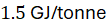 , ensuring economic viability for global net-zero emissions targets.




Comments (0)
Login to leave a comment.
No comments yet. Be the first to share your thoughts!