
You feel the breeze on your face. You never think about what is floating invisibly in that air.
Every breath we take contains a rising invisible tide of carbon dioxide.
For generations, human activities have pumped billions of metric tons of carbon pollution into the atmosphere. That blanket of gas traps heat, warms our global climate, and alters weather systems across every continent.
Stopping new emissions is vital, but cutting off pollution is no longer enough.
The carbon we already released is lingering up there in the sky, driving climate instability.
A fascinating technological frontier is rising to meet that challenge.
According to tracking data from the International Energy Agency (IEA), environmental governance frameworks from the United Nations Environment Programme (UNEP), energy efficiency metrics from ENERGY STAR, and chemical engineering research, direct air capture (DAC) is changing our climate strategy.
By pulling carbon dioxide directly out of ambient air using chemical filters, large industrial fans are literally scrubbing the sky clean.
Here is how direct air capture works, why filtering a dilute gas is an engineering marvel, and how negative emissions technology helps heal our atmosphere.
The Challenge of Dilute Air
To understand why direct air capture is so difficult, you have to look at the numbers.
When people think of carbon capture, they usually think of industrial smokestacks at power plants or cement factories.
Those industrial sources release exhaust gases containing high concentrations of carbon dioxide, often ranging from 10% to 20% of the total output. Catching carbon right at the smokestack is relatively straightforward.
Ambient air is entirely different.
Out in the open atmosphere, carbon dioxide is heavily diluted. It makes up roughly 0.04% of the air around us—about 420 parts per million.
Filtering carbon out of open air is like searching for a single specific grain of sand scattered across an entire beach, and then pulling it out piece by piece.
It requires massive volumes of air to move through specialized chemical filters.
Designing systems that can process millions of cubic meters or feet of wind without consuming more energy than they save is one of the greatest engineering feats of our time.
What Is Direct Air Capture?
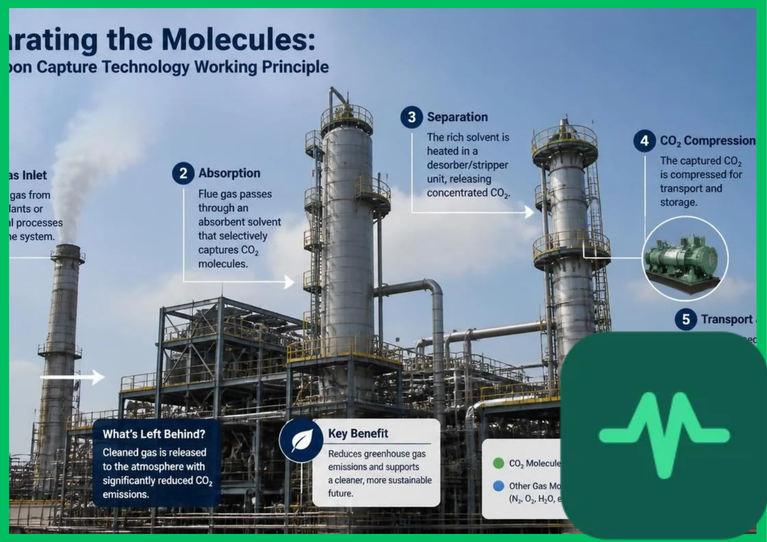
A direct air capture facility uses modular industrial fans to pull ambient air through large capture containers.
Inside those containers, the air passes over specialized chemical capture materials.
Depending on the plant design, engineers use one of two primary methods:
1. Solid Sorbent Systems
Air passes over solid filter materials coated with chemical substances like amines. As the air flows through, carbon dioxide molecules stick securely to the solid filter surface while clean air passes right through the other side. Once the filter reaches saturation, the container seals shut and mild heat (roughly 80°C to 120°C / approx. 176°F to 248°F) is applied, releasing a pure stream of concentrated carbon dioxide gas.
2. Liquid Solvent Systems
Air bubbles through a liquid chemical solution—typically a potassium hydroxide liquid. The liquid reacts directly with the carbon dioxide, trapping it in solution. That liquid mixture then flows through a high-temperature kiln or regenerator, boiling off the pure carbon dioxide gas while recycling the liquid solvent for another round of capture.
Both methods yield a high-purity stream of carbon dioxide gas, ready for permanent underground storage or industrial utilization.
Locking Carbon Away Permanently
Once you capture carbon dioxide from the atmosphere, what do you do with it?
If you capture carbon and simply turn it into fizzy drinks or plastic packaging, the carbon eventually escapes back into the air when those products degrade. That does not solve climate change.
True climate impact requires permanent geological sequestration.
Academic research and UNEP environmental guidelines emphasize that captured carbon must be locked away safely for thousands of years.
Facilities pump the purified carbon dioxide deep underground into stable basalt rock formations or deep saline aquifers.
Over time, through a natural mineralization process, the liquid carbon reacts with underground rock minerals and turns into solid stone.
It becomes stone beneath the earth, safely removed from the active carbon cycle forever.
Powering the Clean Scrubber Network
Running industrial fans and heating chemical filters takes energy.
If a direct air capture plant runs on electricity generated by burning coal or natural gas, it defeats its own purpose, emitting more carbon than it removes.
This is where renewable energy integration becomes non-negotiable.
State-of-the-art direct air capture facilities are built directly next to geothermal fields, solar farms, or wind parks.
Using clean, renewable electricity and waste industrial heat, these plants operate with a net-negative carbon footprint.
According to IEA technology roadmaps, scaling direct air capture globally requires pairing every new capture facility with dedicated zero-emission power supplies.
When powered by clean energy, these plants act as true environmental vacuum cleaners, healing past atmospheric damage.
Scrubbing Our Way to a Balanced Future
Direct air capture is not a magic excuse to keep polluting.
Every climate scientist agrees that stopping fossil fuel emissions at the source remains our absolute top priority.
For hard-to-abate sectors like aviation, shipping, and heavy heavy industry, however, achieving absolute zero emissions is exceptionally difficult.
Direct air capture steps in as an indispensable safety net.
It provides negative emissions capability, balancing out unavoidable residual pollution and pulling historical legacy carbon back out of the sky.
By combining brilliant chemical engineering, permanent geological storage, and 100% renewable energy, direct air capture gives us a powerful tool to restore balance to our atmosphere.
We are learning to clean up our own history, scrubbing the sky to secure a breathable, thriving planet for generations to come.



Comments (0)
Login to leave a comment.
No comments yet. Be the first to share your thoughts!