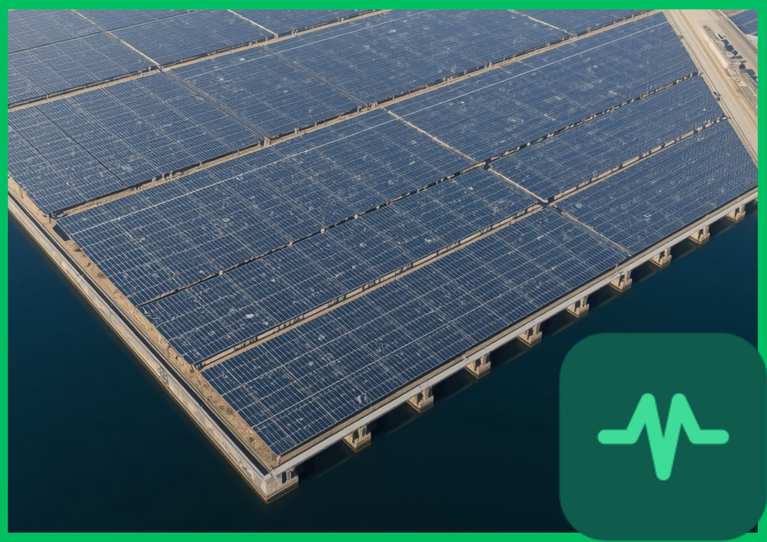
Water ripples softly against the shore, reflecting the bright blue sky above.
For decades, solar energy development faced a constant, frustrating limitation: land scarcity. Building massive utility-scale photovoltaic farms requires clearing hundreds of hectares of open land, competing directly with agriculture, housing, and natural ecosystems.
Finding space for clean power generation gets harder every single day.
An innovative solution is transforming how we deploy solar technology.
According to tracking data and technical reports from the International Energy Agency Photovoltaic Power Systems Programme (IEA-PVPS), environmental assessments, and academic clean energy research, floating solar photovoltaic systems are expanding rapidly worldwide.
Instead of occupying valuable dry land, solar farms are taking to the water.
Here is how floating solar works, why water bodies boost generation efficiency, and how floating power plants are shaping the future of clean energy.
The Land-Use Dilemma in Renewable Energy
To understand the rise of floating solar, you have to look at the spatial challenges of the clean energy transition.
As global demand for renewable power surges, utility companies need large expanses of unobstructed sunshine to build high-capacity solar installations.
Securing large tracts of flat, dry land near existing electrical transmission lines is expensive and logistically difficult.
In densely populated regions, flat land is precious. Using it exclusively for solar panels often triggers land-use conflicts with farming, forestry, and local communities.
Engineers began asking a bold question: what if we utilized the vast, empty surfaces of human-made water bodies?
Hydroelectric dam reservoirs, industrial water treatment ponds, agricultural irrigation basins, and flooded quarry lakes sit idle across the globe.
Covering a fraction of those water surfaces with solar arrays turns underused spaces into high-capacity clean power generators without disturbing a single acre of arable land.
What Is Floating Solar Technology?
Floating solar photovoltaic systems—often called floatovoltaics—are remarkably straightforward in concept.
Traditional solar panels are mounted on lightweight, buoyant pontoon structures made of high-density polyethylene and specialized corrosion-resistant metals.
These floating platforms lock together into stable modular grids, anchored securely to the reservoir floor or shoreline by flexible mooring lines.
The mooring system keeps the entire solar island in place, allowing it to rise and fall safely with changing water levels during seasonal droughts or heavy rains.
Submarine electrical cables run from the floating arrays down to the lakebed and up to the shoreline, transmitting clean electricity directly into regional power grids.
The Natural Cooling Advantage
Floating solar farms do more than just save land; they actually generate more electricity than traditional land-based solar panels.
The secret lies in thermodynamics.
Solar photovoltaic cells lose efficiency as their internal temperatures rise under intense sunlight. On hot, dry land, traditional panels heat up rapidly, causing performance drops during peak summer hours.
When solar panels float directly on top of a body of water, a natural cooling effect takes place.
Evaporative cooling from the water surface keeps the ambient air beneath the panels cooler.
According to academic photovoltaic studies and IEA performance assessments, keeping panels cooler increases their operational efficiency significantly, yielding higher annual electricity output compared to identical land-based systems operating under the same sunlight conditions.
Furthermore, shading the water surface reduces evaporation losses on reservoirs, saving millions of liters of precious water in arid regions.
Overcoming Engineering and Environmental Challenges
Deploying technology on water introduces unique engineering challenges that require careful planning.
Floating structures must withstand shifting winds, wave action, and high humidity without degrading.
Engineers use marine-grade materials, specialized UV-resistant polymers, and flexible anchoring systems designed to endure decades of exposure to harsh weather and water currents.
Environmental monitoring studies coordinated by international research groups track how floating arrays impact aquatic ecosystems.
When designed correctly, floating solar panels can reduce algae blooms by blocking excessive sunlight, protecting aquatic life while generating clean baseload power.
Powering a Sustainable Future From the Water Up
Floating solar proves that innovation often comes from combining existing resources in unexpected ways.
By turning idle reservoirs and inland water bodies into dual-purpose clean energy hubs, we bypass land-use conflicts and boost photovoltaic efficiency at the same time.
We are expanding the boundaries of where and how clean power can be generated.
Through floating power technology, water and sunlight unite to light our path toward a resilient, zero-emission global future.


Comments (0)
Login to leave a comment.
No comments yet. Be the first to share your thoughts!