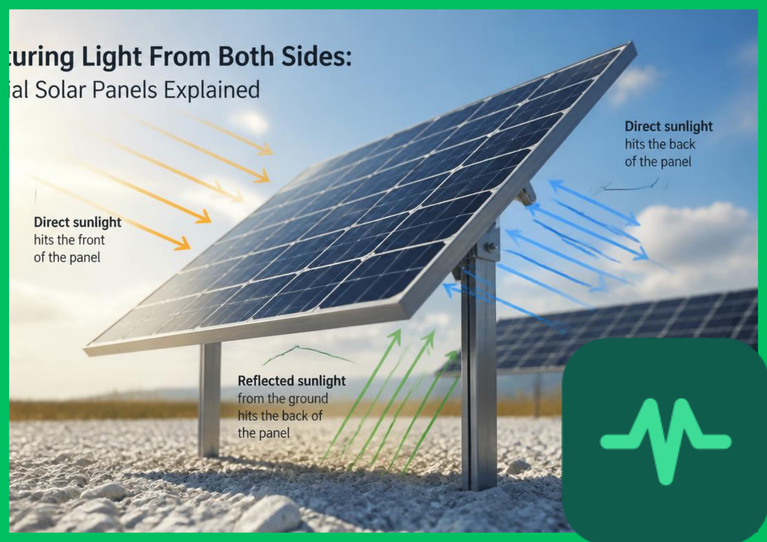
For decades, those solar panels operated in a simple way. They captured direct sunlight shining onto their front faces.
The back of each panel remained completely dark, covered by an opaque backing sheet.
That traditional design worked well, but it left a massive amount of free energy bouncing around underneath the panels, completely ignored.
A quiet engineering shift is changing solar design worldwide.
According to tracking data from the International Energy Agency (IEA), academic photovoltaic research, and renewable energy deployment reports, bifacial solar panel technology is redefining how we harvest solar power.
Instead of looking at the sun from just one side, these advanced panels capture light from both the front and the back.
Here is how bifacial solar panels work, why they represent a major efficiency breakthrough, and how they maximize clean energy generation globally.
The Hidden Energy Bouncing Beneath Our Feet
To understand why bifacial technology matters, you have to look at what happens when sunlight strikes the ground around a solar installation.
Not all incoming sunlight gets absorbed. A significant portion of solar radiation hits the earth, concrete, sand, or grass and bounces right back up into the air.
Scientists call this reflected light albedo.
Traditional solar panels waste all that reflected light. The opaque backing sheet blocks albedo from entering the photovoltaic cells, losing free energy forever.
Bifacial solar panels eliminate that waste.
By replacing the solid back sheet with a transparent glass layer or a clear polymer film, these advanced panels allow sunlight to enter from the rear as well.
They drink in direct sunshine overhead while simultaneously harvesting the reflected light bouncing up from the ground below.
How Bifacial Solar Physics Work
The core physics of photovoltaic generation remain similar to traditional panels, but the internal architecture changes to handle dual-side absorption.
Bifacial modules are built using transparent encapsulation materials and frameless or clear-backed designs.
When sunlight hits the front of the panel, standard silicon solar cells generate electricity.
At the same time, light bounces off the ground, streams up into the back of the panel, and strikes the rear side of the solar cells.
This dual-side generation creates a powerful synergistic effect.
Depending on the reflectivity of the ground surface—known as the surface albedo—rear-side generation can boost total daily energy output significantly.
Bright surfaces like white gravel, desert sand, or fresh snow reflect high amounts of light, supercharging rear-side power generation. Even standard green grass or concrete provides steady, reliable reflected light.
By capturing both direct and reflected photons, a single bifacial panel produces substantially more electricity annually than a traditional monofacial panel occupying the exact same patch of land.
Maximizing Yield in Utility-Scale and Rooftop Installations
The efficiency gains of bifacial solar technology make them an increasingly popular choice for utility-scale solar farms and commercial rooftops.
Academic photovoltaic studies show that optimizing installation parameters unlocks the full potential of dual-side generation.
To maximize rear-side light capture, installers mount bifacial panels higher off the ground than traditional systems, tilting them at optimal angles to ensure maximum exposure to reflected albedo.
Furthermore, pairing bifacial modules with single-axis solar trackers—which rotate smoothly to follow the sun across the sky from morning to evening—creates a continuous harvest of both direct and ambient light.
Even on cloudy or overcast days, when direct beams are blocked, diffuse light scatters from all directions, entering the front and back of the panels to maintain steady, dependable power production.
The Economic and Environmental Logic of Dual-Side Power
Transitioning toward bifacial technology delivers clear economic benefits for clean energy investors and property owners.
Because bifacial panels generate more electricity per square meter of land, they lower the overall cost of solar electricity generation.
When a solar farm produces higher energy yields without requiring additional land acreage, project economics improve dramatically.
Lower capital costs per kilowatt-hour accelerate the global clean energy transition, making solar power even more competitive against legacy fossil fuels.
Durability is another major advantage. Built with dual layers of tempered glass rather than plastic backing sheets, high-quality bifacial modules resist moisture ingress, UV degradation, and extreme weather hazards, ensuring a long, reliable operational lifespan of 30 years or more.
A Brighter Path Forward for Solar Energy
Bifacial solar panels prove that innovation in renewable energy is not just about discovering new materials; it is about smarter engineering.
By capturing the light that used to bounce away and go to waste, we unlock higher efficiency from the exact same sunshine.
We are transforming how our global infrastructure harnesses clean energy.
Through advanced bifacial technology, every ray of sunlight gets put to work, lighting our path toward a sustainable, zero-emission future.



Comments (0)
Login to leave a comment.
No comments yet. Be the first to share your thoughts!