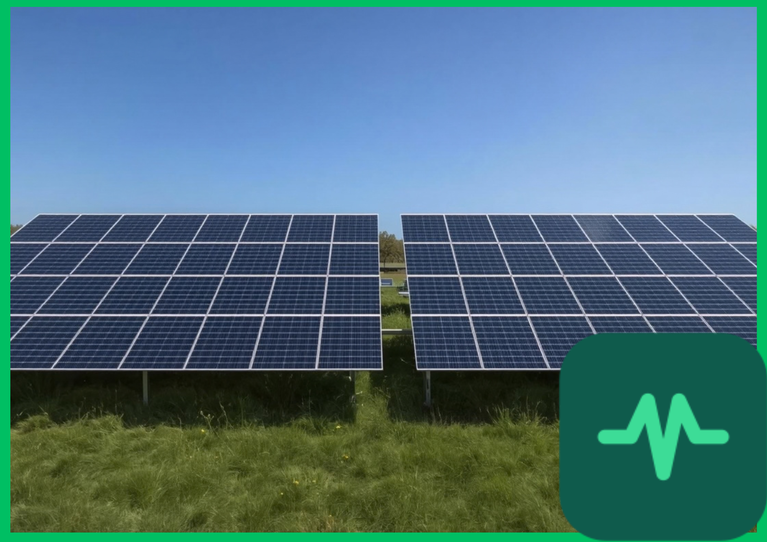
They sit neatly on residential rooftops, tilt upward in commercial solar farms, and gleam quietly under the sun. They capture sunlight on their top surface, converting photons into clean electrical current.
For decades, that top-down design was the undisputed industry standard.
A quiet evolution has taken root in modern photovoltaic engineering. Engineers realized that standard solar panels were leaving half of their potential untouched.
Bifacial solar panels change the rules of clean energy generation by capturing sunlight from both sides of the panel.
Here is how dual-sided photovoltaic technology works and why it is revolutionizing solar energy.
The Physics of Traditional Solar Limitations
To understand bifacial technology, you have to look at what happens to sunlight that misses or passes through a traditional solar panel.
A conventional monofacial solar panel has an opaque backing sheet. When sunlight strikes the front glass, photovoltaic cells absorb the light energy and generate electricity.
However, any sunlight that slips past the gaps between solar cells hits that opaque backsheet and simply bounces away as wasted heat.
Furthermore, sunlight reflects off the ground, surrounding buildings, concrete parking lots, and sandy soil, spraying ambient light upward into the atmosphere.
Monofacial panels ignore all that reflected ground light entirely.
Bifacial panels are engineered to capture it.
How Bifacial Solar Panels Work
Bifacial solar panels feature a transparent glass or polymer backsheet instead of an opaque solid back.
This transparent construction allows sunlight to enter the panel from both the front and the back.
When installed on elevated ground mounts or bright, reflective surfaces, bifacial panels capture direct sunlight on their front face while simultaneously absorbing albedo light—the sunlight reflected upward from the ground—on their rear face.
This dual-sided generation process increases total energy output significantly without requiring a larger physical footprint.
The Importance of Albedo and Installation Angles
The performance of bifacial solar panels depends heavily on environmental surroundings, a concept known as surface albedo.
Albedo measures how strongly a surface reflects light:
- Low Albedo Surfaces: Dark soil, green grass, and asphalt absorb most light, reflecting very little back toward the rear of the panel.
- High Albedo Surfaces: Fresh snow, white concrete, light-colored gravel, and desert sand reflect massive amounts of sunlight upward, supercharging bifacial energy generation.
To maximize rear-side power, bifacial panels are typically installed on elevated, tilted racking systems with unobstructed space beneath them, allowing maximum reflected light to wash over the back of the modules.
Transforming Utility-Scale and Commercial Solar
While bifacial panels can be installed on residential roofs with light-colored reflective roofing materials, their true power shines in utility-scale solar farms and commercial installations.
By generating up to 10% to 30% more electricity from the exact same land area, bifacial technology lowers the levelized cost of solar energy dramatically.
Fewer panels are needed to hit total generation targets, reducing land use, framing materials, and installation labor costs.
As material science advances and manufacturing costs fall, dual-sided solar generation is rapidly becoming the new global standard for clean energy production.



Comments (0)
Login to leave a comment.
No comments yet. Be the first to share your thoughts!