
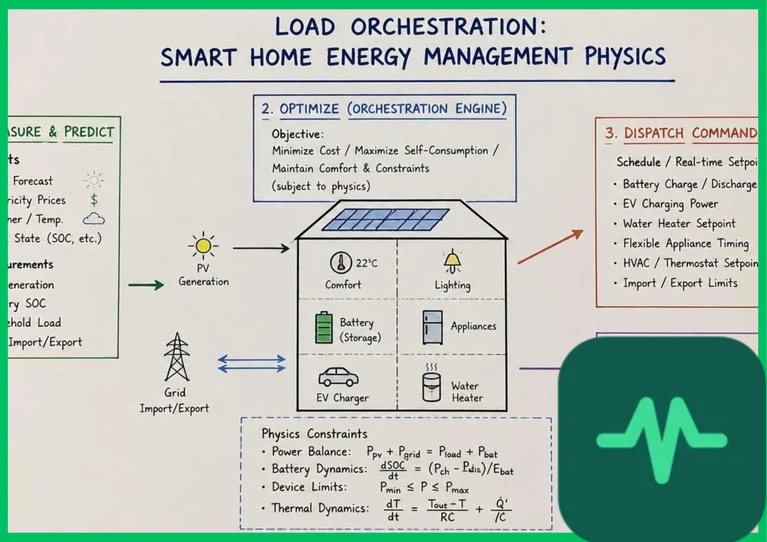
Thermal Mass Pre-Conditioning and Building Heat Balance
Residential indoor air temperature responds to heat gains and losses across walls, windows, roofs, ventilation air exchanges, solar irradiance, and internal equipment or occupant loads. A lumped-capacitance thermal balance describes indoor air and structural thermal mass temperature dynamics:

where  is effective building thermal capacitance (
 or
 ),
 and
 are indoor and outdoor temperatures (
 or
 ),
 is sensible/latent heating or cooling power delivered by the heat pump or air conditioner (
 or
 , where
 ),
 and
 represent solar and internal gains, and
 is equivalent thermal resistance of the building envelope (
 or
 ).
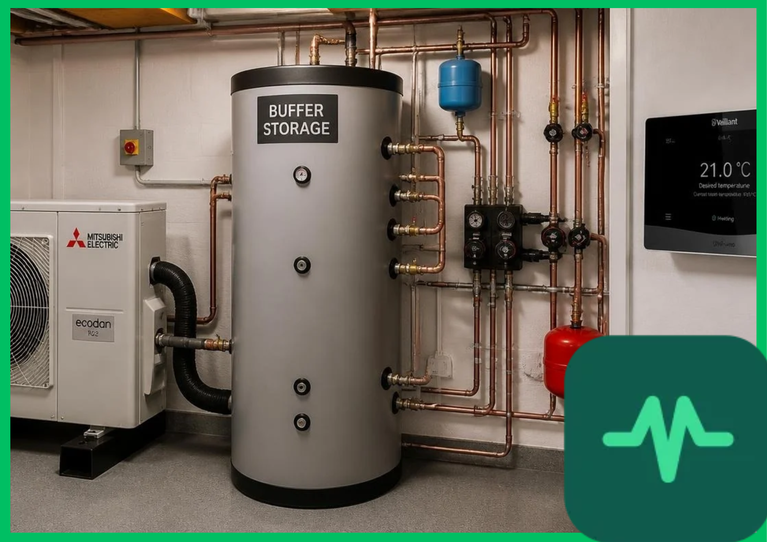
Thermal mass pre-conditioning exploits the thermal time constant (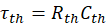 ) of the building envelope, structural slabs, drywall, and domestic hot-water tanks. By pre-cooling indoor spaces slightly before an afternoon cooling peak or pre-heating slightly before a winter evening peak—while outdoor temperatures sit in milder regimes such as
 to
 (
 to
 ) rather than extreme
 (
 ) or
 (
 )—the system stores thermal energy inside building mass and water heaters without sacrificing occupant comfort. Pre-conditioning shifts compressor runtime toward periods with higher coefficient of performance (
 ), lower grid marginal emissions, or lower time-of-use tariffs.
Automated Demand Dispatch and Priority Load Hierarchy
Effective load orchestration balances comfort constraints, equipment cycling limits, and grid signals through automated demand dispatch across tiered residential circuits. High-power flexible loads—such as level-2 electric vehicle chargers ( to
 , or
 to
 ), heat-pump space conditioning (
 to
 electrical input), heat-pump water heaters, pool pumps, and residential battery inverters (
 to
 )—offer substantially larger controllable power than small lighting or electronics loads.
Controllers assign dispatch priorities and operational guardrails to prevent short-cycling compressors, depleting battery backup reserves below storm/outage thresholds, or violating deadband temperature bounds. For example, a controller can modulate electric vehicle charging current continuously via pilot-signal control, delay water-heater element or compressor boost cycles until surplus rooftop solar generation occurs, or discharge home battery storage during peak utility pricing windows while keeping minimum state-of-charge reserves intact.
Plug-Load Telemetry and Sensing Granularity
Accurate orchestration depends on high-resolution measurement of circuit currents, voltages, power factor, and indoor/outdoor states. Plug-load telemetry—provided by smart circuit-panel current transformers ( ), sub-meters, smart plugs, and appliance interfaces—separates continuous baseload draw (refrigerators, standby electronics, network routers) from dispatchable loads and detects abnormal power draw or fault signatures.
Telemetry quality shapes control stability. Coarse hourly billing data hides rapid load spikes from induction cooktops, compressors, or chargers, whereas sub-minute circuit telemetry enables accurate state estimation, solar self-consumption tracking, and verification of load curtailment during grid flexibility events. Standard open communication protocols and local edge control ensure deterministic response even if external cloud links experience latency or packet loss.
Technical Data Specifications of Smart Home Load Orchestration
| Orchestration Parameter | Residential Energy System Specification Standard |
|---|---|
| Primary Controllable Loads | EV chargers, HVAC heat pumps, water heaters,  |
| Power & Unit Conversion Basis |  ; 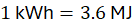 |
| Indoor Comfort Envelope | Typically  to  (  to  ) operative span |
| Outdoor Ambient Span |  to  (  to  ) climate envelope |
| Telemetry & Control Cadence | Sub-minute to  sensing/dispatch loops |
| Envelope Thermal Lever | Thermal mass pre-conditioning & hot-water storage |
| Core Performance Metric | Peak  reduction,  shift,  , self-consumption |
Grid-Interactive Home Efficiency and Rebound Mitigation
Advancing toward grid-interactive home efficiency requires aligning household load shaping with distribution network physics rather than creating synchronized secondary peaks. When hundreds of homes on a distribution transformer shift charging or heating loads to the exact same minute at the end of a peak window, simultaneous turn-on creates a rebound spike that stresses transformers and voltage regulators.
Smart controllers mitigate rebound effects using randomized start offsets, ramped power curves, and local feeder or inverter power-limiting rules. At the same time, orchestration delivers lasting savings only when paired with sound envelope insulation, airtightness, and high-efficiency appliances—because shifting inefficient heat loss across hours still consumes excess total energy. Combining structural efficiency, accurate plug-load telemetry, and physics-aware load orchestration turns residential buildings into reliable, flexible assets within modern power grids.

Comments (0)
Login to leave a comment.
No comments yet. Be the first to share your thoughts!