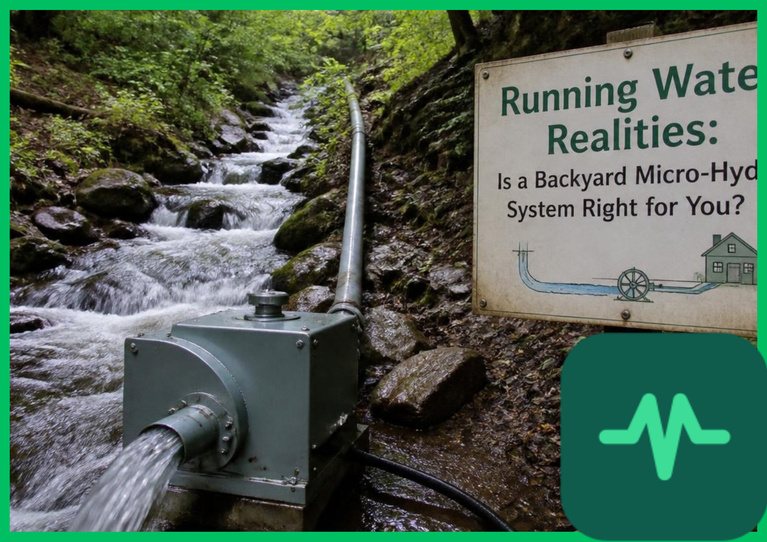
For properties with running water, there is a far more consistent alternative flowing right past the back door. Water never sleeps. A stream that flows steadily through your land keeps moving at midnight, through dense cloud cover, and during heavy seasonal downpours.
Capturing that kinetic energy does not require building a massive concrete dam or flooding a valley. Small-scale water turbines can generate continuous, reliable electricity with minimal disruption to the environment. However, moving from a natural stream to a functioning domestic power source requires a solid understanding of the technology, physics, and financial commitments involved.
Understanding the Mechanics of Small-Scale Water Power
Before looking at equipment, it helps to understand how a micro hydro power setup actually extracts energy from a stream. The process relies on two core metrics: head and flow. Head represents the vertical distance the water drops from the intake point to the turbine. Flow is the actual volume of water moving past a specific point within a given timeframe.
A high head system uses a steep drop to build pressure, while a high flow system relies on the sheer weight and speed of a larger volume of water. To capture this energy, a small amount of the stream's water is diverted into a pipeline called a penstock. This pipe carries the water downhill, narrowing along the way to increase pressure before it strikes the blades of a turbine.
The moving water spins the turbine runner, which drives a generator to create electricity. Once the water passes through the system, it exits through a discharge pipe and returns straight to the original stream. The water is never consumed, contaminated, or permanently diverted; its movement is simply borrowed for a moment to harvest clean energy.
Calculating the Practical Setup Costs
Moving from theory to reality requires a clear assessment of the financial investment. When estimating a small scale micro hydro generator cost, you have to look well beyond the price tag of the turbine itself. The mechanical generator is often the least expensive part of the entire project.
The true expenses lie in the civil engineering and site preparation. You must budget for the intake structure, the hundreds of meters or feet of durable penstock piping, the turbine housing, the electrical wiring to connect the site to your home, and the electronic control systems. Because every stream has a unique shape, speed, and slope, these systems cannot be mass-produced as a simple plug-and-play kit. Each installation must be custom-tailored to the landscape.
For properties entirely cut off from public utility lines, this upfront investment often makes perfect financial sense. Building a traditional power line through miles of dense forest or rugged terrain can cost an astronomical amount. In contrast, an off grid micro hydro system price provides an independent, highly reliable source of continuous power that can significantly reduce your reliance on expensive, high-maintenance diesel backup generators.
Assessing Your Land and Water Rights
Determining if your property can support a residential water power system setup requires precise measurement rather than guesswork. You cannot simply look at a fast-moving stream and assume it will power a house. You must accurately measure the vertical drop and the seasonal water volume to calculate your potential wattage output.
Geography is only half the equation. You must also navigate the legal realities of water use. In almost every part of the world, owning a piece of land does not give you unrestricted ownership over the water flowing across it. Downstream neighbors, local agricultural communities, and environmental agencies all have a stake in that water.
Before placing a single pipe in the water, you must secure the proper environmental permits. Regulatory bodies will want proof that your intake structure will not trap migrating fish, that your system will not alter the natural water temperature, and that you will maintain a safe minimum water flow in the main stream bed during dry seasons to protect local aquatic life.
The Reality of Ongoing Upkeep
The greatest benefit of a backyard water turbine electricity setup is its exceptional capacity factor. Because it runs 24 hours a day, a small hydro system can produce up to four times more total electricity over a year than a solar array of the exact same wattage rating.
However, that continuous operation comes with a trade-off: mechanical wear and tear. Solar panels have zero moving parts and require almost no maintenance beyond an occasional rinse. A water turbine is an active, spinning machine subjected to constant friction, rushing water, and abrasive sediment.
Regular maintenance is mandatory to keep the system running. Leaves, twigs, and river debris will inevitably clog your intake screens, requiring manual clearing. Silt and fine sand can act like sandpaper, slowly eroding turbine blades over time. Bearings must be lubricated, and electrical connections must be kept perfectly dry. If you enjoy hands-on projects and monitoring mechanical equipment, a micro-hydro system offers an incredibly rewarding way to achieve true energy independence. If you prefer a completely hands-off system, the demands of a water-powered property might prove overwhelming.
Balancing the Energy Scales
Investing in water power transforms your relationship with nature. Instead of fighting the elements or worrying about seasonal weather shifts, you learn to adapt to the natural flow of your local watershed.
For the right property, a micro-hydro system provides an unmatched level of energy security. It offers a steady, predictable baseline of electricity that can easily run large household appliances, heat living spaces, and charge electric vehicles day or night. By understanding the physical demands of your stream and committing to the necessary upkeep, you can turn a simple patch of running water into a highly efficient, lifelong power station.
Comments (0)
Login to leave a comment.
No comments yet. Be the first to share your thoughts!