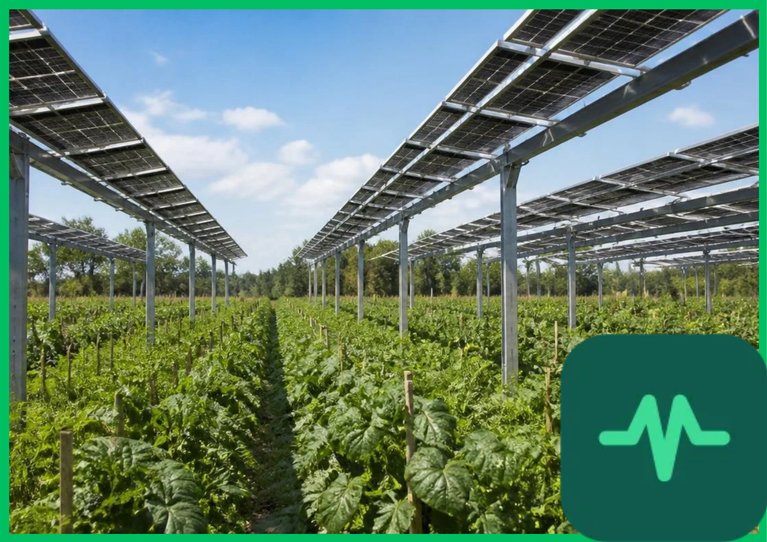
Rows of green leafy crops stretch out before you. They sway gently in the midday breeze, healthy and vibrant under the open sky.
Look up just a few meters above your head.
Instead of an empty horizon, clean rows of photovoltaic solar panels tilt toward the sun, casting a soft, dappled shadow over the growing plants below.
For generations, humanity treated food production and energy generation as fierce competitors for land.
If you wanted to build a solar farm, you cleared the land, cut down the crops, and covered the soil in steel and glass. If you wanted to grow food, you kept industrial solar panels far away from agricultural fields.
That rigid division is beginning to fade away.
According to agricultural research from the United Nations Environment Programme (UNEP), renewable integration studies from the International Energy Agency (IEA), efficiency frameworks from ENERGY STAR, and comprehensive academic research, a brilliant new synergy is taking root.
It is called agrivoltaics.
By co-locating solar panels and agricultural crops on the exact same piece of land, farmers harvest sunshine and food simultaneously.
Here is how agrivoltaics works, why crop microclimate shading changes farming forever, and how dual-use solar farming maximizes land-use efficiency across the globe.
The False Choice Between Food and Energy
To understand why agrivoltaics is such a powerful breakthrough, you have to look at the mounting pressure on our global land resources.
Our planet is finite.
As populations grow, we need more land to grow nutritious food, more land to protect natural ecosystems, and more land to build the clean renewable energy infrastructure required to stop climate change.
For years, critics argued that large solar installations stole valuable agricultural soil out of production.
Farmers faced a painful economic choice. They could sell their productive farmland to energy developers and abandon agriculture entirely, or they could struggle with volatile crop prices and unpredictable weather while ignoring the clean energy transition.
That conflict created unnecessary friction between rural farming communities and renewable energy advocates.
Agrivoltaics completely eliminates that false choice.
It proves that soil can produce watts and wheat at the very same time.
What Is Agrivoltaics?
Agrivoltaics is the thoughtful co-location of agricultural production and photovoltaic solar power generation on a shared piece of land.
The installation looks different from a traditional flat-earth solar farm.
In an agrivoltaic system, solar mounting structures are elevated higher off the ground—often standing 2 to 4 meters (approx. 6.5 to 13 feet) high.
The panels are spaced further apart or mounted on single-axis trackers that tilt smoothly throughout the day.
This elevated design leaves plenty of clearance underneath for farm machinery, livestock grazing, or crop cultivation.
Sunlight hits the upper surface of the panels to generate clean electricity for the regional power grid.
Filtered, dappled sunlight passes through the gaps between the panels, showering the crops growing safely in the soil below.
It is a clever partnership between modern engineering and ancient agricultural traditions.
The Science of Crop Microclimate Shading
The real magic of agrivoltaics lies in how plants experience the microclimate beneath solar panels.
Many people assume that plants need 100% direct, baking sunlight to grow successfully.
In reality, many crops—especially leafy greens, berries, root vegetables, and delicate specialty plants—suffer under extreme heat and intense summer sun.
When temperatures soar past optimal thresholds, plants experience heat stress, close their stomata to conserve moisture, and slow down photosynthesis.
Academic agricultural research shows that the soft shade cast by elevated solar panels protects crops from scorching afternoon temperatures.
This microclimate shading reduces soil evaporation rates dramatically.
Moisture stays in the ground longer. Water requirements drop by 20% to 40% for certain crops, saving precious water resources in drought-prone regions.
Furthermore, the microclimate benefits run in both directions.
As crops transpire moisture through their leaves, they cool the air underneath the solar array.
Cooler ambient temperatures make photovoltaic panels operate more efficiently, because solar panels actually lose electrical conversion efficiency when they overheat under blazing, unshaded summer sun.
The plants cool the panels, and the panels protect the plants.
Maximizing Land-Use Efficiency
The economic and ecological benefits of dual-use solar farming are staggering.
Land-use efficiency measures how much utility you extract from a single hectare or acre of soil.
When you combine farming and solar generation on the same plot, total land productivity multiplies.
Academic studies evaluating land equivalent ratios show that well-designed agrivoltaic systems can increase overall farm revenue significantly compared to single-use farming or traditional solar installations alone.
Farmers gain a steady, drought-resistant secondary income stream from clean energy generation, insulating their household finances from bad weather, pest outbreaks, and volatile commodity market crashes.
Rural communities retain their agricultural identity and open green spaces while contributing directly to regional decarbonization goals.
Energy developers, meanwhile, secure prime land access without facing local resistance from agricultural communities.
Cultivating a Sustainable Agricultural Future
Agrivoltaics proves that human ingenuity can harmonize opposing industrial needs.
We do not have to pave over our best farmland to build a clean energy economy.
By raising solar panels into the air and welcoming crops back underneath, we transform solar farms into living, breathing agricultural landscapes.
Through smart engineering, microclimate optimization, and sustainable land management, agrivoltaics nourishes our bodies while powering our world.
We step past old land-use conflicts, harvesting sunshine and crops together to build a resilient, abundant future for all.

Comments (0)
Login to leave a comment.
No comments yet. Be the first to share your thoughts!