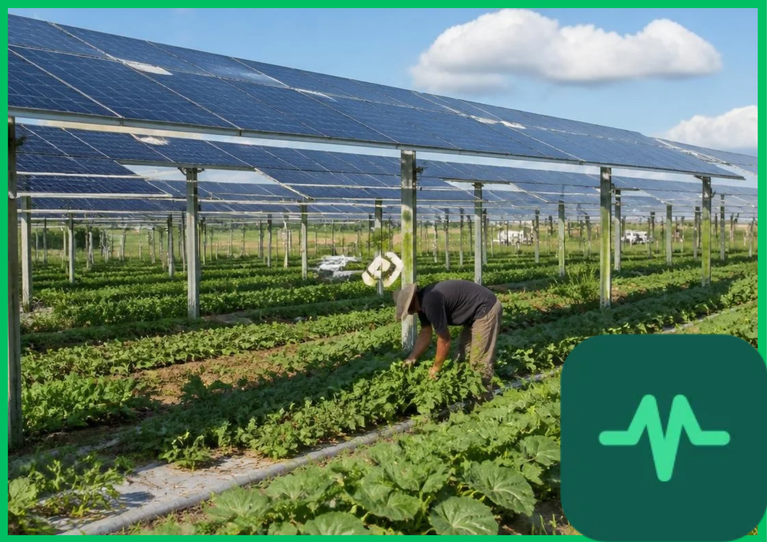
The air shimmers with heat. The soil under your boots feels dry and baked by the relentless sun.
Normally, crops suffer under this kind of intense, baking glare. Leaves curl up. Plants drop their fruit before it ripens. Farmers worry about their yields and watch their water bills climb.
Then, you step beneath a tall row of elevated solar panels.
The air feels cooler here. The soil beneath your feet holds onto its moisture.
Green leafy crops stretch upward, thriving in the dappled shade cast by the clean energy array above them.
You look up. The panels catch the bright sunlight, turning clean solar energy into electricity while protecting the growing plants below.
For generations, humanity treated food production and energy generation as fierce enemies fighting for the exact same ground.
We cleared vast natural fields to plant crops. Then, we cleared more land to build sprawling solar farms.
People argued that we had to choose between feeding our communities and powering our homes.
That false choice created tension in rural communities across the globe.
We cannot pave over every acre of farmland just to capture renewable energy. We also cannot ignore the urgent need to transition our electrical grids away from fossil fuels.
What if we stopped choosing between food and clean power?
What if the exact same plot of land could grow healthy crops while generating electricity at the same time?
A quiet, brilliant agricultural revolution is transforming farms across the globe.
According to global renewable energy reports from the International Energy Agency (IEA), resource protection frameworks from the United Nations Environment Programme (UNEP), efficiency benchmarks from ENERGY STAR, and academic agricultural research, agrivoltaics and dual land use are changing our relationship with the land.
By raising solar panels high above fields, we protect delicate crops from extreme heat while producing clean energy from the sky.
Here is how agrivoltaics works, why dual-use farming changes agricultural economics, and how sharing land secures our sustainable future.
The False Choice Between Food and Clean Power
To understand why agrivoltaics matters so much, you have to look at the land-use pressures facing rural communities today.
As the world builds more solar farms to fight climate change, energy developers look for flat, sunny tracts of land.
Those flat, sunny tracts are almost always prime agricultural soil.
When developers buy up farmland to build ground-mounted solar arrays, local farmers lose their livelihoods. Rural towns watch their agricultural economies shrink.
Friction grows between environmental advocates pushing for clean energy and farmers fighting to protect their soil.
That conflict made people assume that solar panels and farming could never mix.
Engineers and agronomists looked at that deadlock and realized something profound.
Solar panels do not need to sit flat on the ground. When you lift them a few meters or feet into the air, everything changes.
The space beneath the panels opens up. Sunlight filters through the gaps. Rainwater drips off the edges.
The land becomes a shared ecosystem where agriculture and energy work hand in hand.
What Is Agrivoltaics?
Agrivoltaics is the agricultural practice of integrating photovoltaic solar energy production directly with crop cultivation or livestock grazing on the exact same piece of land.
Instead of stripping the soil bare and covering it with gravel, farmers install elevated solar mounting structures over their existing fields.
The panels sit high enough off the ground to let tractors drive underneath and farm workers tend to crops normally.
This dual-use approach creates a microclimate beneath the panels.
In arid regions or during scorching summer heatwaves, the solar panels cast protective partial shade over delicate crops like leafy greens, berries, and tomatoes.
That shade shields plants from blistering sunburn and reduces water evaporation from the soil.
Water stays in the ground longer. Plants retain moisture.
In return, the plants transpire water vapor, cooling the air around the solar panels.
Cooler solar panels operate at higher electrical efficiencies than overheated panels sitting on bare desert ground.
The crops help the solar panels make more electricity. The solar panels help the crops survive the heat.
It is a stunning cycle of mutual benefit.
The Science of Plant Physiology and Solar Efficiency
How do different crops respond to growing underneath an elevated canopy of solar panels?
It comes down to plant biology and light management.
Academic agricultural research shows that many crops do not need 100% direct sunlight to thrive. In fact, excessive midday sun can stress plants, causing them to shut their pores and stop growing to conserve water.
Under an agrivoltaic array, crops receive gentle morning and evening sunlight while escaping the harsh, burning glare of midday.
Water-use efficiency climbs dramatically.
Farmers using dual-use land systems report cutting their irrigation water usage by up to 20% to 30% in dry climates, conserving precious regional water supplies while maintaining healthy harvest yields.
Furthermore, livestock integration—such as sheep grazing peacefully beneath tracker panels—keeps grass trimmed naturally, eliminating the need for heavy mowing equipment while providing sheltered pastureland for animals.
According to ENERGY STAR and international agricultural efficiency evaluations, agrivoltaic installations maintain high land-use efficiency ratios, maximizing both food and energy output per acre or hectare.
Environmental Integrity and Rural Economic Resilience
The benefits of agrivoltaics extend far beyond saving water or generating clean electricity.
They protect the financial stability of farming families and rural communities.
Farming is notoriously unpredictable. Weather swings, droughts, and fluctuating crop prices can ruin a family farm in a single season.
Agrivoltaic systems give farmers a reliable secondary income stream.
By leasing a portion of their sky to clean energy generation while continuing to harvest crops below, farmers insulate themselves against agricultural market crashes.
According to UNEP resource circularity frameworks, dual land use prevents the destruction of fertile topsoil and preserves natural biodiversity on working farms.
According to IEA clean energy roadmaps, expanding agrivoltaics accelerates renewable energy deployment without triggering local land-use conflicts or destroying prime agricultural zones.
When communities see that solar panels and farming support each other, local opposition to clean energy projects fades away.
Overcoming Engineering and Operational Realties
Designing and building an agrivoltaic farm involves careful planning and custom engineering.
Mounting structures must be taller and stronger than conventional solar frames to withstand high winds and clear farm machinery.
Farmers and energy developers must select crops that tolerate partial shade well, shifting away from sun-hungry grains toward shade-tolerant vegetables, berries, and medicinal herbs.
As agricultural universities publish new field data and equipment manufacturers design specialized farm-friendly solar trackers, agrivoltaics is expanding rapidly from experimental research plots into commercial farming operations across the globe.
Farming Our Future Toward Sustainability
Agrivoltaics and dual land use prove that human ingenuity can harmonize food production with clean energy generation.
We no longer have to accept that feeding our world requires destroying natural landscapes or that powering our homes requires paving over fertile soil.
By raising solar panels above our fields, we protect crops, conserve water, and generate clean power all at the same time.
We step away from land-use conflict, embracing an intelligent, cooperative, and enduring standard of agriculture.
Through brilliant agricultural science, smart engineering design, and deep respect for our working lands, farming the sun secures a clean, fed, and sustainable future for every community on Earth.
Comments (0)
Login to leave a comment.
No comments yet. Be the first to share your thoughts!