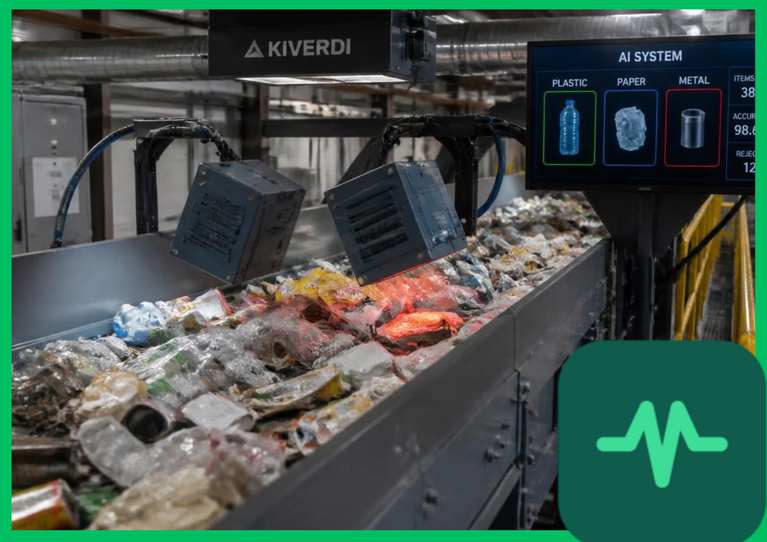
Here's an honest truth many people don't realize. A meaningful portion of what gets placed in recycling bins never actually gets recycled, mostly due to contamination and sorting errors that happen after it leaves your home.
The honest scale of the sorting problem
Recycling facilities process enormous volumes of mixed materials daily, and correctly separating everything by type has always been genuinely difficult. Different plastics look nearly identical to the human eye despite requiring completely different recycling processes. Food residue contaminates otherwise recyclable materials. Items get miscategorized constantly.
For years, this sorting relied heavily on manual labor and relatively basic mechanical systems, both of which have genuine, honest limitations in speed and accuracy.
How artificial intelligence is genuinely changing this
Modern recycling facilities are increasingly using AI-enhanced sorting systems, combining sensor technology with machine learning to identify materials with considerably greater accuracy and speed than previous approaches could achieve.
Reported efficiency improvements from this technology have been genuinely significant, with some facilities seeing meaningful increases in sorting accuracy and throughput after implementing these systems.
What makes AI sorting genuinely different
Traditional sensor-based sorting could identify basic material categories, but struggled with more complex distinctions, like separating food-grade plastic from non-food plastic, or identifying composite materials made from multiple substances combined together.
AI-enhanced systems can learn to recognize these more subtle, complex distinctions, continuously improving their accuracy as they process more material and receive more training data over time.
Why this matters beyond just efficiency
More accurate sorting directly translates into higher-quality recycled materials. When contamination gets caught and removed more effectively, the resulting recycled material becomes more valuable and more usable for manufacturing new products.
This creates a genuinely positive cycle. Higher-quality recycled material increases demand from manufacturers willing to use it, which in turn makes recycling programs more economically sustainable and worth continued investment.
The honest labor question
AI sorting technology also addresses a genuine, practical challenge many recycling facilities face, difficulty finding enough workers for manual sorting roles. Automation reduces dependence on labor availability, which has become an increasingly relevant, honest concern for many facilities globally.
This isn't necessarily about eliminating jobs entirely. It often means shifting workers toward roles overseeing and maintaining these more sophisticated automated systems, rather than performing repetitive manual sorting tasks directly.
What this means for everyday recycling habits
Encouragingly, improved sorting technology means some of the sorting mistakes individuals make, an item placed in the wrong bin, or slight contamination that wasn't fully rinsed away, can increasingly get caught and corrected during processing, rather than contaminating an entire batch of otherwise good material.
That said, this doesn't mean careful sorting at home no longer matters. Reducing contamination before it even reaches a facility remains genuinely valuable, complementing rather than replacing improved sorting technology further down the process.
The honest limitations still worth acknowledging
AI sorting technology isn't a complete, universal fix for every recycling challenge. Adoption varies considerably across different regions and facility types, meaning the benefits aren't yet evenly distributed everywhere.
Implementation costs remain genuinely significant for smaller facilities, which means this technology has spread unevenly, with larger, better-funded operations adopting it more quickly than smaller, resource-limited facilities.
Why continued investment in this technology matters
As global recycling targets continue increasing and pressure grows to reduce reliance on landfills and virgin material extraction, technology that genuinely improves recycling accuracy and efficiency becomes increasingly important infrastructure, not simply an optional upgrade.
Continued investment and gradually falling implementation costs should help this technology spread more broadly over time, extending these genuine benefits to a wider range of recycling facilities globally.
A hopeful, honest sign for recycling's future
Recycling has faced legitimate, honest criticism over the years regarding how much material genuinely gets processed effectively versus how much ultimately ends up contaminated or improperly sorted despite people's genuine good intentions.
Improved sorting technology directly addresses one of the most significant honest weaknesses in the entire recycling system, giving genuine reason for optimism that recycling can become more consistently effective over time, rather than remaining held back by persistent sorting limitations.
The honest bottom line
Artificial intelligence is quietly, meaningfully improving one of recycling's most persistent challenges, accurately sorting mixed materials at genuine scale. This technology won't solve every problem instantly, and adoption remains uneven globally.
But the direction is genuinely encouraging. Combined with continued individual effort to sort thoughtfully at home, improving sorting technology represents real, meaningful progress toward making recycling programs genuinely more effective worldwide.

Comments (0)
Login to leave a comment.
No comments yet. Be the first to share your thoughts!