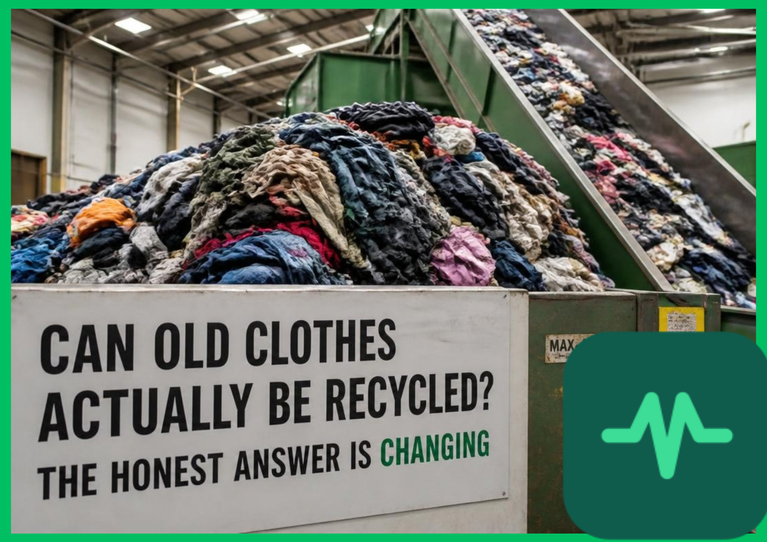
For years, the honest answer was discouraging. Most textile waste ended up in landfills, regardless of good intentions. That's genuinely starting to change.
The honest problem with old clothing recycling
Fabric is genuinely difficult to recycle using traditional mechanical methods. Shredding and reprocessing fabric fibers mechanically tends to weaken and degrade them with each cycle, meaning recycled fabric from this process is typically lower quality than the original material.
This limitation meant that even well-intentioned clothing donations and recycling efforts often resulted in genuinely lower-value materials, used for things like industrial padding or insulation, rather than being turned back into new, quality clothing.
What's genuinely different now
A newer approach called chemical recycling is changing this picture considerably. Rather than mechanically shredding fabric, this process breaks fabric down at a molecular level, into its basic chemical building blocks, then reassembles those building blocks into genuinely new fiber.
This matters enormously because it means the resulting material isn't degraded compared to the original. It can genuinely match the quality of virgin fiber, materials made from scratch rather than recycled, something mechanical recycling methods simply couldn't achieve.
Why this breakthrough took so long
Developing reliable, commercially viable chemical recycling processes required genuine scientific and engineering breakthroughs, moving technology from small laboratory experiments into processes capable of handling genuinely large volumes of real-world textile waste economically.
Multiple companies have now demonstrated this transition successfully, moving from experimental research into genuine commercial-scale operations, with meaningful capacity increases planned over the coming years.
The honest scale of impact this could have
Industry projections suggest textile recycling capacity using these newer methods could expand dramatically over the coming years, processing considerably more waste annually than current, more limited recycling approaches manage today.
This matters enormously given how much clothing gets produced and discarded globally each year. Even modest improvements in genuine recycling capability, applied at this kind of scale, represent real, meaningful environmental impact.
What this means for the clothes you already own
This shift doesn't mean you should suddenly discard clothing carelessly, assuming everything will now get perfectly recycled regardless. Reducing consumption and extending the useful life of clothing you already own remains genuinely valuable, regardless of improving recycling technology.
But it does mean that when clothing genuinely reaches the end of its useful life, worn beyond repair or donation, there's increasingly a real, meaningful pathway for that material to become something new, rather than simply becoming permanent landfill waste.
How to actually participate in this shift
Look for clothing donation and take-back programs specifically designed for textile recycling, rather than assuming all donation bins handle materials identically. Some programs are specifically connected to these newer, more effective recycling processes.
Some clothing brands have also begun establishing their own take-back programs, accepting old garments specifically for recycling into new material, creating a more direct, traceable pathway from old clothing back into new products.
The honest challenges still being addressed
This technology, while genuinely promising, is still scaling up globally. Availability of dedicated collection and recycling infrastructure varies considerably by region, meaning access to genuinely effective textile recycling isn't yet universally available everywhere.
Cost also remains a factor as this technology continues maturing, though industry projections suggest continued improvement and expansion as more facilities come online and processes become more refined over time.
Why this matters for the broader conversation around clothing waste
Clothing waste has become an increasingly prominent, honest concern globally, as fashion consumption has increased considerably in recent decades. Genuine, effective recycling solutions address a real, meaningful part of this larger problem, complementing other efforts like reducing overall consumption and extending garment lifespan through better care and repair.
No single solution solves clothing waste entirely on its own, but genuinely effective textile recycling represents a real, significant piece of a more complete answer.
A genuinely hopeful shift worth understanding
For years, the honest answer to "can old clothes actually be recycled" was disappointing, technically possible in limited ways, but rarely resulting in genuinely high-quality outcomes.
That honest answer is meaningfully improving. While not yet universally available everywhere, the technology and infrastructure supporting genuine textile recycling has made real, measurable progress, worth understanding rather than dismissing based on outdated assumptions.
The honest bottom line
Textile recycling has moved from a genuinely limited, lower-quality process into something considerably more capable, thanks to newer chemical recycling methods reaching real commercial scale. This represents genuine progress, not merely promotional optimism.
The next time you're sorting through old clothing, it's worth researching what genuine recycling options exist specifically in your area, since the honest answer to what's actually possible has meaningfully improved in recent years.

Comments (0)
Login to leave a comment.
No comments yet. Be the first to share your thoughts!