 ). In contrast, green hydrogen generated via water electrolysis powered by dedicated wind and solar generation produces zero direct carbon emissions, yet faces high capital expenditure (
 ) hurdles. Analyzing the capital cost drivers, capacity factors, and financial amortization frameworks of green hydrogen investments is essential for evaluating market parity.
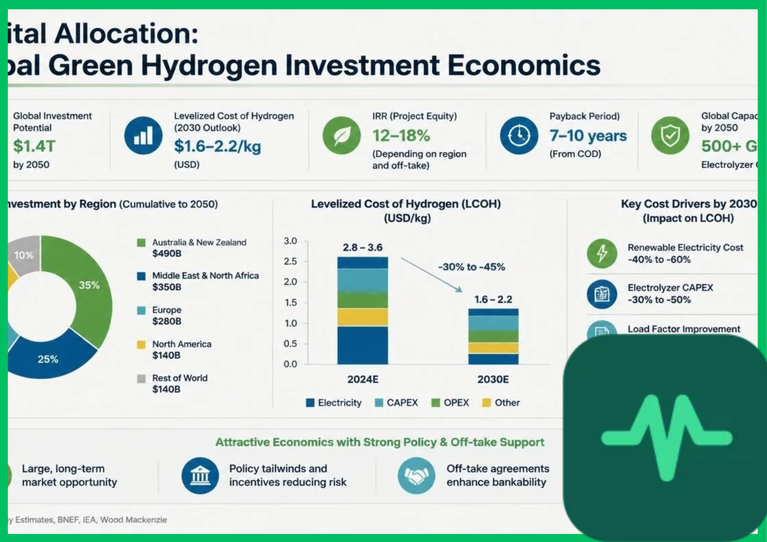
Levelized Cost of Hydrogen and Capital Expenditure Drivers
The foundational financial metric governing green hydrogen economic viability is the levelized cost of hydrogen ( ), expressed in United States Dollars per kilogram (
 ). The levelized cost formula aggregates capital expenditures, operational expenditures, electricity feedstock costs, and system efficiency losses over the operational lifecycle of the production facility:
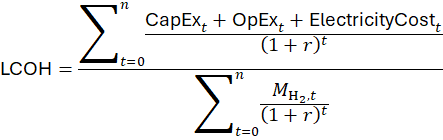
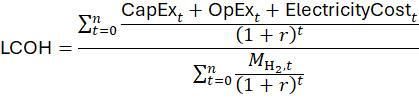
where  represents initial capital investments,
 denotes annual operations and maintenance expenses,
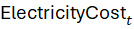 accounts for power purchase costs,
 is annual hydrogen mass yield, and
 is the discount rate over operational lifetime
 .
Capital expenditures for utility-scale green hydrogen plants are dominated by two primary cost components: the renewable electricity generation park (solar photovoltaics or wind turbines) and the electrolysis plant infrastructure. Electrolyzer stack capital costs range from  \mathrm{kW}>4,500\text{ to }6,000\text{ operating
 hours per year}$), which requires pairing electrolysis systems with hybrid renewable generation or firm grid power agreements.
Electrolyzer Manufacturing Scale and Alkaline Versus PEM Economics
Capital allocation strategies in the green hydrogen sector depend heavily on selecting between competing electrolyzer technologies, each characterized by distinct capital expenditure profiles and operating parameters:
- Alkaline Water Electrolyzers (AEL): Represent the most mature industrial technology, utilizing liquid potassium hydroxide (
 ) electrolytes and inexpensive nickel-plated electrode catalysts. AEL systems exhibit lower stack capital costs ($$400\text{ to }
 ) and long operational lifespans, but suffer from lower current densities and slower dynamic response times when coupled with intermittent renewable energy inputs.
- Proton Exchange Membrane (PEM) Electrolyzers: Utilize solid perfluorosulfonic acid (PFSA) polymer electrolyte membranes and noble-metal catalysts (
 and
 ). PEM systems command higher initial stack capital costs ($$700\text{ to }
 ) due to noble-metal scarcity, but operate at higher current densities (
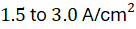 ), deliver high-pressure hydrogen directly without mechanical compressors, and track fluctuating wind and solar power profiles instantaneously.
- Solid Oxide Electrolyzer Cells (SOEC): Operate at high temperatures (
 to
 [
 to
 ]), leveraging external waste heat to reduce electrical energy demand. While SOEC technology offers high electrical conversion efficiencies, commercial capital amortization models remain constrained by high material degradation rates and short stack lifespans.
Technical Data Specifications of Green Hydrogen Investment Parameters
| Green Hydrogen Economic Parameter | Engineering & Financial Specification Standard |
|---|---|
| Alkaline Electrolyzer Stack CapEx |  to  per kilowatt (  ) |
| PEM Electrolyzer Stack CapEx |  to  per kilowatt (  ) |
Target Levelized Cost of Hydrogen ( ) |  to 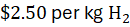 commercial parity threshold |
| Renewable Electricity Cost Baseline |  to  (  ) |
| Electrolyzer Capacity Utilization Factor |  |
| System Electrical Energy Consumption |  to  per kilogram of  |
| Global Electrolyzer Manufacturing Scale | Multi-gigawatt annual factory production capacity |
Financial Amortization Models and Risk Mitigation Strategies
Structuring bankable green hydrogen projects requires mitigating complex off-take risks, electricity price volatility, and technology obsolescence. Financial institutions evaluate clean energy investments using discounted cash flow (DCF) models and debt-service coverage ratios ( ). Because green hydrogen off-take agreements are emerging across global commodities markets, project developers rely on long-term power purchase agreements (PPAs) combined with fixed-price hydrogen supply contracts to secure low-cost debt financing.
According to IEA clean energy financing analyses, reducing weighted average cost of capital (WACC) from 8% down to 4% cuts the levelized cost of green hydrogen by 20% to 30%, highlighting the critical role of concessional financing, sovereign risk guarantees, and multilateral climate funds in accelerating early-stage commercial deployment. Furthermore, scaling global electrolyzer manufacturing from megawatt-scale assembly lines to multi-gigawatt automated gigafactories achieves capital expenditure reductions via standard manufacturing learning curves.
The Final Take
Mastering green hydrogen production capital expenditure trends accelerates the global transition toward zero-emission industrial chemical feedstocks and energy carriers. Citing IEA energy investment reports and techno-economic literature, scaling electrolyzer manufacturing capacity, optimizing stack electrical efficiency, and securing low-cost renewable electricity drives levelized hydrogen production costs toward commercial parity. By deploying robust financial amortization models and risk-mitigated capital allocation strategies, green hydrogen establishes an indispensable foundation for global industrial decarbonization.


Comments (0)
Login to leave a comment.
No comments yet. Be the first to share your thoughts!