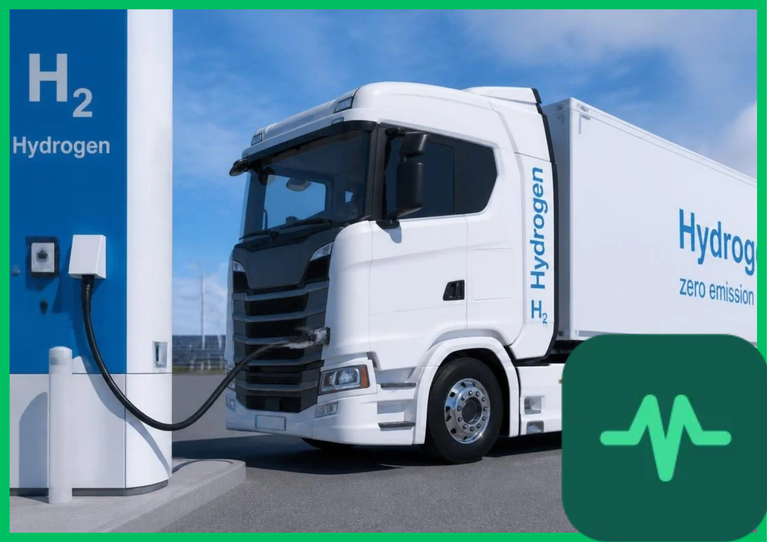
A massive long-haul freight truck rumbles past you, carrying tons of cargo across the continent.
You hear the deep roar of its heavy diesel engine. You watch a cloud of dark exhaust drift into the air.
Now look out toward a busy port terminal. Huge cargo ships glide across the water, burning heavy bunker fuel. Look up into the sky. Large commercial aircraft burn thousands of liters or gallons of jet fuel every single hour.
These transport giants drive global commerce.
They also pump immense amounts of carbon pollution and toxic soot into the air we all breathe.
For cars and light delivery vans, batteries changed the game. Electric motors powered by lithium-ion cells easily handle daily suburban commutes and city driving.
Heavy transport is an entirely different challenge.
If you tried to build a battery-powered cargo ship or a transcontinental freight truck, the sheer physical weight of the batteries would take up all the cargo space.
We need a zero-emission power source packed with high energy density.
That missing piece is hydrogen fuel cell technology.
According to clean transport reports from the International Energy Agency (IEA), environmental governance guidelines from the United Nations Environment Programme (UNEP), energy efficiency metrics from ENERGY STAR, and academic automotive engineering research, hydrogen fuel cells are transforming heavy mobility.
By combining stored hydrogen with ambient oxygen to generate clean electricity on demand, fuel cells power what batteries cannot reach.
Here is how hydrogen fuel cells work, why zero-emission maritime shipping and long-haul freight need this technology, and how clean propulsion cleans up our global supply chains.
The Heavy Weight Limits of Batteries
To understand why hydrogen fuel cells are essential for heavy transport, you have to look at the laws of physics and battery chemistry.
Batteries store electricity chemically inside solid cells. That system works wonderfully for passenger cars driving 300 to 500 kilometers (approx. 186 to 310 miles) between charges.
Scale that up to a heavy-duty freight truck hauling 40 metric tons (approx. 88,000 pounds) across rugged terrain for 1,000 kilometers (approx. 620 miles).
If you tried to power that heavy truck using standard lithium-ion batteries alone, the battery pack would weigh several tons.
It would take up half the trailer space, leaving almost zero room for actual cargo.
The same problem applies to maritime shipping and aviation. Batteries are simply too heavy and bulky for long-distance, high-load travel.
We needed a power system that generates heavy electricity without carrying a massive, dead-weight battery pack.
What Is a Hydrogen Fuel Cell?
A hydrogen fuel cell is an electrochemical conversion device, not a mechanical combustion engine.
Think of it as an onboard power plant that creates clean electricity right where you need it.
Inside a fuel cell stack, pressurized hydrogen gas flows into the anode side while ordinary ambient air flows into the cathode side.
A specialized polymer electrolyte membrane separates the two sides.
When hydrogen molecules hit the platinum catalyst on the anode, they split into protons and electrons.
The electrons are forced to travel through an external electrical circuit, creating the direct current (DC) electricity that powers an electric motor driving the wheels or propellers.
The protons migrate across the internal membrane, combining with oxygen and returning electrons to form the final exhaust product: pure water vapor ( ).
There are no gears, no pistons, no spark plugs, and no carbon emissions.
You put hydrogen gas and fresh air in. You pull clean electricity and pure water out.
Powering Long-Haul Freight and Zero-Emission Shipping
The practical impact of hydrogen fuel cells on heavy transport is profound.
Heavy-duty commercial freight trucks face grueling schedules. Drivers cannot afford to sit idle for hours waiting to recharge massive battery packs.
A hydrogen-powered fuel cell truck refuels in 10 to 15 minutes at a specialized station, exactly like a traditional diesel rig.
Once refueled, it travels 800 to 1,000 kilometers (approx. 500 to 620 miles) carrying full loads across international borders with zero tailpipe emissions.
The maritime shipping sector faces an even greater decarbonization hurdle. Cargo ships spend weeks at sea crossing vast oceans.
According to UNEP environmental assessments and IEA maritime transition roadmaps, hydrogen-derived fuels and fuel cell propulsion systems offer the only viable path to eliminate emissions from global shipping lanes.
Academic engineering studies show that fuel cell systems scale cleanly from multi-megawatt marine propulsion units down to heavy-duty regional freight chassis.
Overcoming Infrastructure and Production Hurdles
If hydrogen fuel cells offer such a brilliant solution for heavy transport, why aren't all trucks running on hydrogen today?
The transition faces real-world hurdles.
The biggest obstacle is infrastructure. Building a network of high-pressure hydrogen refueling stations along major international freight corridors requires massive capital investment.
Furthermore, the hydrogen used in fuel cells must be green hydrogen—produced via water electrolysis using 100% renewable energy.
If trucks run on hydrogen made from fossil natural gas, the climate benefit disappears.
Automotive and energy companies are working together to expand green hydrogen production facilities and build regional refueling networks.
As industrial supply chains scale up and fuel cell durability improves, costs drop steadily, making hydrogen-powered transport increasingly competitive in global markets.
Driving Toward a Clean Logistics Future
Hydrogen fuel cells prove that human engineering can solve our toughest environmental challenges.
We no longer have to accept that moving heavy freight, sailing cargo ships, and operating industrial transport requires poisoning our global atmosphere with diesel soot and carbon.
By combining clean electrochemical power generation, rapid refueling times, and high energy density, fuel cells fill the exact gap where batteries fall short.
We step away from fossil combustion, turning to the clean physics of hydrogen to power our heaviest machines.
Through innovation, infrastructure development, and sustainable engineering, hydrogen fuel cells anchor a truly clean and resilient global transport network.



Comments (0)
Login to leave a comment.
No comments yet. Be the first to share your thoughts!