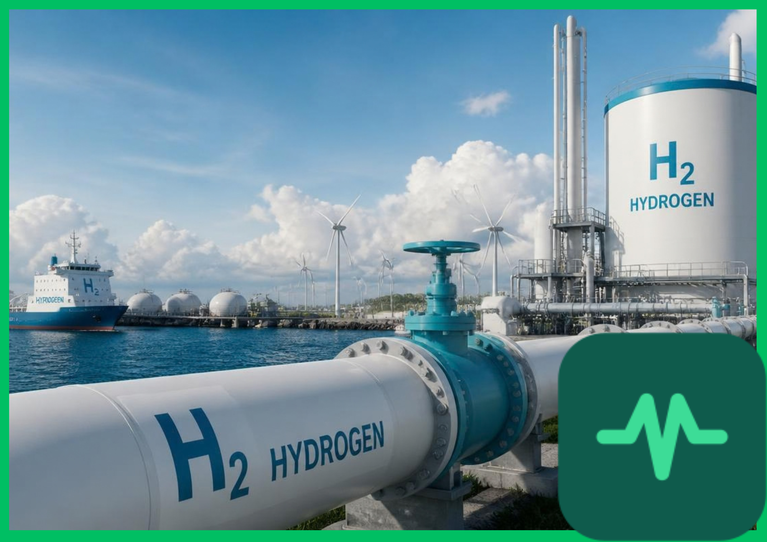
You see tanks, heavy pipes, and specialized loading docks.
Clean fuel is produced right there through renewable water electrolysis, but a major question remains: how do you move that fuel across countries and continents safely?
Generating green hydrogen is only half the battle.
Hydrogen is the smallest, lightest element in the universe. While its lightness makes it an incredible energy carrier, it also makes it notoriously difficult to handle, store, and transport.
For decades, industrial hydrogen stayed locked near local chemical refineries because moving it over long distances was too complex and expensive.
That logistical barrier is finally crumbling.
According to infrastructure tracking data from the International Energy Agency (IEA), environmental safety reports, and academic research on clean energy logistics, global hydrogen supply chain infrastructure is scaling up rapidly.
Here is how engineers, transport planners, and energy providers are building the pipelines and logistics networks to carry clean hydrogen across the globe.
The Physical Puzzle of Hydrogen Logistics
To understand why building hydrogen infrastructure is so challenging, you have to look at the physics of the gas.
Hydrogen molecules are tiny. They slip through microscopic gaps in standard metal pipes that would easily hold natural gas or petroleum.
Furthermore, hydrogen gas has low volumetric energy density at normal atmospheric pressure.
Even though it packs an immense amount of energy by weight, a standard volume of hydrogen gas holds much less energy than an equal volume of natural gas.
If you try to pump raw hydrogen through a standard pipeline without modifying the system, it leaks easily and requires significantly more compression energy to keep moving.
To transport hydrogen efficiently over hundreds or thousands of miles, engineers had to rethink storage and transport from the ground up.
They needed specialized materials, high-pressure pipelines, and cryogenic cooling technologies.
Upgrading Pipelines and Underground Storage
The most cost-effective way to move large volumes of gas across land has always been pipelines.
The global energy industry is not starting from scratch.
Academic research and IEA grid analyses show that existing natural gas pipeline networks can handle blended hydrogen safely when upgraded with specialized polymer liners and composite coatings.
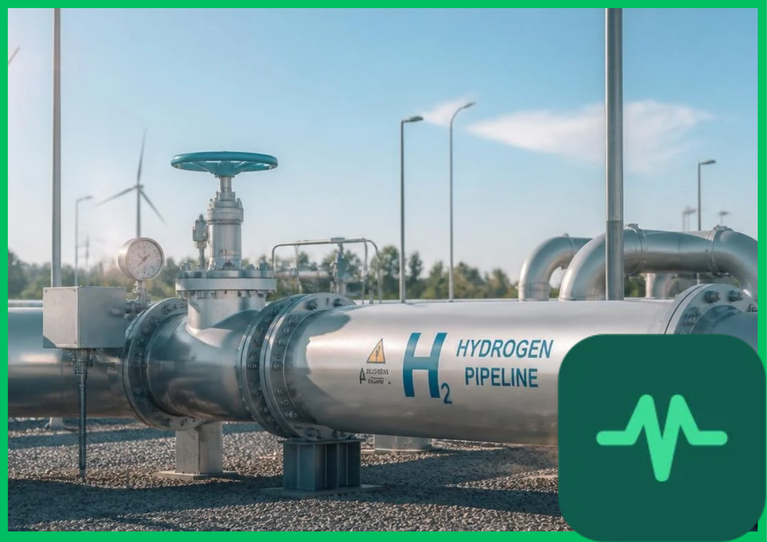
For dedicated 100% hydrogen transmission, engineers are constructing new high-pressure steel pipelines designed specifically to resist metal embrittlement caused by hydrogen molecules.
Once the gas reaches its destination, it needs to be stored safely until industrial facilities or power plants call for it.
Salt caverns deep underground provide the ultimate solution for large-scale energy storage.
These geological formations offer massive, airtight chambers where millions of kilograms of hydrogen can be stored securely under high pressure, buffering seasonal supply swings and ensuring a reliable, year-round fuel supply.
Cryogenic Shipping and Liquid Hydrogen Carriers
Pipelines work brilliantly across landmasses, but what happens when clean hydrogen needs to cross oceans?
You cannot build a pipeline across the Atlantic or Pacific Ocean.
For international trade, hydrogen must be converted into a liquid state or bound to a stable carrier molecule.
Cooling hydrogen gas into a liquid requires dropping its temperature to a staggering minus 253 degrees Celsius (minus 423 degrees Fahrenheit).
Engineers have adapted cryogenic tanker technology—similar to liquefied natural gas shipping—to transport liquid hydrogen safely across global maritime routes.
Alternatively, industries convert hydrogen into liquid ammonia by combining it with nitrogen. Ammonia is much easier to handle, liquefies at a manageable minus 33 degrees Celsius (minus 27 degrees Fahrenheit), and can be shipped using existing chemical tanker fleets.
Once the ammonia arrives at its destination port, it can be cracked back into pure hydrogen or used directly as a clean zero-emission fuel in heavy shipping engines.
Safety, Standards, and Global Interoperability
Scaling any new energy network requires absolute safety and universal regulatory standards.
Because hydrogen is flammable, public safety perceptions and strict handling protocols are paramount.
International energy bodies and engineering research groups work continuously to establish rigorous safety codes for pipeline welding, fueling stations, and port handling terminals.
When equipment manufacturers, pipeline operators, and shipping companies follow uniform global standards, accidents are prevented and public confidence grows.
Universal interoperability ensures that hydrogen produced in one part of the world flows seamlessly into industrial hubs across another continent.
Unlocking a Borderless Clean Energy Economy
Building global hydrogen infrastructure transforms clean energy from a local novelty into a borderless, interconnected market.
By investing in high-pressure pipelines, underground salt cavern storage, and cryogenic maritime shipping routes, we bridge the gap between renewable energy production centers and heavy industrial demand hubs.
We are building a robust supply chain that moves clean fuel safely across the planet.
With every mile of pipeline laid and every specialized tanker launched, we secure a resilient, zero-emission energy future for generations to come.


Comments (0)
Login to leave a comment.
No comments yet. Be the first to share your thoughts!