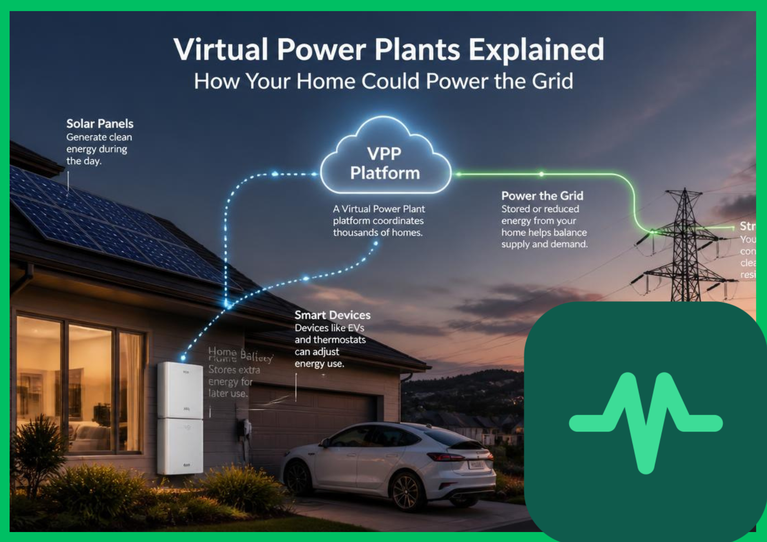
Here's a genuinely surprising idea. Your home battery, the one you installed for backup power during outages, could actually help power your entire neighborhood too, and you might get paid for it.
This isn't science fiction. It's called a virtual power plant, and it's quietly becoming a real thing across American neighborhoods. Let's break down how it actually works.
What a Virtual Power Plant Actually Is
Despite the name, a virtual power plant isn't one single building somewhere. It's a network, potentially thousands of home batteries, solar panels, and smart devices, all connected together and coordinated as one system.
Think of it like this. Instead of one giant power plant generating electricity in a central location, a virtual power plant combines tiny amounts of stored energy from thousands of individual homes. Together, all those small contributions add up to something genuinely significant.
Why This Idea Exists in the First Place
Power grids face a real challenge during peak demand hours, typically hot summer afternoons when everyone's air conditioning runs at once. Traditionally, utilities handle this by firing up expensive, often dirty "peaker plants," backup facilities that only run during these high-demand moments.
Virtual power plants offer a genuinely cleaner alternative. Instead of firing up a polluting backup plant, utilities can draw small amounts of stored energy from thousands of home batteries simultaneously, easing pressure on the grid without burning extra fossil fuel.
How This Actually Works for Homeowners
If you have a home battery, solar panels, or even a smart thermostat, you can often opt into these programs voluntarily. Nobody takes control of your home without your permission.
When the grid needs extra support, usually during predictable peak hours, your battery might discharge a small amount of stored energy back to the grid. Your smart thermostat might adjust slightly too, barely noticeable to you, but meaningful when combined across thousands of homes.
In exchange, many programs pay participating homeowners directly, either through bill credits or genuine cash payments.
Why This Feels Like Real Empowerment
There's something genuinely satisfying about this idea beyond just the financial angle. For years, homeowners were purely energy consumers, passively receiving power from a distant, faceless utility.
Virtual power plants flip that relationship. Your home becomes an active participant in the grid, not just a passive user. That shift feels meaningful, turning your rooftop solar and battery investment into something that benefits your whole community too, not just your own household.
The Real Financial Benefits Worth Knowing
Let's talk honest numbers here. Payments vary considerably by program and utility, but participating homeowners can earn meaningful money, sometimes several hundred dollars annually, just for allowing their battery to occasionally support the grid.
This doesn't drain your battery when you actually need it. Programs are carefully designed to leave you with enough backup power for genuine emergencies, while still capturing real value during predictable peak demand windows.
Do You Need Solar Panels to Participate?
Not necessarily, though it certainly helps. Homes with just a battery, even one charged from regular grid electricity during off-peak hours, can often participate in these programs too.
Solar panels paired with a battery, though, typically offer the strongest financial case. You're generating your own clean electricity, storing the excess, and then getting paid to share some of it back during peak demand.
Why Utilities Genuinely Love This Idea
This isn't just good for homeowners. Utilities benefit enormously too, which is exactly why these programs keep expanding.
Virtual power plants are typically cheaper than building new power plants or expensive grid infrastructure. They're also more flexible, able to respond to sudden demand spikes far faster than traditional backup power plants can.
Growing Availability Across American States
These programs remain more common in some states than others right now, largely tied to how progressive local utility regulations are around this technology.
California, Texas, and several northeastern states have led the way here, with genuinely robust virtual power plant programs already running. Availability keeps expanding steadily, though, as more utilities recognize the real value these programs offer.
What to Check Before Signing Up
Before enrolling your home battery or solar system, check the specific program details carefully. Understand exactly how much backup power gets reserved for your own emergency use.
Ask about payment structures too, some pay per event, others offer flat annual payments. Read the fine print honestly before committing, just like you would with any financial agreement.
Common Questions About Virtual Power Plants
Do I need solar panels to join a virtual power plant program?
Not necessarily, though solar combined with a battery typically offers the strongest financial case for participation.
Will participating drain my battery during an emergency?
Well-designed programs reserve backup power for your own use, so you shouldn't lose emergency capacity by participating.
How much money can I actually earn?
It varies by program and location, but many homeowners earn several hundred dollars annually through participation.
Is this available everywhere in America?
Not yet universally, but availability is expanding steadily as more utilities and states adopt these programs.
Final Thoughts
Virtual power plants represent something genuinely exciting, a way for regular homeowners to actively support their community's power grid, get compensated fairly, and feel like an active participant in the clean energy transition rather than a passive bystander.
If you already have solar panels or a home battery, it's genuinely worth checking whether your utility offers a program like this. Your investment might already be doing more good, and earning you more money, than you realized.
Comments (0)
Login to leave a comment.
No comments yet. Be the first to share your thoughts!