You turn on your lights, plug in your electric car, and run your washing machine.
You never give a second thought to where that electricity comes from or how it arrives at your wall outlet.
Behind that simple light switch lies the most complex machine ever built by human hands.
The global electrical grid is a sprawling, continent-spanning web of power lines, transformers, and generators.
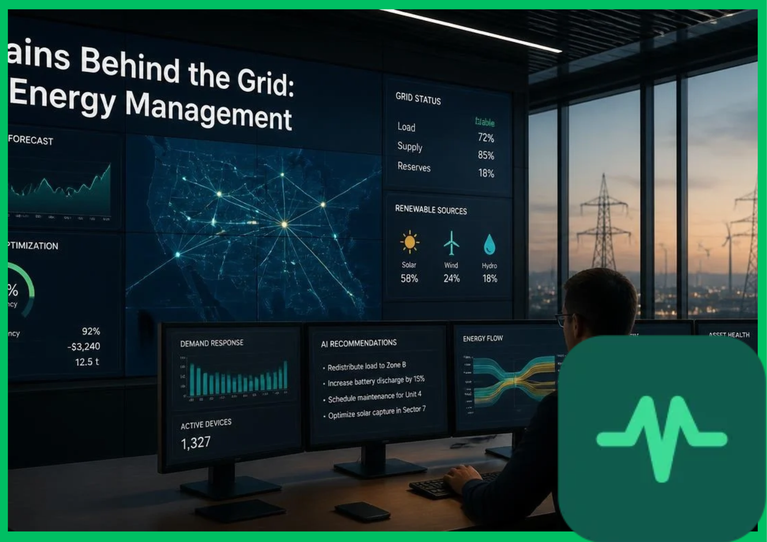
For over a century, managing that machine required human operators sitting in darkened control rooms, watching flickering analog dials and making split-second manual adjustments to balance supply and demand.
That old manual control model is reaching its absolute breaking point.
Millions of rooftop solar panels feed power back into neighborhood wires.
Wind farms surge and drop as weather patterns shift across the horizon.
Millions of electric vehicles plug in simultaneously every evening.
Human operators alone cannot balance a volatile, fast-moving renewable energy grid using spreadsheets and intuition.
We cannot build a clean energy future while managing 21st-century renewable power networks with 20th-century control rooms.
What if intelligent software could predict electricity demand before it happens?
What if lightning-fast machine learning algorithms could balance electrical grids in milliseconds, preventing blackouts before they ever start?
A quiet, brilliant digital revolution is transforming energy control centers across the globe.
According to global energy reports from the International Energy Agency (IEA), resource protection frameworks from the United Nations Environment Programme (UNEP), efficiency benchmarks from ENERGY STAR, and academic smart grid research, artificial intelligence power grid load balancing is changing how our electrical infrastructure operates.
By using advanced machine learning algorithms to forecast weather patterns, balance volatile renewable inputs, and regulate grid frequency in real time, we keep power grids stable and secure.
Here is how grid artificial intelligence works, why automated frequency regulation changes energy economics, and how automated balance secures our sustainable future.
The Growing Chaos of Modern Power Grids
To understand why artificial intelligence matters so much to modern power grids, you have to look at how clean energy transformed the old rules of electricity.
In the old days of fossil-fuel dominance, grid management was predictable.
If a city needed more power, operators shoveled more coal into a boiler or opened a natural gas valve.
Power generation followed demand like a faithful shadow.
Today, renewable energy replaces controllable fossil fuels with variable wind and sun.
Clouds roll over a major city, causing solar generation to drop by fifty percent in thirty seconds.
A sudden storm gust hits a wind farm, spiking generation instantly.
If grid operators fail to balance those sudden swings within milliseconds, voltage drops, circuits trip, and massive regional blackouts plunge millions of homes into darkness.
Skeptics once argued that turning critical energy infrastructure over to computer algorithms was too risky and unpredictable.
Electrical engineers and machine learning researchers proved those skeptics wrong.
Human reflexes are simply too slow to catch a sub-second frequency drop on a continent-wide grid.
Algorithms react in microseconds.
What Is AI Power Grid Load Balancing?
AI power grid load balancing is an advanced software system that uses machine learning, neural networks, and real-time data analytics to predict renewable energy generation, forecast household electricity demand, and automatically regulate power flow across transmission lines to maintain absolute grid stability.
Instead of relying purely on human intuition, control room operators work alongside intelligent digital agents:
- Weather Predictive Modeling: Machine learning algorithms ingest satellite cloud imagery, radar data, and atmospheric sensors to predict solar and wind output hours before generation shifts.
- Demand Forecasting: Predictive models analyze historical consumption patterns, local temperature forecasts, and smart meter data to anticipate exactly when neighborhoods will draw peak power.
- Automated Frequency Regulation: Software agents adjust power generation and battery storage discharge rates within milliseconds to keep grid frequency locked securely at standard operational targets.
- Predictive Asset Maintenance: Computer vision algorithms inspect remote transmission towers and substation transformers using drone footage, spotting hairline cracks before equipment fails.
The grid heals itself, balances itself, and adapts to weather changes invisibly behind the scenes.
The Science of Machine Learning and Grid Stability
How can computer algorithms coordinate millions of decentralized solar panels, batteries, and appliances faster than any human operator?
It comes down to predictive neural networks and automated control theory.
Academic smart grid research shows that modern AI models process thousands of data variables simultaneously, identifying hidden correlations between weather shifts and power consumption that human analysts would take days to notice.
When a sudden surge in electricity demand hits a regional grid, automated software does not wait for a human phone call.
It triggers responses across thousands of connected home batteries and industrial loads instantly, smoothing out voltage spikes.
Furthermore, ENERGY STAR and international electrical efficiency evaluations prove that AI-optimized grid management reduces transmission losses and cuts the energy waste associated with running spinning reserve fossil-fuel plants.
Software replaces brute-force fossil backup with calculated digital precision.
Environmental Integrity and Renewable Integration
The environmental benefits of artificial intelligence power grid load balancing extend far beyond preventing neighborhood blackouts or lowering operational utility costs.
They provide the essential digital glue required to achieve 100% renewable energy grids worldwide.
According to UNEP environmental governance frameworks, integrating high shares of wind and solar power without intelligent grid balancing leads to severe curtailment—where clean electricity gets thrown away simply because the grid cannot safely absorb sudden surges.
When artificial intelligence coordinates storage batteries and flexible loads dynamically, every single kilowatt-hour of clean wind and solar energy finds a home.
According to IEA clean energy roadmaps, scaling up smart digital grid infrastructure is an absolute pillar to accelerate global decarbonization targets.
When software manages the flow of electricity, our entire civilization runs with unprecedented cleanliness and efficiency.
Overcoming Cybersecurity and Data Privacy Realties
Scaling artificial intelligence load balancing from pioneering research labs into universal national grid operations involves navigating real-world cybersecurity and infrastructure hurdles.
Connecting critical power grid substations to cloud software networks creates new digital entry points that malicious actors could target.
Grid operators, software engineers, and cybersecurity experts solve these challenges by deploying isolated edge-computing systems that process data locally on secure hardware, implementing military-grade cryptographic protocols, and maintaining strict human-in-the-loop safety overrides.
As secure digital architectures mature and regulatory standards for critical infrastructure harden, AI grid management is transitioning successfully from experimental control rooms into standard utility operations worldwide.
Achieving Automated Balance Toward a Sustainable Future
Artificial intelligence in power grids proves that advanced digital technology can tame the wildest variables of renewable energy and build an unbreakable foundation for our clean future.
We no longer have to accept that balancing continent-wide electricity grids requires guessing games and polluting fossil-fuel backup plants.
By harnessing machine learning, predictive weather modeling, and automated load balancing, we ensure that clean wind and solar power flow reliably to every home on Earth.
We step away from grid vulnerability, embracing a smart, responsive, and enduring standard of electrical engineering.
Through brilliant software design, rigorous academic research, and a deep respect for our planetary climate, automated balance secures a clean, stable, and sustainable future for every community on Earth.

Comments (0)
Login to leave a comment.
No comments yet. Be the first to share your thoughts!