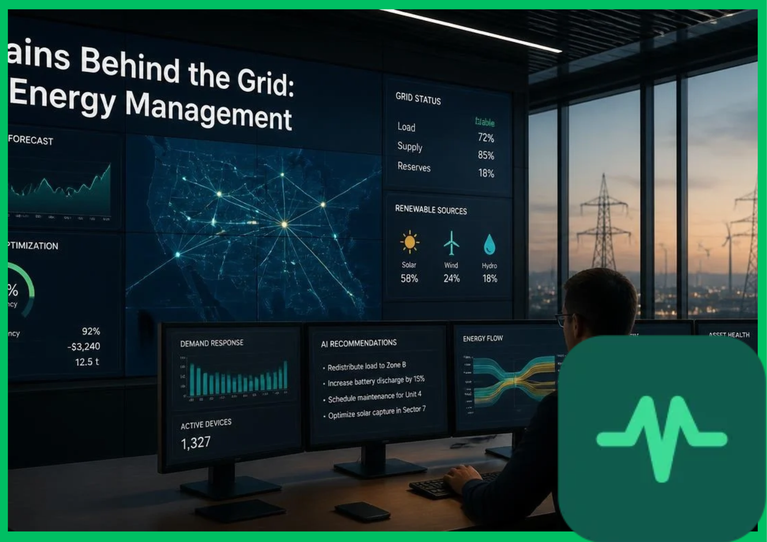
A gentle wave of warmth greets you the moment you walk through the door.
Your rooms feel cozy. Your electric vehicle is plugged into the garage, charging up quietly on low-cost overnight power. Your home battery is topped off and ready for whatever tomorrow brings.
You did not adjust a single thermostat setting before leaving for work this morning. You did not check the weather forecast or calculate wholesale electricity prices.
Your home did it all by itself.
Invisible to your eyes, a smart digital brain operated silently in the background.
It analyzed weather patterns, predicted solar generation, tracked energy market shifts, and coordinated your appliances with millisecond precision.
For over a century, electrical grids operated like clumsy giant machines.
Operators guessed how much power cities would need, shoved coal into boilers, and hoped supply met demand.
That old guessing game is coming to an end.
A brilliant technological revolution is bringing artificial intelligence into our power systems.
According to global energy reports from the International Energy Agency (IEA), resource protection frameworks from the United Nations Environment Programme (UNEP), efficiency standards from ENERGY STAR, and academic smart grid research, AI-driven smart home energy management is transforming how we consume electricity.
By using machine learning algorithms to predict power needs and automate energy distribution, we build smarter, cleaner, and cheaper homes.
Here is how artificial intelligence manages energy, why predictive software changes power distribution, and how smart algorithms secure our sustainable future.
The Chaos of Modern Power Consumption
To understand why artificial intelligence matters so much, you have to look at the sheer complexity of modern household energy use.
Decades ago, homes were simple. You turned on a light, powered a television, and ran a toaster.
Today, our homes are turning into miniature power plants and charging stations.
We drive electric vehicles that pull as much electricity as an entire second house. We install rooftop solar arrays that generate fluctuating power every time a cloud drifts overhead. We adopt heat pumps that adjust their heating cycles based on outdoor temperatures.
Juggling all these moving parts manually is impossible.
If you try to time your EV charging, battery storage, and appliance use by hand, you miss the cheapest electricity rates and waste valuable clean energy.
We needed a system smart enough to handle thousands of moving variables in real time.
We needed a digital brain.
What Is AI-Driven Smart Home Energy Management?
AI-driven smart home energy management is an advanced software platform that uses machine learning algorithms and predictive analytics to coordinate your household appliances, solar panels, and battery storage automatically.
Instead of waiting for you to flip switches, the system learns your daily habits.
It notices when your family wakes up, when you leave for work, and when you plug in your electric car.
It combines your personal routine with live external data, including regional weather forecasts, cloud cover predictions, and wholesale electricity market prices.
If a stormy afternoon is approaching, the AI software charges your home battery fully from cheap morning solar power before the clouds roll in.
If wholesale electricity prices are expected to spike during an evening heatwave, the software disconnects your home from the grid and runs your house entirely on stored battery power.
You save money every single month without lifting a finger.
The Science of Machine Learning and Grid Optimization
How does a software program predict your energy needs before they even happen?
It comes down to advanced machine learning and pattern recognition.
Academic smart grid research shows that neural network models analyze years of historical energy data to forecast micro-climates and household loads with astonishing accuracy.
When your rooftop solar panels experience a sudden shadow from a passing cloud, the AI predicts the drop in power generation seconds before it registers on your electrical inverter.
It adjusts your home battery discharge rate smoothly to cover the dip, preventing voltage fluctuations and keeping your appliances running without a hiccup.
According to ENERGY STAR and international appliance efficiency evaluations, automated AI optimization reduces total household energy waste by up to 15% to 25% annually.
The software ensures that every kilowatt of electricity generated by renewable sources is used at maximum efficiency.
Balancing Regional Grids Through Distributed Intelligence
The benefits of artificial intelligence extend far beyond individual household savings.
They play a vital role in stabilizing regional power grids.
When thousands of AI-managed homes operate across a city, they form a coordinated digital network.
If a sudden heatwave triggers a massive surge in air conditioning demand across the region, utility operators do not need to fire up polluting fossil-fuel peaker plants.
The AI software in thousands of homes communicates with the grid automatically, shifting EV charging schedules by an hour and drawing minor power adjustments from home batteries.
According to UNEP resource sustainability frameworks, distributed AI optimization prevents grid overloads and reduces the need for expensive, environmentally destructive transmission line expansions.
IEA energy transition assessments highlight that artificial intelligence is the essential glue holding modern renewable energy grids together.
Designing an Intelligent Home Energy Hub
Bringing artificial intelligence into your living space does not require a degree in computer science.
Modern smart energy hubs feature intuitive mobile apps that let you set your comfort preferences and financial priorities.
You tell the system whether you want maximum cost savings, maximum battery backup security, or 100% green energy usage.
The AI takes your preferences and builds a custom daily operational plan for your home.
It respects your comfort, protects your privacy, and quietly manages the background mechanics of sustainable living.
Stepping Into an Intelligent Future
AI-driven smart home energy management proves that the future of clean energy relies on digital intelligence as much as physical hardware.
We no longer have to guess how to manage our power use or struggle to balance solar generation with daily routines.
By harnessing machine learning algorithms, predictive energy software, and automated grid optimization, we build homes that think for themselves.
We step away from wasteful energy habits, embracing a seamless, intelligent, and effortless standard of living.
Through brilliant computer science, smart home design, and deep respect for our planetary climate, artificial intelligence secures a clean, bright, and sustainable future for our world.


Comments (0)
Login to leave a comment.
No comments yet. Be the first to share your thoughts!