Wind howls through the trees overhead. Rain lashes against your windows in blinding sheets.
Suddenly, a loud pop echoes down the street.
Every streetlamp flickers once and dies. The lights in your house go pitch black.
Outside, your entire neighborhood sinks into an eerie, cold darkness.
You pull out a flashlight and wonder how long you will sit in the dark this time. Days? A week?
For millions of people across the globe, a severe storm means an immediate, terrifying loss of connection to the outside world.
When central power grids fail, hospitals struggle, water pumps stop, and families shiver in unheated homes.
We built our modern civilization on massive, centralized electrical grids.
When those giant grids break down, entire regions collapse into vulnerability.
What if your neighborhood did not have to wait for a distant utility company to fix a broken transmission line miles away?
What if your community could disconnect from the failing main grid, stand completely on its own two feet, and keep the lights shining bright?
A brilliant, community-driven revolution is changing how local towns and neighborhoods protect themselves.
According to global energy reports from the International Energy Agency (IEA), resource protection frameworks from the United Nations Environment Programme (UNEP), efficiency benchmarks from ENERGY STAR, and academic microgrid research, microgrid resilience for communities is transforming disaster recovery.
By combining local solar arrays, shared battery storage, and smart automated switches, neighborhoods can disconnect from major outages and power themselves independently.
Here is how community microgrids work, why localized power networks change disaster survival, and how decentralized grid reliability secures our sustainable future.
The Danger of Fragile, Centralized Grids
To understand why community microgrids matter so much, you have to look at the weak points of traditional electrical infrastructure.
For over a century, electricity flowed in a single direction from giant, centralized power plants located miles away from population centers.
That power traveled across hundreds of kilometers or miles of high-voltage transmission lines, open country fields, and neighborhood telephone poles.
It was an efficient model for mass production.
It was also terrifyingly vulnerable to severe weather.
When a single fallen tree branch takes out a transmission line in a remote forest, an entire city hundreds of miles away can plunge into darkness.
Climate change brings stronger storms, heavier floods, and fiercer heatwaves that test aging electrical grids past their breaking point.
When the central grid goes down, local communities sit helpless, waiting days or weeks for utility crews to travel across damaged roads and restore power.
We needed a system that keeps power local, resilient, and independent.
What Is a Community Microgrid?
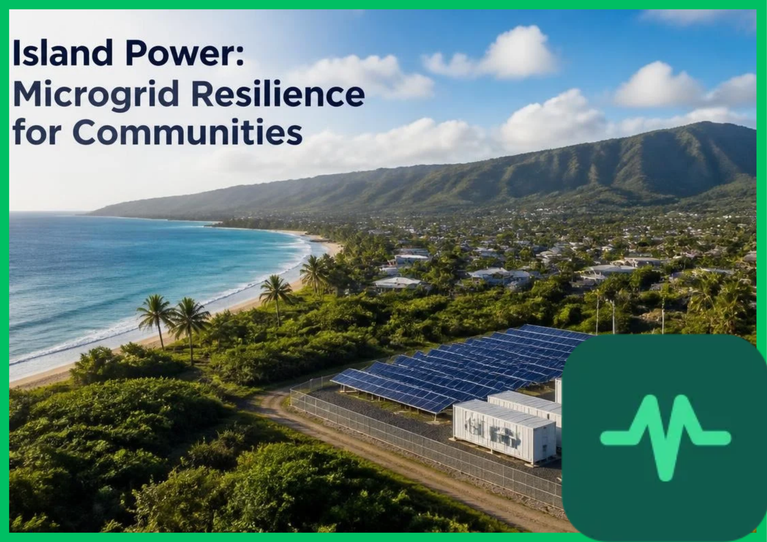
A community microgrid is a localized group of electricity generators, energy storage batteries, and smart loads—such as homes, schools, and community centers—that can operate completely independently from the regional transmission grid.
Think of it like an electrical island.
Under normal daily conditions, the microgrid stays connected to the main utility grid, buying and selling power smoothly.
When a severe storm knocks out regional power lines, automated safety switches pop open.
The microgrid physically disconnects itself from the failing main grid in a fraction of a second.
Inside the microgrid boundary, local rooftop solar panels, neighborhood wind generators, and shared battery storage systems keep working seamlessly.
The lights stay on. Refrigerators keep running. Water treatment pumps continue operating.
The neighborhood becomes an island of safety and light in the middle of a regional blackout.
The Science of Islanding and Automated Switching
How does a neighborhood disconnect from a dying grid so fast that your digital clock does not even blink?
It comes down to advanced power electronics and intelligent control software.
Academic microgrid research shows that static switches and automated relays monitor grid frequency and voltage continuously.
The exact moment the main utility supply drops or fluctuates outside safe parameters, the microgrid controller triggers islanding mode.
During islanding, local inverters take complete control of the neighborhood voltage and frequency, balancing power generation with local energy consumption in real time.
If clouds block the sun and solar generation drops for a few minutes, the neighborhood battery storage steps in instantly to supply the missing power.
When the storm passes and utility repair crews fix the main transmission lines, the microgrid synchronizes its frequency with the main grid and reconnects automatically without a single flicker.
Environmental Protection and Community Self-Reliance
The benefits of microgrids extend far beyond keeping the lights on during severe weather emergencies.
They transform how neighborhoods consume clean energy every single day.
According to UNEP resource sustainability frameworks, localized microgrids encourage communities to invest in shared renewable energy resources, reducing reliance on fossil fuels and keeping energy wealth within the local economy.
When schools, community centers, and residential homes pool their solar arrays and battery storage, they share clean power efficiently among neighbors.
According to IEA clean energy transition assessments, decentralized microgrids reduce line transmission losses significantly, because electricity is consumed right where it is generated.
ENERGY STAR efficiency evaluations highlight that smart community microgrids optimize local power distribution, ensuring that every kilowatt of solar energy is put to work locally.
Building Resilient Communities for the Future
Designing a resilient community microgrid requires thoughtful planning and local cooperation.
Neighborhoods identify critical infrastructure—such as local medical clinics, water pumping stations, grocery stores, and emergency shelters—and wire them into the primary microgrid loop.
Even if residential homes experience temporary power rationing during extended multi-day storms, essential community services remain fully operational.
Families know they have a safe, warm place to gather, charge devices, and access clean water when disaster strikes.
According to real-world disaster resilience data, communities equipped with microgrids recover from extreme weather events in a fraction of the time required by traditionally wired towns.
Lighting the Way Toward a Sustainable Future
Microgrid resilience for communities proves that true security comes from local connection and intelligent design.
We no longer have to accept that severe weather must plunge our neighborhoods into days of helpless darkness.
By combining rooftop solar power, shared battery storage, and automated islanding switches, we build self-reliant communities that can weather any storm.
We step away from vulnerable centralized grids, embracing a resilient, community-driven standard of living.
Through brilliant electrical engineering, smart grid automation, and deep respect for our neighbors, island power secures a safe, bright, and sustainable future for our world.

Comments (0)
Login to leave a comment.
No comments yet. Be the first to share your thoughts!