
Round-Trip Efficiency (RTE) and Power Conversion Losses
The foundational operational metric governing grid-scale energy storage is round-trip efficiency (RTE), defined as the ratio of electrical energy discharged from the storage system relative to the electrical energy consumed during the charging cycle:

Modern utility-scale lithium-ion battery energy storage systems achieve aggregate round-trip efficiencies between 85% and 92%. Total energy losses within a grid-scale installation stem from three primary engineering domains:
- Coulombic Efficiency Losses: Governed by side reactions and parasitic charge transfer within the battery cells, where fractional amounts of lithium ions are consumed irreversibly during intercalation cycles. High-quality utility cells maintain coulombic efficiencies exceeding 99.5% per cycle.
- Voltage Efficiency Losses: Caused by internal DC resistance (
 ) during high-current charging and discharging, resulting in overpotential voltage drops that dissipate electrical energy as internal joule heating (
 ).
- Parasitic Auxiliary Losses: Consumed by external facility infrastructure, including liquid chiller thermal management units, high-voltage bidirectional inverter-transformer stations, battery management system (BMS) controllers, and emergency ventilation blowers.
Lithium Iron Phosphate (LFP) Degradation Kinetics and Calendar Aging
Utility-scale stationary storage installations rely predominantly on lithium iron phosphate ( [LFP]) chemistry rather than nickel-manganese-cobalt (NMC) formulations, prioritizing high thermal stability, safety, and cycle longevity over maximum gravimetric energy density. LFP cells achieve operational lifespans exceeding 6,000 to 10,000 deep discharge cycles while retaining 80% of initial nameplate capacity.
Degradation in grid-scale LFP battery packs is governed by two distinct aging mechanisms: cycle aging and calendar aging. Cycle aging is driven by cumulative throughput ampere-hours, mechanical stress during lithium-ion insertion into the olivine crystal structure, and gradual growth of the solid electrolyte interphase (SEI) layer on the graphite anode. Calendar aging occurs continuously over time, accelerated by high state-of-charge (SoC) storage states (holding cells at 100% SoC) and elevated ambient operating temperatures. Maintaining cell operating temperatures within an optimal window of  to
 (
 to
 ) via closed-loop liquid thermal management minimizes parasitic calendar degradation rates.
Technical Data Specifications of Grid-Scale Storage Parameters
| Grid Storage & BESS Parameter | Engineering Specification Standard |
|---|---|
| Round-Trip Efficiency (RTE) | 85% to 92% AC-to-AC system efficiency |
| Primary Battery Cell Chemistry | Lithium Iron Phosphate ( [LFP]) |
| Nameplate Cycle Life Expectancy | 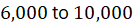 cycles at 80% capacity retention |
| C-Rate Operational Profile |  to  charge/discharge rate |
| Optimal Thermal Management Band |  to  (  to  ) cell core temp |
| Frequency Regulation Response Time |  sub-second droop control |
| Containerized Power Density |  to  per standard 40-foot enclosure |
Thermal Runaway Containment and Safety Architecture
Ensuring the operational safety of containerized grid-scale battery systems housing tens of thousands of individual lithium-ion cells requires robust thermal runaway mitigation engineering. If an internal short circuit, mechanical puncture, or severe overcharging event breaches a cell separator, exothermic decomposition cascades rapidly, elevating local temperatures above  (
 ) and generating toxic, flammable off-gases.
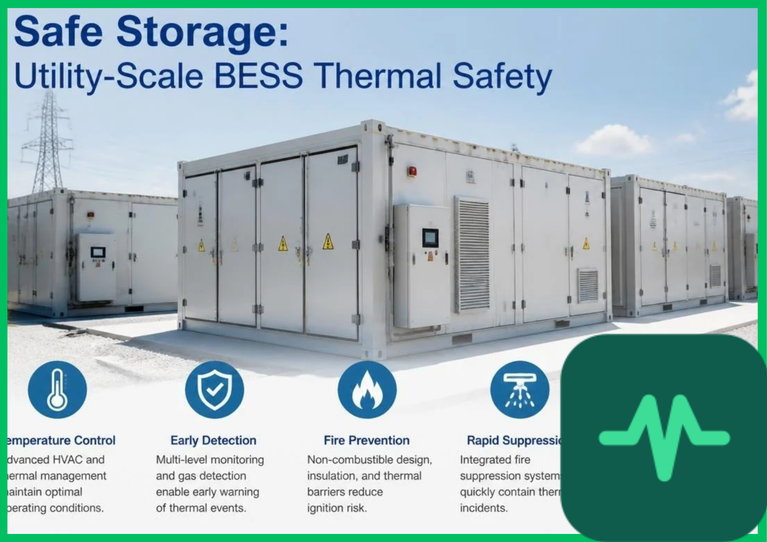
Grid-scale BESS enclosures implement multi-layered safety architecture compliant with rigorous international standards (such as NFPA 855 and UL 9540A):
- Cell-to-Cell Thermal Barriers: Aerogel insulation blankets and mica sheets inserted between prismatic cells inhibit thermal propagation, preventing a single failing cell from triggering cascading failure across entire battery modules.
- Exhaust Gas Venting Plenums: Integrated pressure-relief ducts channel hazardous off-gases rapidly out of the enclosure and through exterior flame-arresting vent valves.
- Aerosol and Clean Agent Suppression: Automated multi-stage fire suppression systems inject condensed aerosol fire extinguishing agents or clean water mist directly into the rack compartment to suppress thermal combustion.
Frequency Regulation Response and Ancillary Grid Services
Beyond energy time-shifting (storing excess midday solar generation to discharge during evening demand peaks), grid-scale battery storage systems provide critical ancillary services that stabilize municipal transmission networks. Traditional synchronous generators provide rotational inertia that resists sudden frequency deviations when large power plants trip offline. As fossil-fuel generation is phased out, power grids face declining system inertia.
Grid-scale batteries equipped with grid-forming inverters emulate synthetic inertia and provide primary frequency response within 100 milliseconds. When regional grid frequency dips below the nominal  or
 threshold, the central battery control system detects the phase angle displacement and injects active power instantaneously, arresting frequency decay faster than mechanical turbine governors. Furthermore, batteries provide rapid voltage regulation by injecting or absorbing reactive power (
 ), supporting transmission grid stability across fluctuating load profiles.
The Final Take
Mastering grid-scale battery energy storage system efficiency ensures the reliability and flexibility of modern low-carbon power systems. Citing IEA grid integration assessments and power engineering literature, optimizing round-trip efficiency, deploying robust LFP thermal management, and enforcing strict thermal runaway containment standards maximize operational performance. By delivering sub-second frequency regulation and reliable energy time-shifting, utility-scale BESS architecture establishes an indispensable foundation for global electrical grid decarbonization.


Comments (0)
Login to leave a comment.
No comments yet. Be the first to share your thoughts!