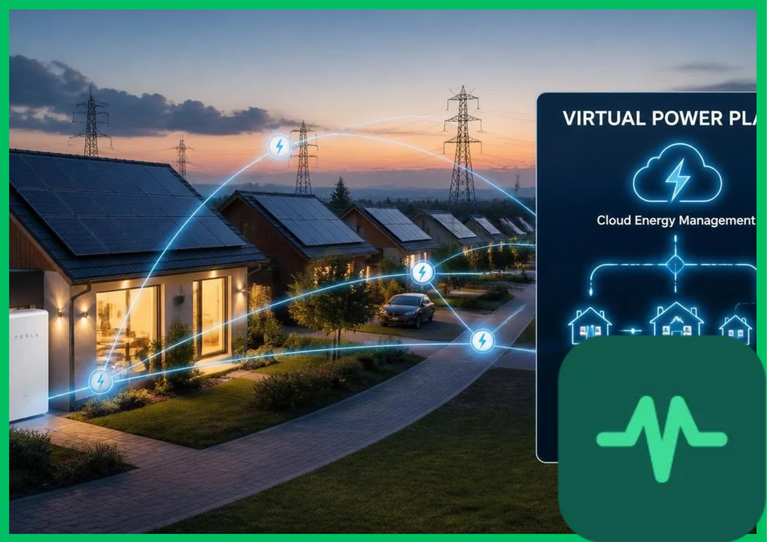
Outside, the sun beats down relentlessly on your neighborhood roofs.
Every home around you has turned on its air conditioning unit. Millions of compressors hum at maximum speed, pulling massive amounts of electricity from the local power lines at the exact same time.
Somewhere across the region, a massive fossil-fuel power plant groans under the strain, burning extra coal just to keep up with the sudden surge in demand.
You look at your own garage.
Your solar panels are drinking in the bright sunlight, pumping clean electricity into your home battery storage system.
Your battery is already completely full.
Normally, that extra solar energy would just sit there or feed trickling power back into the local grid for pennies.
What if your battery could do something much more powerful?
What if your battery joined forces with thousands of other home batteries across your city to act as a single, massive power plant?
A quiet, brilliant energy revolution is connecting independent homes into smart digital networks.
According to global energy reports from the International Energy Agency (IEA), resource protection frameworks from the United Nations Environment Programme (UNEP), efficiency benchmarks from ENERGY STAR, and academic smart grid research, virtual power plants and home batteries are changing how we power our world.
By linking thousands of residential batteries together through cloud software, we create a flexible, clean energy network that stabilizes regional grids without burning fossil fuels.
Here is how virtual power plants work, why decentralized energy networks change power distribution, and how peer-to-peer power sharing secures our sustainable future.
The Fragility of Centralized Power Grids
To understand why virtual power plants matter so much, you have to look at the outdated design of traditional electrical grids.
For over a century, electricity operated on a one-way street.
Giant, centralized power plants—burning coal, gas, or splitting atoms—generated massive amounts of electricity miles away from cities.
That power traveled across long high-voltage transmission lines straight to your neighborhood transformers and into your home walls.
It was a rigid, top-down system.
When a heatwave hit or a transmission line failed, the whole system wobbled.
To prevent catastrophic blackouts, grid operators relied on dirty, expensive fossil-fuel peaker plants.
Those peaker plants sat idle for 90% of the year, firing up for just a few frantic hours on hot summer afternoons when electricity demand spiked vertically.
That centralized model is inefficient, polluting, and increasingly fragile in a changing climate.
We needed a way to transform millions of passive energy consumers into active grid participants.
What Is a Virtual Power Plant?
A virtual power plant (VPP) is not a physical building with smokestacks, turbines, or cooling towers.
You cannot drive up to it or touch its walls.
Instead, a virtual power plant is a cloud-based software network that connects thousands of individual home batteries, rooftop solar systems, and smart appliances into a single, coordinated digital pool of energy.
When regional electricity demand spikes, the VPP software communicates instantly with participating home batteries across the city.
It taps into a tiny sliver of stored energy from thousands of residential garages simultaneously.
Instead of turning on a polluting fossil-fuel peaker plant, the grid operator draws clean power from your battery and your neighbors' batteries for a few hours.
The lights stay on. The grid stays stable.
You help power your community, and you earn financial rewards for sharing your clean energy.
The Science of Smart Grid Orchestration
How do thousands of independent home batteries coordinate their power output with millisecond precision?
It comes down to cloud software and automated machine-learning algorithms.
Academic smart grid research shows that VPP platforms monitor weather forecasts, wholesale electricity market prices, and grid frequency signals in real time.
When a summer storm approaches or local demand surges, the VPP software sends an encrypted signal to your home battery management system.
Your battery responds instantly, shifting from self-consumption mode to grid-support mode.
Because the response is distributed across thousands of homes spread over hundreds of kilometers or miles, the network absorbs localized disruptions effortlessly.
According to ENERGY STAR and international industrial efficiency evaluations, VPP orchestration optimizes local power distribution, reducing line losses and keeping regional energy networks balanced without expensive infrastructure upgrades.
Empowering Communities and Cutting Carbon
The environmental and social benefits of virtual power plants extend far beyond keeping the lights on during peak hours.
They dismantle the monopoly of dirty fossil-fuel generation.
According to UNEP resource sustainability frameworks, decentralized energy networks empower local communities to take charge of their own power generation and storage, fostering a true circular economy of energy.
When homes generate clean solar power and store it in modular batteries, they stop relying on distant coal plants.
According to IEA clean energy transition assessments, widespread VPP adoption reduces global power sector carbon emissions significantly by replacing fossil peaker plants with stored renewable sunshine.
Furthermore, homeowners participating in VPP programs receive financial compensation from local utilities for sharing their battery capacity during emergencies, turning home energy systems from a household expense into an active economic asset.
Overcoming Software and Regulatory Hurdles
If virtual power plants offer such clear advantages, why aren't they managing every home battery on Earth today?
The challenges are primarily regulatory and software-based rather than physical.
Traditional electricity markets were designed for giant, centralized utilities, not millions of households trading power back and forth.
Grid regulators across the globe are working rapidly to update market rules, ensuring that residential battery owners can connect safely to wholesale energy markets without complex red tape.
As software platforms improve and cybersecurity standards tighten, virtual power plants are scaling up into mainstream energy infrastructure.
Uniting Our Power Toward a Sustainable Future
Virtual power plants and home batteries prove that true strength comes from unity and connection.
We no longer have to rely on giant, polluting fossil-fuel power plants to keep our cities running during peak hours.
By linking independent home batteries through smart cloud software, we transform millions of scattered rooftops into a massive, flexible, clean energy network.
We step away from vulnerable centralized grids, embracing a resilient, community-driven standard of living.
Through brilliant digital engineering, smart grid orchestration, and deep respect for our planetary climate, power in unity secures a clean, bright, and sustainable future for our world.

Comments (0)
Login to leave a comment.
No comments yet. Be the first to share your thoughts!