Down in the garage, your electric vehicle sits plugged into a smart charger.
Your home battery system rests quietly against the wall, fully charged and ready for the evening.
Individually, your home is just one small household managing its own energy.
Multiply that single home by tens of thousands across a region, however, and something extraordinary happens.
For over a century, electrical grids relied entirely on massive, centralized power plants to keep the lights on. Whenever demand spiked, utility operators fired up massive coal or gas turbines to match the load.
That old, top-down model is changing.
According to tracking frameworks from the International Energy Agency (IEA), resource assessments from the United Nations Environment Programme (UNEP), efficiency metrics from ENERGY STAR, and academic power systems research, digital aggregation is reshaping our energy networks.
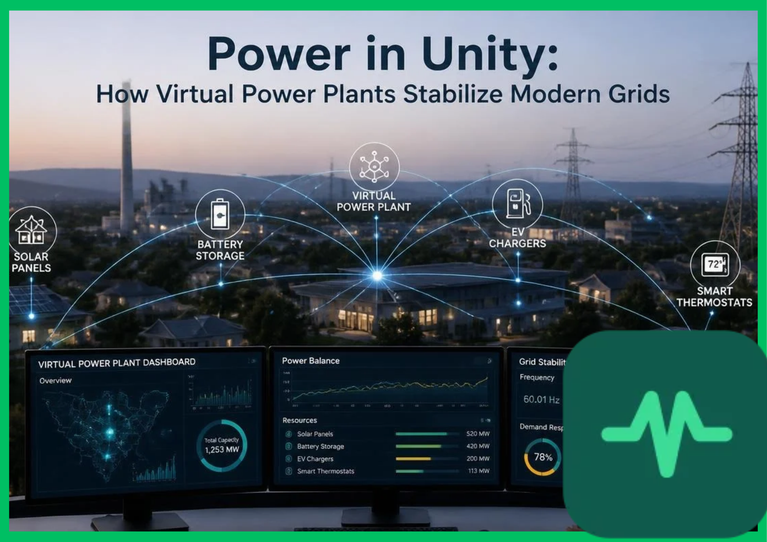
A virtual power plant (VPP) unites thousands of independent clean energy assets into a single, coordinated powerhouse.
Here is how virtual power plants work, why distributed coordination outperforms old central generation, and how power in unity stabilizes modern power grids.
The Fragmented Power of Distributed Energy
To understand why virtual power plants are a breakthrough, you have to look at the massive shift happening in global energy architecture.
For generations, electricity flowed in one single direction. It traveled downward from massive central power stations across high-voltage transmission lines straight to passive consumers.
Today, millions of people generate their own electricity.
Rooftop solar panels, residential battery storage systems, electric vehicles, and smart heat pumps are popping up on homes and businesses everywhere.
While this decentralized clean energy boom is wonderful for the planet, it creates a massive logistical puzzle for grid operators.
How do you manage millions of tiny, independent power sources scattered across thousands of neighborhoods?
Controlling each home individually is impossible. Ignoring them leaves vast amounts of flexible clean energy sitting idle.
We needed a digital bridge to connect the pieces.
What Is a Virtual Power Plant?
A virtual power plant is not a physical building with smokestacks or generators.
It is a cloud-based software platform that aggregates thousands of scattered, distributed energy resources (DERs) and manages them as a single, unified generation asset.
The software connects smoothly with participating homes and businesses via secure internet protocols.
It reads real-time weather forecasts, local grid conditions, and wholesale electricity market prices.
When regional electricity demand spikes during a hot summer afternoon or a freezing winter evening, the VPP platform acts instantly.
Instead of turning on a polluting fossil-fuel peaker plant, the virtual power plant software sends automated signals to thousands of connected homes at the exact same millisecond.
It gently pauses residential EV charging, dials down smart air conditioning units by a fraction of a degree, and discharges a tiny, safe fraction of stored energy from home batteries.
To the local utility grid, that coordinated group of thousands of houses looks and acts exactly like a single, reliable 500-megawatt power plant.
Unlocking Flexibility and Grid Resilience
The true power of a virtual power plant lies in its incredible operational flexibility.
Traditional power stations take hours to ramp up or shut down.
Virtual power plants respond in milliseconds.
Academic power systems research highlights that VPP aggregations provide vital grid services, including frequency regulation, peak shaving, and rapid load balancing.
When an unexpected storm knocks out a major transmission line, the VPP steps in immediately.
It fills the power gap by drawing on thousands of distributed residential batteries simultaneously, keeping the local grid frequency stable and preventing cascading blackouts.
According to IEA clean energy transition assessments, aggregating small-scale storage and electric vehicles reduces the need to build costly new fossil-fuel infrastructure, saving society billions of dollars while hardening grid resilience against extreme weather.
Empowering Households in the Clean Economy
Virtual power plants do more than stabilize regional power grids. They put financial power directly into the hands of everyday people.
Under traditional energy systems, individual households were treated as passive consumers who simply paid whatever flat rate utilities printed on their monthly bills.
With VPP participation, your home becomes an active market participant.
When wholesale electricity prices soar during peak demand windows, your aggregated battery storage and smart appliances help support the grid.
In return, utility providers and aggregators reward participating households with financial credits, lower energy bills, or direct cash payouts.
UNEP circular economy frameworks emphasize that this democratization of energy builds community resilience and aligns individual financial incentives with global decarbonization goals.
You earn rewards while helping your entire neighborhood stay powered with clean energy.
Powering a Connected, Resilient Future
Virtual power plants prove that true strength comes from connection.
By linking thousands of small, independent clean energy assets through intelligent cloud software, we dissolve the boundaries between individual homes and massive power grids.
We no longer need to rely on dirty, centralized fossil-fuel generators to keep our societies running smoothly.
Through digital coordination, distributed storage, and shared purpose, we turn scattered rooftop solar panels and garage batteries into a mighty force.
Power in unity transforms our energy system, securing a clean, flexible, and deeply resilient future for our global community.

Comments (0)
Login to leave a comment.
No comments yet. Be the first to share your thoughts!