Across town, millions of air conditioners roar to life simultaneously. Electrical demand spikes vertically, pushing regional power grids toward their absolute breaking point.
For generations, utility operators faced only one dangerous choice during these critical stress peaks: fire up dirty, expensive fossil-fuel peaker plants or risk widespread rolling blackouts.
Today, a powerful new defense is changing grid management completely.
It does not live inside a massive industrial power station with smokestacks. It lives in your garage, your basement, and your driveway.
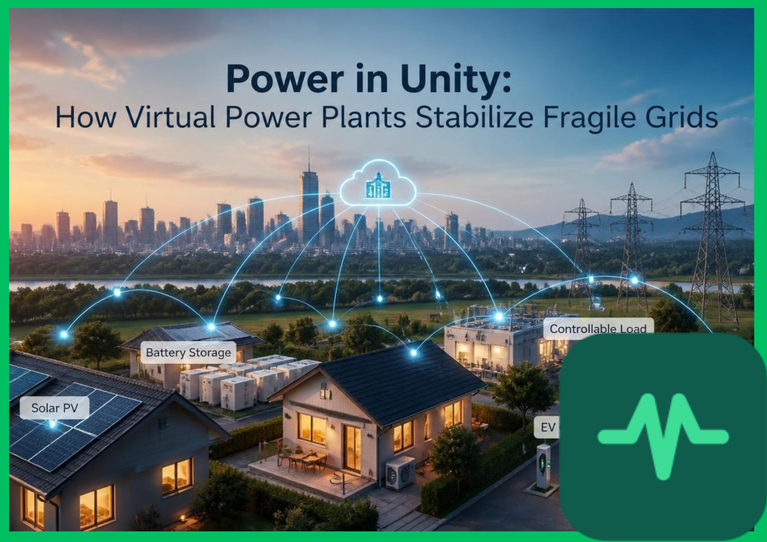
Virtual power plants are linking thousands of residential solar batteries and electric vehicles together into agile, synchronized networks.
According to tracking data and academic research on modern energy systems, virtual power plants are transforming decentralized home assets into vital grid-stabilizing power sources.
Here is how connected homes are working together to stabilize fragile electrical grids worldwide.
The Fragility of Centralized Power
To understand the brilliance of virtual power plants, you have to look at the structural weaknesses of legacy electrical grids.
Traditional power grids were built on a top-down model. A handful of massive, centralized power stations generated electricity and pushed it outward through long-distance transmission lines to passive consumers.
When extreme weather hits or sudden demand spikes occur, those aging centralized networks struggle to adapt.
Building new fossil-fuel power plants just to handle a few hours of peak demand each year is economically inefficient and environmentally destructive.
We needed a flexible solution that avoids building massive new infrastructure while securing absolute grid stability.
What Is a Virtual Power Plant?
A virtual power plant is not a physical power station.
It is a cloud-based software network that aggregates hundreds or thousands of individual, decentralized energy assets—like residential rooftop solar batteries and electric vehicles—into a single, unified power resource.
Each participating home maintains its own independence, running its daily energy needs seamlessly.
However, through secure smart software, the virtual power plant platform can coordinate with your home battery and EV charger in milliseconds.
When regional grid demand spikes, the aggregator software signals thousands of home batteries simultaneously to discharge small, safe fractions of their stored energy back out to the local distribution network.
To the utility operator, those connected homes act like a single, massive, clean power plant.
Rewarding Homeowners for Grid Support
Participating in a virtual power plant is not just an act of civic duty; it provides tangible financial benefits for everyday homeowners.
When your home battery or electric vehicle helps stabilize the local grid during high-demand events, utility operators compensate you for that service.
Instead of letting your battery sit idle after charging on cheap solar power, your system earns credits or direct cash payouts by supplying emergency power during peak stress hours.
You turn your residential energy storage investment into an active financial asset that pays for itself over time.
Decentralized Resilience and the Future of Energy
Virtual power plants represent a fundamental shift in how we think about electrical infrastructure.
Instead of relying on fragile, centralized monopolies, we are building resilient, democratic, and interconnected community energy networks.
By tying millions of smart homes together through advanced software, virtual power plants prove that the strongest electrical grid is not a giant monolith, but a collaborative web of clean energy assets working together to keep the lights on for everyone.

Comments (0)
Login to leave a comment.
No comments yet. Be the first to share your thoughts!