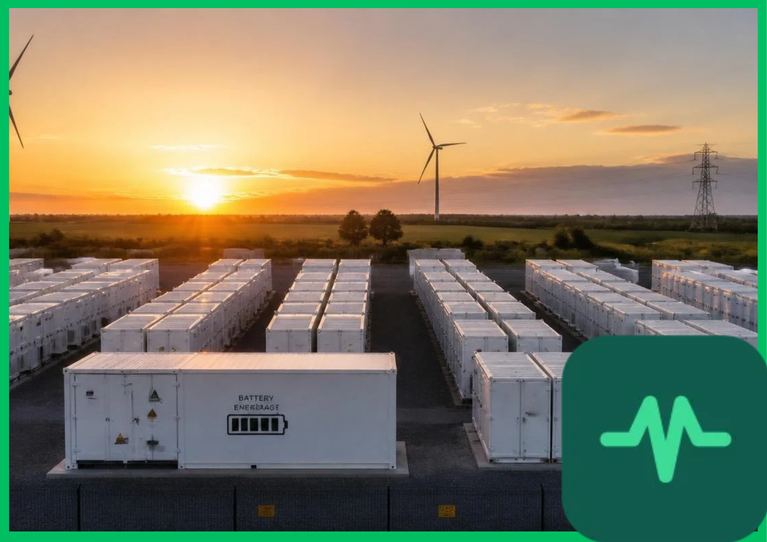
There are no smokestacks here. No roaring combustion engines. No roaring noise venting steam into the atmosphere.
Yet, inside those unassuming metal containers, an astonishing amount of power rests in total silence.
For over a century, electrical grids relied on massive fossil-fuel power plants to keep the system stable. When electricity demand spiked, operators shoveled more coal or piped more gas into boilers to spin heavy turbines.
That old, rigid method is giving way to a cleaner, faster foundation.
According to global energy reports from the International Energy Agency (IEA), resource tracking from the United Nations Environment Programme (UNEP), efficiency metrics from ENERGY STAR, and academic power systems research, utility-scale battery storage is transforming electrical grids worldwide.
By storing massive volumes of surplus clean energy and releasing it in milliseconds, utility-scale battery energy storage systems (BESS) anchor modern power grids.
Here is how grid-scale storage works, why rapid frequency response matters, and how multi-megawatt batteries secure our sustainable energy future.
The Balancing Act of Modern Power Grids
To understand why utility-scale batteries are essential, you have to look at the fragile physics of an electrical grid.
Electricity must be consumed the exact fraction of a second it is generated.
If generation exceeds demand, grid frequency rises, threatening sensitive equipment. If demand outstrips supply, frequency drops, triggering rolling blackouts.
Historically, grid operators maintained that balance using fossil-fuel peaker plants. Those emergency generators sat idling or ramped up slowly whenever demand spiked, burning dirty fuels at high economic and environmental costs.
As the world rapidly integrates variable renewable energy sources like wind and solar, the grid faces a new dynamic.
The sun shines brightly at noon, and wind farms produce gales overnight, but human electricity demand peaks during late afternoon and evening hours.
Without massive storage buffers, that timing mismatch leads to wasted clean energy and grid instability.
We needed a system that could absorb energy swiftly and respond instantly to sudden grid fluctuations.
Inside a Multi-Megawatt Storage Facility
A utility-scale battery installation operates on a massive industrial scale.
Instead of small home battery boxes, these facilities consist of rows of heavy-duty shipping containers packed with thousands of lithium-ion or lithium iron phosphate cells.
When renewable generation outstrips local demand, power conversion systems route surplus electricity into the battery array.
The system converts incoming alternating current (AC) from transmission lines into direct current (DC), storing it safely inside chemical cells.
When demand surges or a local power line trips offline, the process reverses in milliseconds.
Inverters transform the stored DC power back into smooth AC electricity, injecting megawatts of power straight into transmission wires.
According to IEA deployment data, global utility-scale battery capacity has expanded exponentially, accounting for the vast majority of all new storage installations worldwide.
Sub-Second Response and Frequency Regulation
The true superpower of utility-scale storage is speed.
Traditional thermal power plants rely on heavy metal turbines spinning at thousands of rotations per minute. Ramping those massive machines up or down takes precious minutes.
Batteries have zero mechanical lag.
Academic power systems research highlights that battery management systems can detect a frequency drop and inject full power onto the grid in under a second.
This lightning-fast response provides vital frequency regulation.
When a sudden storm knocks out a transmission line or an industrial factory draws heavy power unexpectedly, utility-scale batteries act as an immediate shock absorber.
They stabilize local electrical frequencies instantly, preventing cascading outages before slow-reacting backup generators even have time to start.
They bridge the gap between sudden disruption and permanent stability.
Energy Arbitrage and Renewable Integration
Beyond emergency grid stabilization, utility-scale batteries drive profound economic efficiency through energy arbitrage.
During sunny midday hours, solar farms often produce more electricity than local transmission lines can carry.
Without storage, grid operators are forced to curtail—or waste—that clean generation.
Utility-scale storage captures that surplus midday solar power, holding it safely in reserve.
When the sun sets and electricity demand peaks across the region, the batteries discharge that stored solar energy into the evening market.
According to academic economic evaluations, this time-shifting capability slashes reliance on expensive, polluting fossil-fuel peaker plants while maximizing the financial return on renewable energy investments.
Energy is saved, clean power is utilized fully, and wholesale electricity prices stabilize.
Anchoring a Resilient Global Transition
Utility-scale battery infrastructure proves that modern engineering can solve the inherent variability of renewable energy.
We no longer have to depend on burning coal or gas to guarantee steady electrical baseloads.
By deploying strategic multi-megawatt storage assets across regional transmission networks, we create a flexible, shock-resistant power grid.
We protect our communities from blackouts, integrate record-breaking shares of wind and solar power, and phase out dirty fossil emissions.
Through intelligent storage design and rapid response technology, utility-scale batteries anchor our global transition toward a clean, reliable, and sustainable energy future.



Comments (0)
Login to leave a comment.
No comments yet. Be the first to share your thoughts!