

Four-Quadrant Inverter Topologies and DC-to-AC Power Conversion
The foundational electrical engineering principle governing bidirectional charging is four-quadrant power conversion executed by advanced inverter architectures. A bidirectional charger must regulate active power ( ) and reactive power (
 ) independently across both directions of energy flow. The apparent power (
 ) vector is formulated mathematically as:

During standard charging (power flow from grid to vehicle), the power converter operates in rectifying mode, converting grid AC voltage ( to
 AC) into regulated DC voltage (
 to
 DC) to charge the lithium-ion traction battery. During discharging (power flow from vehicle to grid), the converter switches to inversion mode, synthesizing a clean sinusoidal AC waveform synchronized precisely with the frequency (
 or
 ) and phase angle of the local utility grid.
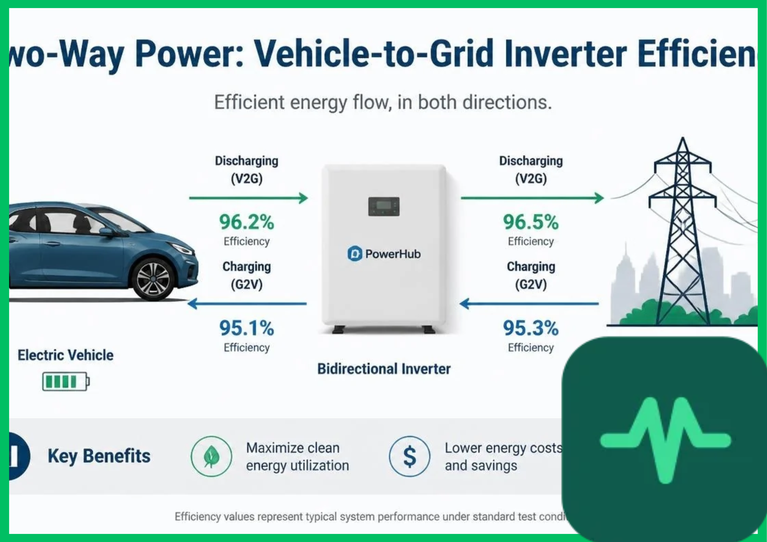
Modern bidirectional chargers utilize dual-active-bridge (DAB) DC-DC converters combined with active front-end (AFE) grid-tied DC-AC inverters equipped with silicon carbide (SiC) or gallium nitride (GaN) semiconductor switches. These wide-bandgap semiconductors minimize switching losses, achieving round-trip DC-AC-DC conversion efficiencies exceeding 92% to 95% across operating loads.
Grid Synchronization, Phase-Locked Loops, and Harmonic Standards
Feeding electrical power from a mobile vehicle battery back into public utility distribution infrastructure requires rigorous adherence to power quality standards and grid synchronization protocols. Unsynchronized power injection causes severe voltage fluctuations, phase angle displacement, and harmonic distortion that can trip substation protective relays.
Bidirectional inverters deploy advanced software algorithms, specifically synchronous reference frame phase-locked loops (SRF-PLL), to track utility grid voltage vectors in real time. The inverter adjusts its output current waveform dynamically to match grid frequency within milliseconds. To prevent harmonic contamination, total harmonic distortion (THD) of the injected AC current must remain below 5%, complying with international IEEE 1547 and IEC 61850 interconnection standards. Active filtering algorithms within the AFE inverter suppress low-order harmonic currents (such as the 3rd, 5th, and 7th harmonics), ensuring that power fed back into the grid is cleaner than standard base-load utility power.
Technical Data Specifications of Bidirectional V2G Parameters
| Bidirectional V2G Parameter | Engineering Specification Standard |
|---|---|
Round-Trip Energy Efficiency ( ) | 90% to 95% DC-AC-DC conversion efficiency |
| Bidirectional Power Transfer Capacity |  to  (AC residential) /  (DC fast) |
| Inverter Switching Architecture | Silicon Carbide (SiC) / GaN four-quadrant MOSFETs |
| Grid Output Frequency Synchronization |  or  locked via SRF-PLL |
| Current Total Harmonic Distortion (THD) |  compliance with IEEE 1547 standards |
| Battery Cycle Degradation Threshold | Controlled micro-cycling ( annual capacity loss) |
| Response Time for Frequency Regulation |  rapid grid stabilization |
Battery Degradation Kinetics and Micro-Cycling Realities
A primary technical challenge constraining widespread commercial adoption of vehicle-to-grid systems is the accelerated degradation of lithium-ion battery cells resulting from frequent micro-cycling. Every time a traction battery discharges energy back into the grid to support peak shaving or frequency regulation, electrochemical intercalation and de-intercalation occur within the electrodes, inducing mechanical stress and cumulative capacity fade.
Lithium-ion battery degradation is governed by cumulative throughput ampere-hours and depth of discharge (DoD). Shallow micro-cycles utilized in V2G frequency regulation (DoD  ) inflict lower mechanical strain on graphite anodes and transition metal oxide cathodes compared to deep full-charge depletion cycles. However, continuous high-power discharging elevates internal cell temperatures, accelerating parasitic side reactions at the solid electrolyte interphase (SEI) layer. Battery management systems (BMS) mitigate this degradation by implementing smart optimization algorithms that restrict V2G participation when state of health (SoH) drops below critical thresholds or when battery temperatures exceed
 (
 ).
Grid-Scale Ancillary Services and Peak Load Shaving
From a macro-level energy economics perspective, aggregated fleets of bidirectional electric vehicles provide vital ancillary services to power systems experiencing high penetration of intermittent renewable generation (wind and solar). When solar photovoltaic generation drops abruptly at sunset while regional electricity demand peaks, V2G-enabled vehicles discharge stored electrical energy back into the distribution network, flattening municipal load curves and eliminating the need for fossil-fuel peaker power plants.
According to IEA smart grid integration analyses, bidirectional charging fleets offer spinning reserves capable of responding to frequency deviations within 100 milliseconds. This rapid response stabilizes grid frequency far faster than traditional thermal generation plants. Furthermore, vehicle-to-home (V2H) architectures provide reliable emergency backup power during grid blackouts, supplying uninterrupted household electrical loads ( to
 ) for multiple days using the vehicle's high-capacity traction battery (
 to
 ).
The Final Take
Mastering bidirectional ev charging vehicle-to-grid efficiency transforms electric vehicles from passive electrical loads into active distributed energy storage assets. Citing IEA smart grid reports and power electronics literature, four-quadrant silicon carbide inverters enable high-efficiency DC-AC power conversion and precise grid frequency synchronization. By balancing battery degradation kinetics with advanced micro-cycling optimization algorithms, V2G technology establishes an indispensable technical foundation for future smart electrical grids.
Comments (0)
Login to leave a comment.
No comments yet. Be the first to share your thoughts!