
 by intercalating one lithium ion per six carbon atoms (
 ). In contrast, silicon anodes exhibit a theoretical gravimetric capacity exceeding
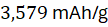 by alloying up to
 per silicon atom (
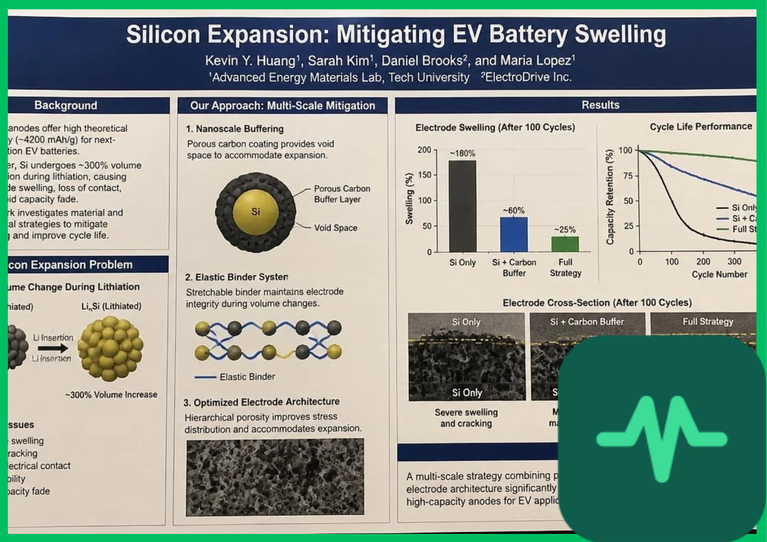
 ) at room temperature. This high lithium storage capacity elevates cell energy density by 20% to 40%. However, silicon undergoes severe volumetric expansion of 300% to 400% during full lithiation, inducing particle pulverization, electrical contact loss, and rapid capacity degradation unless controlled via advanced mechanical and binder engineering.
Lithiation Mechanics and Volumetric Swelling Physics
The foundational physical challenge governing silicon anode performance is the immense mechanical strain generated during electrochemical alloying and de-alloying. When lithium ions migrate through the electrolyte and intercalate into silicon particles during charging, the atomic crystal lattice expands outward as amorphous lithium-silicon alloys form.
The volumetric strain ( ) is formulated mathematically by comparing the volume of the lithiated silicon phase (
 ) to the pristine silicon volume (
 ):
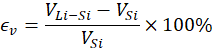
This massive 300% to 400% volumetric expansion generates severe localized mechanical stresses exceeding the yield strength of silicon ( scale), causing microscopic particle fracturing, cracking, and pulverization. When silicon particles fracture, fresh unoxidized surfaces are exposed continuously to the liquid electrolyte, accelerating parasitic chemical reactions that consume active lithium ions and thicken the solid electrolyte interphase (SEI) layer. This continuous SEI consumption depletes cycle life, causing rapid capacity fade within initial operating cycles.
Binder Elasticity Management and Conductive Matrix Architecture
Mitigating structural pulverization requires advanced polymer binder systems and elastic conductive additive matrices that accommodate large volumetric shifts without losing electrical contact. Traditional polyvinylidene fluoride (PVDF) binders rely on weak van der Waals forces and exhibit brittle mechanical behavior, causing electrode delamination under high silicon swelling pressures.
Modern silicon anode manufacturing incorporates self-healing elastomers, cross-linked polyacrylic acid (PAA), sodium alginate, or conductive hydrogel binders. These elastic polymer networks possess high tensile strength and elongation capabilities exceeding 150% to 300%, enabling the binder to stretch and retract elastically during repetitive lithiation and delithiation cycles. Furthermore, integrating one-dimensional carbon nanotubes (CNTs) or two-dimensional graphene nanosheets into the conductive matrix maintains continuous electronic pathways across expanding and contracting silicon domains, preventing isolated micro-regions from becoming electrically inactive.
Technical Data Specifications of Silicon Anode Parameters
| Silicon Anode Parameter | Engineering Specification Standard |
|---|---|
| Theoretical Specific Capacity | 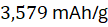 (  alloy stoichiometry) |
| Graphite Baseline Specific Capacity |  (  intercalation limit) |
| Volumetric Expansion Rate | 300% to 400% volume swelling during full lithiation |
| Polymer Binder Elongation Threshold | 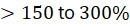 elastic strain capacity |
| Silicon Particle Size Distribution | Nano-sized ( ) or micro-porous architectures |
| Initial Coulombic Efficiency (ICE) | 88% to 92% initial charge-discharge efficiency |
| Electrode Porosity Target | 30% to 40% void volume to absorb swelling stress |
Nano-Structured Architectures and Void Volume Engineering
To prevent bulk mechanical failure, silicon anodes are engineered using complex nano-structures and porous composite architectures that decouple particle-level expansion from macro-scale electrode destruction. Instead of using solid micro-sized silicon particles, advanced battery developers utilize three primary morphological designs:
- Silicon Nanoparticles: Fabricated with diameters below
 , these particles fall below the critical fracture size threshold, allowing them to withstand volumetric expansion without cracking.
- Porous Silicon Sponges: Features interconnected internal void spaces that absorb volumetric expansion internally, preventing external macro-swelling of the electrode coating.
- Core-Shell Silicon-Carbon Composites: Encapsulates nano-silicon domains inside conductive carbon shells or graphene cages, creating a protective buffer layer that restricts direct electrolyte contact and stabilizes SEI layer formation.
Maintaining controlled electrode porosity (30% to 40% void volume) within the slurry coating structure provides necessary spatial buffer zones, preventing the electrode sheet from crushing adjacent separators or pressing against cell casing walls during high-state-of-charge expansion.
Solid Electrolyte Interphase (SEI) Stabilization and Pre-Lithiation
Stabilizing the solid electrolyte interphase layer on silicon surfaces is essential for maximizing initial coulombic efficiency (ICE) and preventing continuous electrolyte decomposition. Because silicon exhibits a low electrochemical reduction potential versus lithium ( vs.
 ), electrolyte solvents and conductive salts reduce irreversibly during the initial charge cycle, consuming mobile lithium ions to form the SEI film and dropping ICE values to 85% or lower.
Researchers apply artificial protective coatings—such as atomic layer deposition (ALD) aluminum oxide ( ), fluorinated carbon matrices, or polymer electrolyte interphases—to passivate silicon surfaces and facilitate selective
 ion transport while blocking parasitic solvent reduction. Additionally, industrial pre-lithiation techniques introduce sacrificial lithium sources during manufacturing or utilize electrochemical pre-doping to compensate for initial lithium inventory loss, restoring full cell energy density.
The Final Take
Mastering silicon anode ev battery volumetric expansion mechanics transforms high-capacity lithium storage by uniting elastic polymer binders, nano-structured void engineering, and stable interfacial passivation. Citing IEA advanced battery assessments and electrochemical literature, controlling 300% to 400% volume swelling eliminates particle pulverization and extends cycle life. By scaling silicon-graphite composite architectures, next-generation EV batteries establish an indispensable foundation for high-energy-density vehicle electrification.
Comments (0)
Login to leave a comment.
No comments yet. Be the first to share your thoughts!