Ten or fifteen years from now, that car will reach the end of its road life.
When an electric vehicle finishes its driving days, what happens to the heavy battery pack bolted to its floor?
A common myth assumes those retired packs become immediate electronic waste, piling up in industrial yards or heading straight to shredders.
That assumption misses an incredible second chapter.
According to tracking data from the International Energy Agency (IEA), resource circularity frameworks from the United Nations Environment Programme (UNEP), efficiency benchmarks from ENERGY STAR, and academic energy storage research, retired EV batteries have plenty of life left.
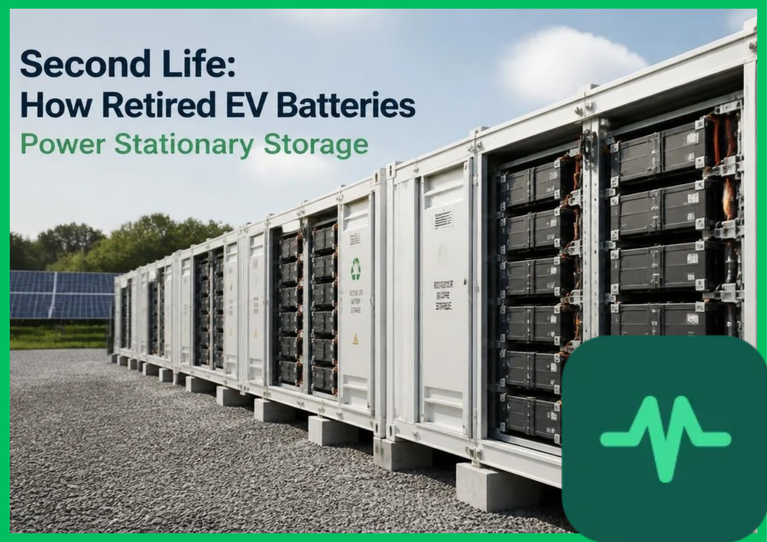
Before those cells head to recycling plants, they embark on a second life as stationary energy storage systems, stabilizing renewable power grids and powering buildings.
Here is how second-life battery reuse works, why automotive retirement does not mean energy exhaustion, and how repurposing packs transforms clean technology.
The Resilient Nature of Retired Cells
To understand why second-life applications work so well, you have to look at how batteries age inside an electric car.
When an EV battery's capacity drops to roughly 70% or 80% of its original maximum, it can no longer deliver the long driving range that owners expect on the highway.
For high-speed vehicle transport, that battery is retired.
For stationary storage, however, that same battery is still remarkably potent.
Stationary energy storage systems do not need to fight wind resistance, climb steep mountain roads, or deliver instant high-voltage acceleration.
They sit securely in a basement, a commercial utility shed, or an outdoor container, quietly storing and discharging electricity.
Academic battery degradation research shows that after a decade of vehicle use, lithium-ion cells stabilize into a gentle, predictable aging curve.
They can easily operate for another ten to fifteen years in stationary applications before their chemical life truly ends.
What Is Second-Life Energy Storage?
Second-life energy storage takes retired automotive battery packs and repurposes them for stationary grid support.
The process begins with thorough diagnostic testing.
Engineers inspect retired packs, testing cell health, internal resistance, and thermal integrity.
Healthy modules are reconfigured into modular stationary storage racks, paired with specialized battery management systems, and connected to inverters.
These repurposed systems serve multiple critical functions in the global energy ecosystem:
- Storing surplus solar and wind power during peak generation hours
- Providing backup power resilience for residential and commercial buildings
- Regulating electrical frequency across local power distribution grids
Instead of rushing straight to heavy chemical recycling, these packs continue useful work right where society needs them most.
Buffering Renewable Energy Grids
The rise of wind and solar power brings a major technical challenge: natural variability.
The sun does not shine at night, and the wind does not blow on command.
Power grids need massive amounts of energy storage to capture renewable surplus and release it when demand spikes.
Manufacturing brand-new stationary storage batteries requires heavy mining and industrial processing.
By utilizing second-life EV batteries, we bypass the need for immediate raw material extraction.
We capture the embodied carbon and mineral value already locked inside existing battery packs, stretching their utility across a double lifespan.
According to IEA clean energy transition assessments, integrating second-life storage into regional power networks reduces capital costs for renewable microgrids while accelerating global decarbonization.
Bridging the Gap to Ultimate Recycling
Second-life applications do not replace recycling; they complement it perfectly.
Circular economy frameworks emphasized by UNEP highlight the importance of cascading resource use.
The ideal lifecycle for a lithium-ion battery follows a clear path:
- Powering electric vehicles on our roads for a decade or more
- Retiring to stationary storage units to buffer clean energy grids for another decade
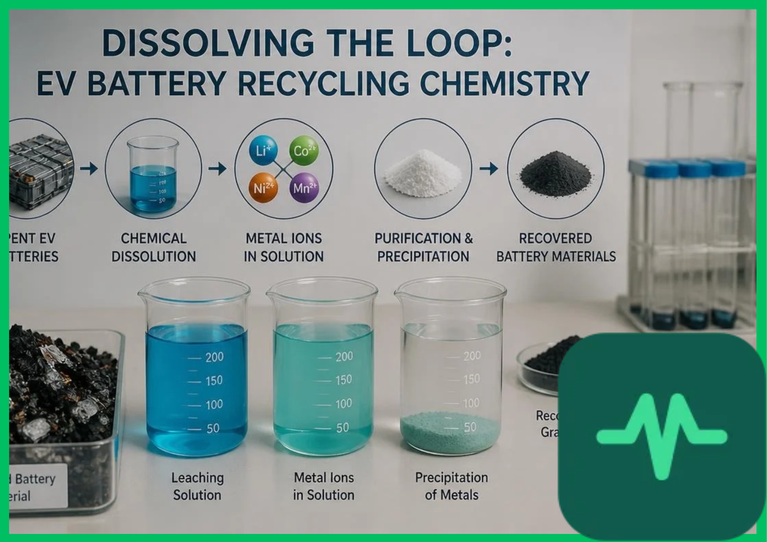
- Heading to advanced hydrometallurgical recycling facilities for closed-loop mineral recovery
By inserting that vital middle chapter into the timeline, we maximize the economic and environmental return on every kilogram of lithium, cobalt, and nickel extracted from the earth.
Retired car batteries do not die quietly. They transition into steady guardians of our clean energy grids.
Powering a Circular Energy Economy
Second-life EV batteries prove that modern technology can eliminate waste through intelligent design.
We are moving away from linear consumption models and embracing circular systems that honor the finite resources of our planet.
By giving retired vehicle batteries a productive second career buffering renewable grids, we reduce mining pressures, lower storage costs, and strengthen local power resilience.
Through clever engineering and circular thinking, yesterday's vehicle power source becomes tomorrow's grid stabilizer, lighting our way toward a sustainable future.

Comments (0)
Login to leave a comment.
No comments yet. Be the first to share your thoughts!