The lamp glows instantly.
You never think about the invisible, delicate heartbeat that keeps the electricity flowing smoothly through your walls.
For over a century, power grids relied on massive, heavy steam turbines spinning inside fossil-fuel and nuclear power plants.
Those giant rotating steel shafts weighed hundreds of metric tons.
They acted as a giant physical flywheel for the entire regional grid.
When a sudden surge in electricity demand hit the system, the sheer momentum of those heavy spinning turbines kept grid frequency stable for crucial seconds while operators fired up backup generators.
As we retire coal and gas plants to fight climate change, we remove those heavy spinning masses from our electrical grid.
Without that physical momentum, modern power grids become vulnerable to sudden voltage drops, frequency wobbles, and micro-blackouts.
We cannot build a stable, 100% renewable energy future while leaving our electrical grids without instant physical inertia.
What if we could replace those dirty fossil-fuel turbines with clean, high-speed kinetic energy storage systems?
What if a spinning cylinder floating in a vacuum could provide instant frequency regulation and short-duration power backup for our entire electrical grid?
A quiet, brilliant mechanical engineering revolution is transforming energy substations across the globe.
According to global energy reports from the International Energy Agency (IEA), resource protection frameworks from the United Nations Environment Programme (UNEP), efficiency benchmarks from ENERGY STAR, and academic grid stabilization research, flywheel energy storage rapid response grid systems are changing our electrical infrastructure.
By using advanced carbon-fiber rotors spinning on magnetic bearings inside vacuum chambers, we store kinetic energy and deliver sub-second frequency stabilization to regional power grids.
Here is how flywheel energy storage works, why kinetic spinning reserves change grid economics, and how rapid-response mechanics secure our sustainable future.
The Frequency Stability Crisis of Renewable Grids
To understand why flywheel energy storage matters so much, you have to look at the fragile physics of grid frequency.
Electrical grids operate on a strict heartbeat.
In North America, that target frequency is 60 hertz; across Europe and much of the world, it is 50 hertz.
If electricity generation exceeds demand, frequency creeps upward.
If demand exceeds generation, frequency drops.
When frequency drops too far too fast, protective relays trip substations offline, causing cascading regional blackouts.
Traditional fossil-fuel power plants provided natural inertia because their heavy turbines resisted sudden speed changes.
Wind and solar farms generate clean power through electronic inverters, lacking that physical rotating mass.
When clouds roll over solar farms or wind gusts drop suddenly, modern grids experience sharp frequency drops.
Skeptics once argued that mechanical flyhouses and kinetic energy storage devices were too small, expensive, and short-lived to replace heavy industrial turbines.
Electrical engineers and physicists proved those skeptics wrong.
You do not need a coal boiler to create grid inertia if you use high-speed magnetic-bearing flywheels spinning at incredible velocities.
What Is Flywheel Energy Storage?
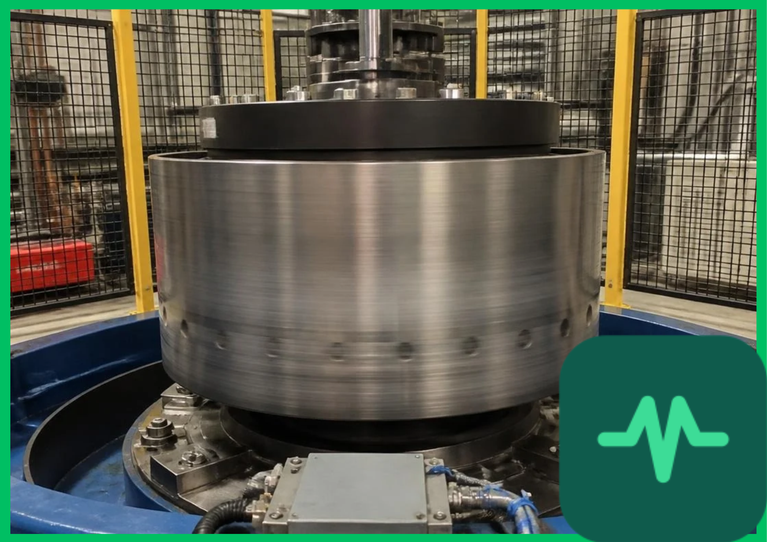
Flywheel energy storage is an advanced mechanical system that converts electrical energy into kinetic energy by spinning a heavy, high-strength composite rotor up to 40,000 to 60,000 revolutions per minute inside a sealed, airless vacuum enclosure supported entirely by magnetic levitation bearings.
Instead of trapping electrons in chemical cells, the system stores energy as pure motion:
- The Charging Phase: When excess renewable electricity flows into the substation, an integrated motor-generator drives electric current into the rotor, accelerating the heavy carbon-fiber cylinder to blistering rotational speeds.
- Vacuum Levitation: Powerful permanent magnets levitate the spinning rotor so it floats completely free of physical contact, eliminating friction entirely.
- Vacuum Chamber Isolation: The entire assembly operates inside a sealed steel vacuum tank, removing air resistance so the rotor can spin for hours without losing speed.
- Instant Discharge: When regional grid frequency drops, the kinetic momentum forces the rotor to act as an electrical generator instantly, pumping power back into the transmission lines within milliseconds.
You store electricity as pure rotational motion, ready to release a burst of power faster than any chemical battery or gas turbine on Earth.
The Science of Kinetic Energy and Sub-Second Response
How can a spinning cylinder of carbon fiber store enough electrical energy to stabilize a continent-spanning power grid during a sudden emergency?
It comes down to classical rotational mechanics and centrifugal physics.
Academic grid stabilization research shows that the kinetic energy stored in a flywheel scales with the square of its rotational speed.
By weaving ultra-strong carbon-fiber composite materials instead of using brittle steel, engineers allow rotors to spin at peripheral speeds exceeding 1,000 meters per second or 2,200 miles per hour.
When a sudden grid fault occurs, chemical batteries take several hundred milliseconds to ramp up their power electronics.
Flywheels respond in less than four milliseconds, reacting instantaneously to frequency drops before humans even notice a flicker.
Furthermore, ENERGY STAR and international electrical efficiency evaluations prove that high-speed magnetic-bearing flywheels achieve round-trip efficiencies exceeding 85% to 90% without suffering capacity degradation after millions of rapid charge-discharge cycles.
Physics replaces chemistry. Mechanical motion preserves our electrical stability.
Environmental Integrity and Mineral Independence
The environmental benefits of flywheel energy storage systems extend far beyond stabilizing grid frequency or preventing local blackouts.
They provide a remarkably clean footprint on the earth compared to the intensive mining operations required for chemical battery production.
According to UNEP resource governance frameworks, manufacturing carbon-fiber and steel flywheels requires zero toxic lithium refining, zero cobalt mining, and zero hazardous wastewater ponds.
At the end of their multi-decade operational lifespan, the composite materials and steel housings are fully recyclable.
When energy storage relies on kinetic motion rather than chemical reactions, industrial infrastructure harmonizes cleanly with local ecosystems.
According to IEA clean energy roadmaps, scaling up rapid-response mechanical storage is an absolute pillar to achieve high shares of wind and solar integration without risking grid collapse.
When motion becomes our battery, our clean energy transition rests on durable, earth-friendly physics.
Overcoming Standby Losses and Mechanical Safety
Scaling flywheel energy storage from specialized industrial pilot sites into universal grid infrastructure involves navigating real-world engineering and safety hurdles.
Even inside a high-vacuum chamber on magnetic bearings, tiny windage losses and electromagnetic drag cause a spinning flywheel to bleed a small percentage of its stored energy over time when sitting idle.
Mechanical engineers, materials scientists, and grid operators solve these challenges by using ultra-high vacuum pumps, zero-power superconducting magnetic bearings, and heavy steel containment armor designed to safely absorb rotational energy in the unlikely event of a mechanical rotor failure.
As engineering techniques mature and standardized modular flywheel arrays enter the global market, kinetic storage is transitioning successfully from specialized power-quality trials into standard utility-scale grid stabilization technology worldwide.
Spinning Reserves Toward a Sustainable Future
Flywheel energy storage systems prove that classical mechanics can solve the most delicate stability challenges of our modern renewable electrical grid.
We no longer have to accept that keeping our power grids balanced requires burning fossil fuels in dirty, spinning turbine plants.
By spinning carbon-fiber rotors on magnetic bearings inside vacuum chambers, we create clean, instant kinetic spinning reserves that protect our power lines around the clock.
We step away from grid vulnerability, embracing a resilient, durable, and enduring standard of electrical engineering.
Through brilliant mechanical physics, rigorous academic research, and a deep respect for our planetary laws, spinning reserves secure a clean, stable, and sustainable future for every community on Earth.


Comments (0)
Login to leave a comment.
No comments yet. Be the first to share your thoughts!