Solar panels soak up brilliant sunshine.
Wind turbines spin quietly in the distance.
Clean electricity floods the electrical grid in wild, unpredictable bursts.
Nature does not care about human schedules or evening peak hours.
When clean energy surges past what the grid can use, operators face a difficult choice.
If they cannot store that surplus electricity safely, it goes to waste.
For generations, power grids solved generation mismatches by burning fossil fuels on demand.
When renewable energy surged, operators shut down wind turbines or dialed back solar arrays.
Throwing away clean electricity is a tragic waste of human ingenuity and natural resources.
We cannot build a fully decarbonized energy future while relying on chemical batteries that degrade over time or throwing away surplus renewable power.
Lithium-ion batteries excel at storing short-term power for a few hours in a home garage or neighborhood substation.
Yet storing days or weeks of bulk wind and solar energy requires something vastly bigger, tougher, and more enduring.
What if we could store electricity inside giant tanks of liquid electrolyte instead of solid chemical cells?
What if liquid flow batteries could decouple power capacity from energy capacity entirely, giving our electrical grid limitless endurance?
A quiet, brilliant electrochemical revolution is transforming energy storage engineering across the globe.
According to global clean energy reports from the International Energy Agency (IEA), resource protection frameworks from the United Nations Environment Programme (UNEP), efficiency benchmarks from ENERGY STAR, and academic battery research, vanadium redox flow batteries and stationary energy storage systems are changing our clean energy landscape.
By pumping liquid chemical solutions through electrochemical cells to store electricity in external tanks, we create long-duration energy storage solutions that stabilize regional power grids.
Here is how redox flow batteries work, why liquid electrolyte storage changes grid economics, and how liquid storage secures our sustainable future.
The Degradation Trap of Solid Lithium Batteries
To understand why redox flow batteries matter so much, you have to look at the physical limits of traditional solid-state chemical batteries.
Lithium-ion batteries pack energy tightly into solid electrodes.
Every time a lithium-ion battery charges and discharges, solid lithium ions wedge themselves into microscopic crystal structures inside the electrodes.
Over thousands of cycles, those solid structures crack, degrade, and wear out.
Solid batteries lose storage capacity year after year until they must be replaced entirely.
Furthermore, scaling up a solid lithium battery's storage duration requires buying more of the expensive active battery cells themselves, making long-duration storage prohibitively costly.
Skeptics once argued that liquid flow batteries were too bulky, complex, and expensive for commercial grid deployment.
Electrochemists and materials engineers proved those skeptics wrong.
You do not need solid, degrading electrodes if you keep your active energy storage chemicals safely dissolved in liquid tanks.
What Is a Redox Flow Battery?
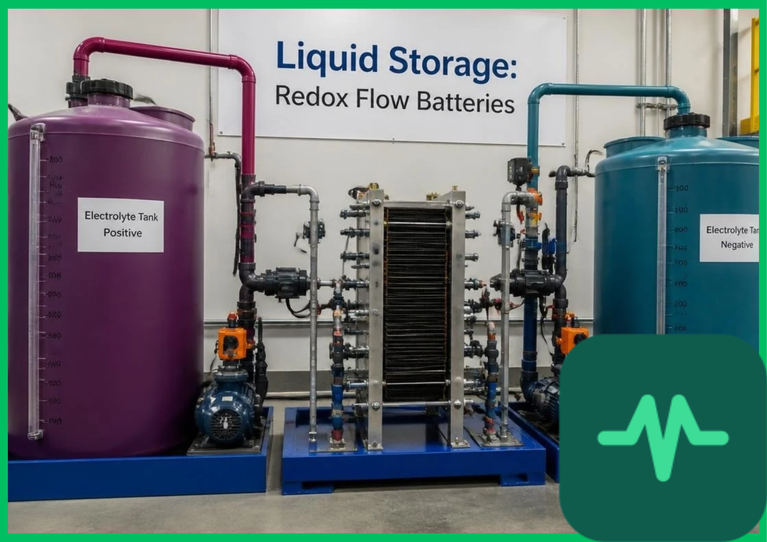
A redox flow battery is an advanced stationary energy storage system that stores electrical energy in liquid chemical electrolyte solutions pumped through an electrochemical cell stack, allowing power output and energy storage capacity to be scaled independently by simply adjusting the size of the power stack or the volume of the liquid storage tanks.
Instead of trapping electrons inside degrading solid plates, the system stores energy through fluid chemistry:
- The Power Stack: Liquid electrolytes containing dissolved vanadium ions flow through specialized carbon-felt electrodes separated by a proton-exchange membrane, where reduction and oxidation reactions transfer electrons to generate electricity.
- External Liquid Tanks: Two separate fluid tanks hold the positive and negative liquid electrolyte solutions completely outside the electrochemical cell stack.
- Independent Scalability: If grid operators want to store ten hours of power instead of four hours, they do not need to buy more expensive cell stacks—they simply install larger liquid storage tanks.
- Zero Degradation Cycling: Because the active energy storage elements exist entirely in liquid solution, the solid membrane and electrodes suffer zero mechanical wear over decades of continuous cycling.
You harness the midnight breeze, pump liquid energy through external tanks, and unleash it whenever humanity needs power.
The Science of Oxidation States and Fluid Dynamics
How can liquid chemicals flowing through a stack store enough electrical energy to power entire cities through calm winter weeks without degrading over time?
It comes down to multi-valence redox chemistry and fluid dynamics.
Academic battery research shows that vanadium ions possess four distinct oxidation states, allowing the same chemical element to serve as both the positive and negative electrolyte in a flow battery.
When charging, electrical current drives electrons through the system, altering the ionic charge states in the flowing liquids.
When discharging, those liquid solutions flow back through the cell stack, releasing electrons smoothly to power the grid.
Because the positive and negative electrolytes share the same vanadium base, cross-contamination across the separator membrane causes zero permanent chemical damage.
Furthermore, ENERGY STAR and international grid efficiency evaluations prove that redox flow batteries maintain round-the-flow efficiencies exceeding 75% to 85% while operating safely at ambient temperatures without thermal runaway risks.
Fluid dynamics replace solid stress. Liquid stability preserves our energy.
Environmental Integrity and Mineral Stewardship
The environmental benefits of vanadium redox flow batteries and stationary energy storage systems extend far beyond balancing regional power grids or storing surplus wind energy.
They provide a remarkably sustainable footprint on the earth compared to massive open-pit mining operations required for traditional solid battery production.
According to UNEP resource governance frameworks, vanadium used in flow batteries can be rented, leased, and fully recovered at the end of the system's operational lifespan, achieving a true circular materials economy with zero permanent chemical waste.
When energy storage relies on liquid electrolytes stored in tanks, industrial infrastructure recycles its active materials indefinitely.
According to IEA clean energy roadmaps, scaling up long-duration liquid storage is an essential pillar to achieve global net-zero emissions targets without straining global mineral supply chains.
When our liquid tanks store energy safely, our clean energy transition rests on stable, recyclable ground.
Overcoming System Complexity and Capital Realties
Scaling redox flow batteries from pioneering utility pilot sites into universal grid infrastructure involves navigating real-world engineering and economic hurdles.
Building liquid storage systems requires specialized pumps, corrosion-resistant plumbing, and large storage footprints compared to compact solid batteries.
Energy developers, chemical engineers, and utility planners solve these challenges by designing modular skid-mounted flow battery units, utilizing advanced polymer piping, and establishing long-term electrolyte leasing programs that lower upfront capital costs for utilities.
As manufacturing techniques mature and standardized modular liquid tank designs enter the global market, redox flow batteries are transitioning successfully from experimental electrochemical trials into standard utility-scale grid balancing technology worldwide.
Liquid Storage Toward a Sustainable Future
Redox flow batteries prove that advanced fluid electrochemistry can solve the most stubborn energy storage challenges of our modern electrical grid.
We no longer have to accept that capturing the unpredictable power of wind and solar energy requires degrading solid batteries or polluting fossil-fuel backup.
By pumping liquid electrolyte solutions through external storage tanks, we store clean power safely with zero capacity decay.
We step away from energy waste and solid battery wear, embracing a resilient, durable, and enduring standard of bulk power management.
Through brilliant electrochemistry, rigorous academic research, and a deep respect for our planetary resources, liquid storage secures a clean, reliable, and sustainable future for every community on Earth.


Comments (0)
Login to leave a comment.
No comments yet. Be the first to share your thoughts!