Then evening arrives. The sun sets.
For years, the great Achilles' heel of renewable energy was timing. The wind does not always blow when energy demand peaks, and the sun sets right when families return home to turn on appliances.
Without a way to store that energy, clean power was limited and fleeting.
That vulnerability is ending. According to comprehensive tracking data and reports from the International Energy Agency (IEA), we have entered a new industrial epoch: the infrastructure era of battery storage.
Battery storage has officially become the fastest-growing power technology in the world.
Here is how massive global scale-up is turning battery storage into the foundational bedrock of modern clean energy grids.
From Niche Technology to Global Infrastructure
To understand the magnitude of this shift, you have to look at how quickly battery storage has expanded.
Not long ago, batteries were viewed as expensive accessories used primarily for small off-grid cabins or consumer electronics.
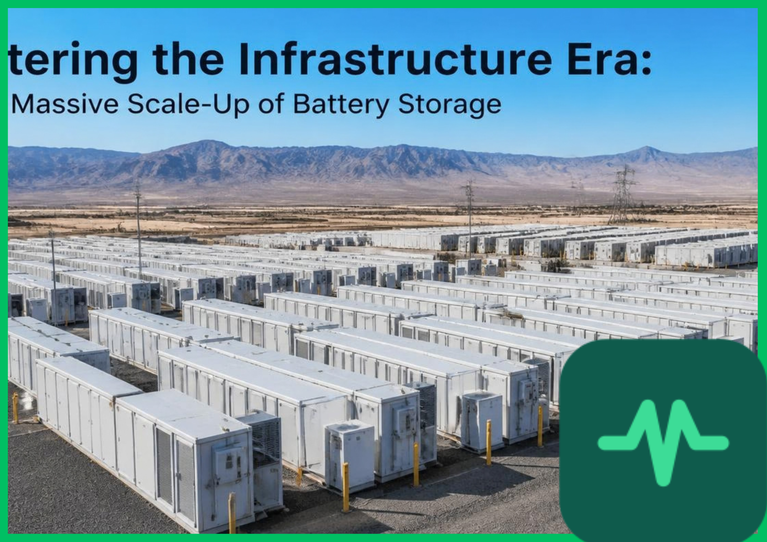
Today, they are massive utility-scale installations deployed across the globe.
According to IEA market reviews, global battery storage deployment expanded dramatically, reaching 108 gigawatts of new capacity in a single recent year—a stunning 40% jump from the previous period.
Installed global battery capacity is now more than eleven times higher than it was at the start of the decade.
This is no longer a pilot project or an experimental phase. It is full-scale industrial deployment, matching the speed and scale of solar and wind expansion.
Utility-Scale Power and Lithium-Iron Phosphate Chemistry
The backbone of this infrastructure boom is utility-scale installations.
Approximately 80% of all new battery capacity additions are utility-scale systems, massive facilities containing thousands of battery racks connected directly to high-voltage transmission substations.
These facilities absorb excess solar and wind power during high-generation hours, storing megawatts of energy safely before dispatching it back out onto the grid when electricity demand peaks.
Driving this massive deployment is a specific chemical evolution: lithium-iron phosphate (LFP) batteries.
LFP batteries now account for roughly 90% of all stationary energy storage deployments. While they carry slightly lower energy density than rival chemistries used in passenger vehicles, LFP cells are safer, cheaper, and exceptionally resilient through thousands of deep charging and discharging cycles.
This chemistry shift made large-scale energy storage economically viable for utilities worldwide.
Behind-the-Meter Storage and Decentralized Resilience
While giant utility-scale batteries anchor regional power grids, smaller batteries are transforming homes and commercial buildings.
Behind-the-meter storage systems—installed by residential and commercial consumers—allow everyday people to store their own rooftop solar surplus.
As academic research and ENERGY STAR efficiency guidelines emphasize, pairing home battery storage with smart energy management systems gives households absolute control over their power flows.
Families can store cheap midday solar energy and use it to power their homes during expensive evening peak hours, or keep essential appliances running seamlessly when regional storms knock out the public grid.
Decentralized storage turns individual homes into resilient microgrids, reducing strain on central transmission lines.
Meeting the Multi-Terawatt Challenge
The scale-up of battery storage is essential to meet global climate goals.
According to IEA infrastructure roadmaps, to successfully integrate the massive waves of new solar and wind power required to triple global renewable capacity, worldwide energy storage infrastructure must expand multi-fold.
Projections indicate that global storage capacity must surge toward several terawatts over the coming decade to ensure absolute grid stability.
Achieving that goal requires ongoing supply chain investments, advanced recycling technologies to recover critical minerals, and streamlined grid interconnection rules.
Powering a Secure Energy Future
The infrastructure era of battery storage is reshaping the foundational physics of electricity.
By capturing intermittent sunshine and shifting wind, batteries give renewable energy permanence.
We are moving away from fragile, fossil-fuel-dependent power grids and building a flexible, resilient, and 100% clean energy architecture that will power human society securely for generations to come.

Comments (0)
Login to leave a comment.
No comments yet. Be the first to share your thoughts!