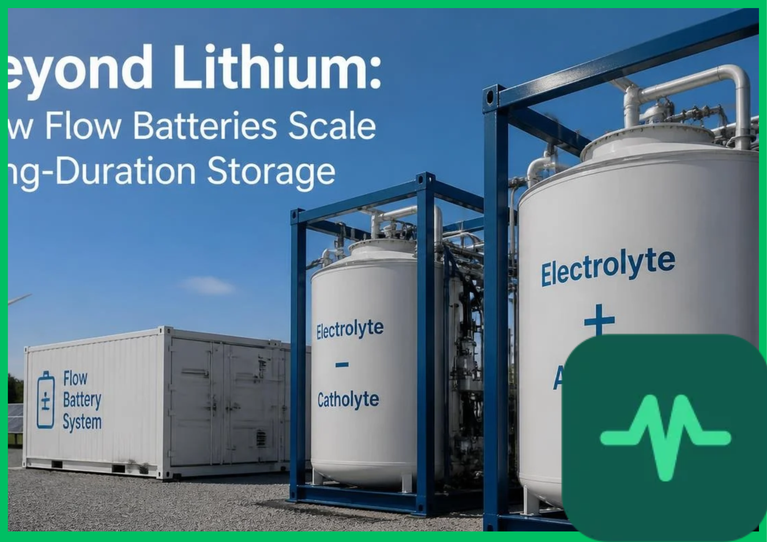
You look at a massive installation of modern energy storage containers. They sit quietly under the open sky, humming with the invisible power of clean energy.
You probably assume those containers are packed with standard lithium-ion batteries.
Lithium-ion batteries transformed our world. They power our phones, our cars, and short-term residential energy storage systems.
They have physical limits, though.
When a power grid needs to store electricity for four hours, lithium cells work brilliantly. When a renewable energy grid needs to store electricity for ten hours, a whole day, or an entire week during a calm, cloudy winter, standard lithium batteries hit a wall.
They become too expensive and too constrained by material scarcity to scale infinitely.
A quiet chemical revolution is taking place in advanced laboratories across the globe.
According to global energy tracking data from the International Energy Agency (IEA), resource assessments from the United Nations Environment Programme (UNEP), efficiency benchmarks from ENERGY STAR, and academic power systems research, flow battery energy storage systems are changing the game.
By separating energy capacity from power output, flow batteries offer a revolutionary path toward true long-duration energy storage.
Here is how flow battery chemistry works, why liquid electrolyte tanks unlock multi-day storage, and how these systems stabilize renewable power grids worldwide.
The Four-Hour Limit of Standard Batteries
To understand why flow batteries matter, you have to look at how conventional solid-state batteries are built.
In a standard lithium-ion cell, the energy storage material—the active chemicals that hold the electrical charge—is packed tightly inside the battery itself.
The power component and the energy component are permanently fused together.
If you want a lithium battery system to store twice as much energy, you have to buy twice as many entire battery blocks, complete with all their internal electrodes and separators.
That architecture makes building multi-day or seasonal energy storage financially prohibitive.
Furthermore, standard batteries degrade over thousands of charge cycles as physical chemical structures expand and crack under stress.
Power grids running entirely on wind and solar power need a storage technology that decouples power from capacity.
They need a system where storing more energy is as simple as building a bigger tank.
What Is a Flow Battery?
A flow battery takes a completely different design approach.
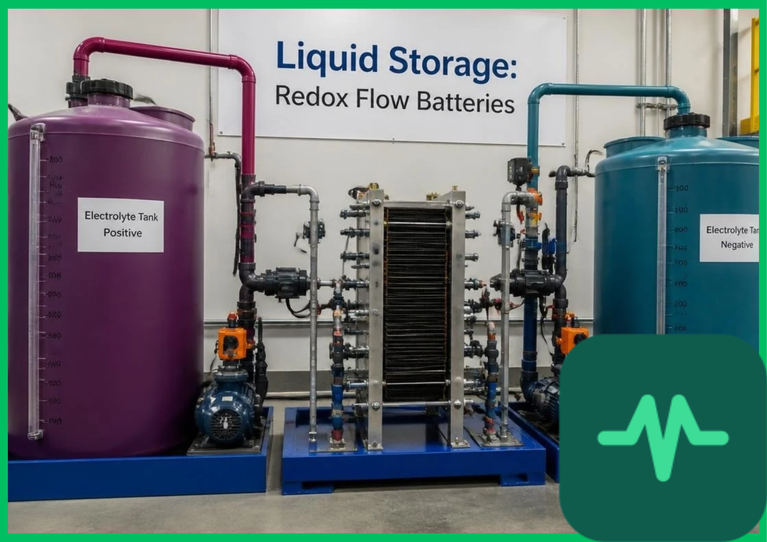
Instead of packing solid chemicals inside sealed blocks, a flow battery stores electrical energy in liquid chemical solutions pumped through an external electrochemical cell stack.
Think of it like a traditional engine connected to external fuel tanks.
The core stack contains the electrodes and membranes where the electrochemical reaction happens. That stack determines how much power—how many megawatts—the system can deliver at any given second.
The liquid electrolytes, meanwhile, are stored separately in large exterior tanks.
Those tanks determine how much energy—how many megawatt-hours—the system can hold.
If you want your flow battery system to store twice as much energy, you do not need to buy more expensive electrode stacks.
You simply pump the liquid electrolyte into a larger or additional plastic tank.
This simple architectural shift changes everything about industrial energy economics.
The Power of Vanadium Redox Flow Cells
Among various flow chemistry designs, vanadium redox flow cells stand out as the leading commercial technology.
In a vanadium flow system, both the positive and negative electrolyte solutions use dissolved vanadium ions in different oxidation states dissolved in a mild acid solution.
Because both sides of the system use the same chemical element, there is no cross-contamination degradation if ions cross the internal membrane over time.
Academic materials research shows that vanadium redox flow cells can cycle tens of thousands of times over twenty years with virtually zero capacity loss.
When energy is cheap and abundant, pumps push the liquid electrolytes through the cell stack, storing electrical energy chemically.
When the sun sets or the wind dies down, the pumps reverse the flow, releasing clean electricity back into the transmission grid.
There are no thermal runaway risks, no flammable organic solvents, and no explosive fire hazards.
The liquid inside the tanks is water-based and chemically stable.
Unlocking Long-Duration Energy Storage
The true magic of flow batteries lies in their ability to deliver true long-duration energy storage.
As wind and solar penetration climbs toward 80% to 100% on regional power grids, operators face extended weather anomalies.
Sometimes, a region experiences a multi-day lull in wind generation combined with overcast skies during a winter storm.
Short-duration four-hour batteries cannot bridge a multi-day energy gap.
Flow batteries fill that exact void.
Because scaling storage capacity only requires adding more low-cost liquid electrolyte to storage tanks, flow systems scale economically from 8 hours to 100+ hours of continuous power discharge.
According to IEA grid integration outlooks, deploying long-duration flow batteries prevents massive renewable curtailment and eliminates the need to fire up dirty fossil backup plants during prolonged weather lulls.
Scaling a Sustainable Grid Future
Flow batteries prove that human engineering can overcome the inherent limitations of conventional technology.
By separating power from capacity and utilizing abundant, recyclable liquid electrolytes, we unlock a scalable foundation for global clean energy systems.
We no longer have to worry about running out of rare minerals or watching expensive battery packs degrade under heavy daily cycling.
Through advanced chemistry, tank-based storage design, and smart grid integration, flow batteries anchor our renewable networks.
We step past the limits of lithium, securing a flexible, durable, and deeply resilient energy future for our entire planet.

Comments (0)
Login to leave a comment.
No comments yet. Be the first to share your thoughts!