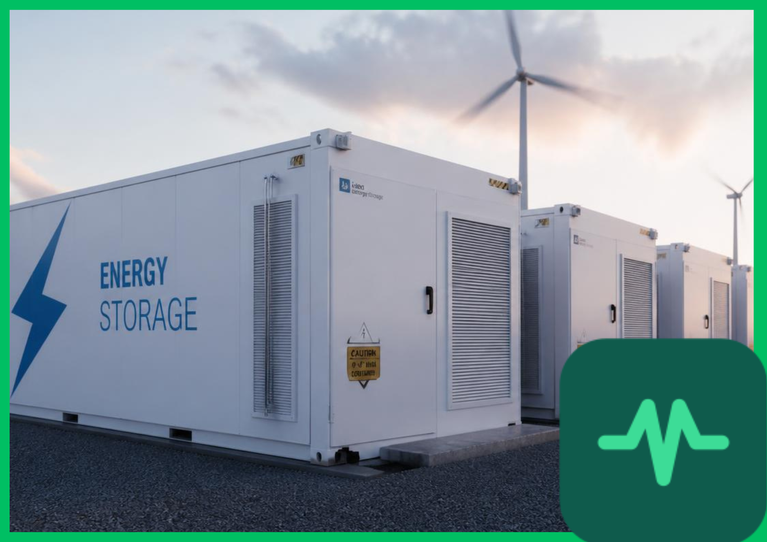
Battery energy storage has become one of the fastest-growing technologies in the electricity sector.
The IEA reports that 108 GW of new battery storage capacity was deployed worldwide in 2025. That was about 40% more than in 2024.
The growth is significant. Electricity systems are changing as solar and wind become larger sources of power.
However, renewable generation can vary. Batteries can help manage that variation.
Why Batteries Matter
The basic role of battery energy storage is simple. A battery stores electricity. Later, it releases that electricity.
This makes batteries useful when electricity production and demand do not match. For example, solar panels can produce large amounts of electricity during the afternoon.
Demand can remain high after sunset. A battery can store some solar electricity and release it later.
Utility-Scale Storage Is Growing
Most new battery energy storage capacity in 2025 was utility-scale. The IEA estimates that about 80% of new capacity was installed at the utility level. These large systems can support electricity networks.
They can respond quickly. They can also help manage renewable electricity.
Homes and Businesses Also Need Batteries
Not all storage is large. Households can install batteries alongside solar panels. Businesses can also use batteries. For a home, the system can store excess solar electricity.
For a business, it can help manage electricity demand. This creates a growing market for smaller battery energy storage systems.
China Leads Deployment
China accounted for around 60% of new global battery-storage additions in 2025. The United States and Europe followed.
However, the market is spreading. Australia and parts of the Middle East are also seeing strong growth.
This suggests that battery energy storage is becoming a global market.
LFP Batteries Are Dominating
Lithium iron phosphate batteries, commonly called LFP batteries, are becoming increasingly important.
The IEA estimates that LFP batteries accounted for around 90% of battery-storage deployments in 2025.
One reason is cost. LFP batteries are generally cheaper than some alternatives. They are also well suited to frequent charging and discharging.
Storage and Solar Are Closely Linked
The expansion of solar power is helping drive demand for battery energy storage. Solar production is concentrated during daylight. Storage can shift some of that electricity to later hours.
This can increase the value of solar generation. It can also reduce pressure on electricity networks during some periods.
Batteries Cannot Do Everything
Despite their advantages, batteries have limits. Most systems today provide electricity for a few hours. Long periods without wind or sunlight may require other solutions.
These could include pumped-storage hydropower, longer-duration storage, flexible generation and stronger regional electricity connections.
Therefore, battery energy storage should be seen as one part of a broader system.
Data Centres Are Another Driver
The growth of data centres is creating additional demand for battery systems. The IEA says battery-based UPS capacity additions reached about 45 GW in 2025, an increase of 30%.
These systems help data centres maintain power during short interruptions. That is different from grid-scale storage, but both markets are growing.
EcoGreenPulse View
The rise of battery energy storage shows that the energy transition is changing. The industry is no longer focused only on producing clean electricity.
It is also focused on managing electricity. Batteries provide flexibility. They can respond quickly. They can be installed in many locations.
That makes them useful for modern electricity systems.
Conclusion
Battery energy storage is becoming a strategic technology for the global power sector. Deployment increased sharply in 2025.
China remains the largest market, while other regions are expanding.
However, batteries will need to work alongside grids, renewable generation and other storage technologies.
The strongest electricity systems will likely use several solutions together.
Source: IEA, Global Energy Review 2026 — Technology: Battery Storage.
Comments (0)
Login to leave a comment.
No comments yet. Be the first to share your thoughts!