A few moments later, an electric car glides by in total silence.
You rarely stop to think about what is happening under the metal hood of either vehicle.
For over a century, society accepted the internal combustion engine as the ultimate way to travel. We poured liquid gasoline into tanks, ignited tiny explosions, and watched most of that precious energy turn straight into waste heat.
The math behind traditional fuel consumption is staggering.
According to transport analyses from the International Energy Agency (IEA), vehicle efficiency reports from ENERGY STAR, and academic automotive research, conventional gas-powered cars waste the vast majority of the energy stored in their fuel.
Electric cars operate on an entirely different level of physics.
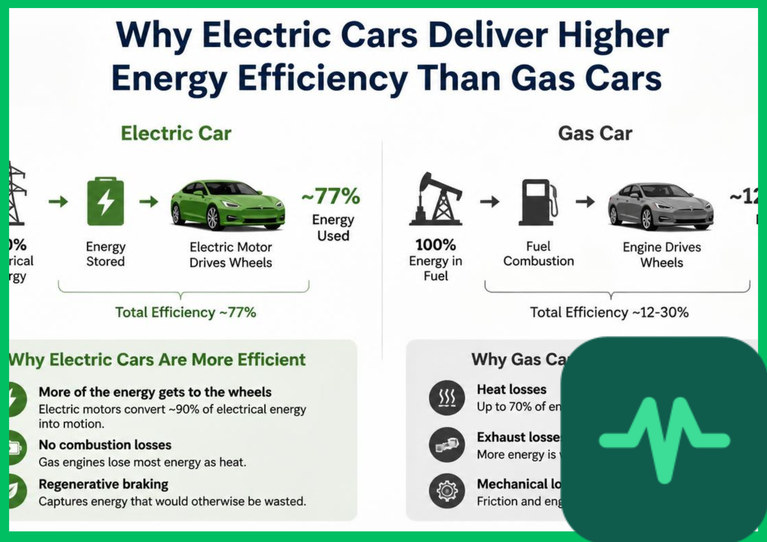
While a standard gas car converts only about 12% to 30% of the energy in gasoline into actual movement at the wheels, a battery electric vehicle converts over 80% to 90% of electrical energy into motion.
Here is how powertrain energy conversion works, why internal combustion wastes so much power, and how electric cars deliver superior efficiency on every journey.
The Hidden Waste of Internal Combustion
To understand why electric vehicles win the efficiency race, you have to look at what happens inside a traditional gasoline engine.
Gasoline holds a tremendous amount of chemical potential energy.
When you pump fuel into a car, you expect that energy to push you down the road.
Instead, a brutal thermodynamic reality takes over.
Inside a gas engine, fuel mixes with air and ignites inside metal cylinders. That explosion pushes pistons down, turning a crankshaft.
The process creates immense heat.
Because of the laws of thermodynamics, a standard combustion engine loses roughly 60% to 70% of its fuel energy immediately as waste heat radiating from the engine block and escaping out the exhaust pipe.
Furthermore, when you sit idling at a red light, a gas engine keeps burning fuel even though the car is going zero kilometers or miles per hour.
Add in the friction of hundreds of moving parts inside a complex multi-speed transmission, and the actual energy making it to the rubber tires drops to a tiny fraction of what you bought at the pump.
You are paying for fuel that mostly heats the open air.
The Elegance of Electric Powertrain Conversion
Electric cars throw out that wasteful combustion cycle entirely.
An electric vehicle relies on a remarkably simple, elegant powertrain consisting of a high-voltage battery pack, a motor controller, and an electric motor.
When you press the accelerator pedal, electricity flows straight from the battery into the motor.
Inside the motor, electric currents create rotating magnetic fields that spin the rotor.
There are no liquid explosions, no exhaust valves, and very few moving parts.
Because electric motors convert electrical energy directly into mechanical rotation using electromagnetism, they operate at peak efficiency.
According to academic powertrain research, electric motors routinely achieve conversion efficiencies exceeding 90%.
When your car is stopped at a traffic light, the electric motor draws zero power. There is no idling waste. Every joule of energy stored in the battery goes toward moving the car forward.
Capturing Momentum Through Regenerative Braking
Electric cars hold another massive efficiency advantage that gas vehicles cannot match: regenerative braking.
When you drive a conventional car and step on the brake pedal, friction pads clamp down on metal rotors.
That physical friction slows the car down, turning all your forward momentum into wasted heat energy.
Electric cars use regenerative braking to reverse that process.
When you lift your foot off the accelerator, the electric motor reverses its operation. It acts as a generator, using the car's forward momentum to spin its internal rotor against a magnetic resistance.
That magnetic drag slows the vehicle down smoothly while converting kinetic energy back into electricity.
That recovered power flows right back down the wires to recharge the battery pack.
In stop-and-go city traffic, regenerative braking recovers a significant portion of energy that would otherwise be lost forever, pushing overall vehicle efficiency even higher.
The Broader Energy Picture
Critics sometimes argue that electricity generation involves losses at power plants.
Even when factoring in the entire fuel cycle—from energy generation to transmission and charging—comprehensive well-to-wheel studies by the IEA prove that electric vehicles consume significantly less primary energy per kilometer traveled than internal combustion cars.
As global power grids incorporate more renewable wind, solar, and hydroelectric generation, the upstream energy cost of driving electric drops closer to zero.
A gas car can never clean up its tailpipe. Its thermodynamic ceiling is fixed by the physics of burning oil.
Electric vehicles improve continuously alongside the grid that powers them.
Driving Into an Efficient Future
Transitioning away from combustion engines is not just about cutting tailpipe emissions; it is about embracing basic efficiency.
Why burn three units of energy to move a car one unit of distance when you can use electricity directly with minimal waste?
By harnessing clean electromagnetic conversion and capturing kinetic energy through regenerative braking, electric cars transform how we use power on the road.
We are moving away from wasteful explosions and stepping into a smart, streamlined future of transport.
Every efficient journey brings us closer to a truly sustainable global economy.

Comments (0)
Login to leave a comment.
No comments yet. Be the first to share your thoughts!