Rain pours down outside, splashing against your windshield.
You shift into park, unbuckle your seatbelt, and reach for the heavy, mud-splattered charging cable hanging on the wall.
You step out into the wet puddle, drag the thick cable across the clean paint of your car, and push the plug firmly into the charging port.
It is a routine millions of drivers perform every single night.
It is also a chore. Cables get stiff in freezing weather. They get heavy and clumsy. Sometimes you forget to plug in, waking up to a low battery on a morning when you need to travel far.
For over a century, electric power has required a physical connection. We plug lamps into walls, appliances into outlets, and cars into chargers.
What if you could completely cut the cord?
Imagine stepping out of your car, walking into your house, and letting your vehicle charge automatically, invisibly, and effortlessly.
A quiet, magical technological shift is happening beneath our tires.
According to global clean transport reports from the International Energy Agency (IEA), resource protection frameworks from the United Nations Environment Programme (UNEP), appliance efficiency standards from ENERGY STAR, and academic power electronics research, wireless inductive EV charging technology is changing how we refuel.
By using magnetic fields to transfer electricity across empty air, we are stepping into a frictionless world of contactless energy.
Here is how inductive charging works, why pad-based systems transform daily convenience, and how dynamic roadway power transfer secures our sustainable future.
The Friction of Physical Cables
To understand why wireless charging feels so revolutionary, you have to look at the minor frustrations of plug-in electric vehicle ownership.
Cables are clumsy. They live on garage floors where they pick up dirt, motor oil, and grit.
When you coil a cold cable in winter, it fights back like a stiff frozen snake.
For drivers with physical mobility challenges, bending down to lift heavy copper-core cables and push them into tight vehicle sockets is a painful daily hurdle.
Furthermore, outdoor public chargers face constant abuse. Vandals damage plugs, weather corrodes metal pins, and moisture shorts out exposed connections.
We accepted these physical headaches because we assumed electricity could only travel through copper wire.
Physics proved that assumption wrong over a century ago.
Nikola Tesla dreamed of transmitting energy through the air without wires. Today, modern power electronics finally turn that dream into practical reality for everyday drivers.
What Is Wireless Inductive EV Charging Technology?
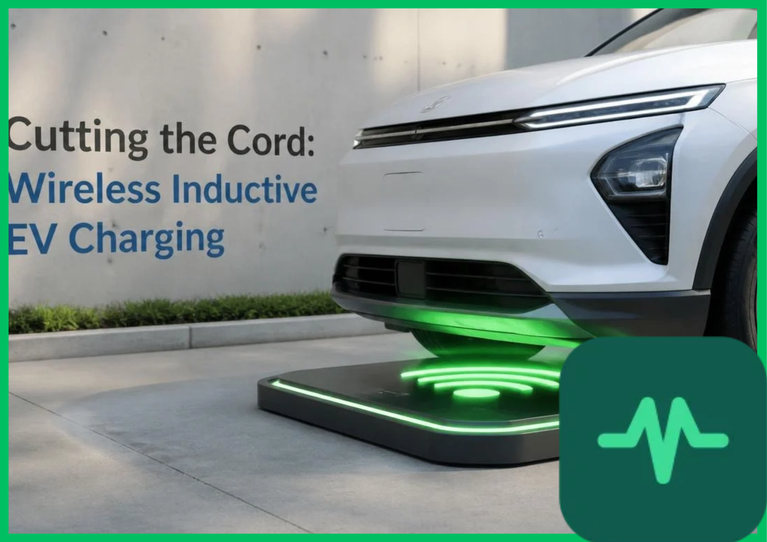
Wireless inductive EV charging technology uses invisible magnetic fields to transfer electricity from a flat charging pad on the ground straight to a receiver pad mounted underneath your car.
There are no plugs. There are no metal pins. There are no cables to touch.
You simply drive your car forward into your garage or parking space, aligning your vehicle over the ground pad.
An indicator light on your dashboard flashes green.
Electricity begins flowing instantly across the air gap between the ground and the bottom of your car.
The system relies on two main components:
- The Transmitting Pad: A flat, durable pad embedded in the ground or laid flat on your garage floor, connected to your home electrical grid. Inside lies a coiled copper wire loop that generates a high-frequency magnetic field.
- The Receiving Pad: A matching coil mounted securely beneath the chassis of your electric vehicle. When parked within 10 centimeters to 20 centimeters (approx. 4 inches to 8 inches) of the ground pad, the receiver captures the magnetic waves and converts them back into electrical current to charge your battery pack.
You park, walk away, and your car fills up with clean power automatically.
The Science of Contactless Power Transfer
How can electricity jump across an empty space of air without shocking everything nearby?
It comes down to the principles of electromagnetic induction and resonant frequency matching.
When alternating electrical current passes through the copper coil in the ground pad, it creates a rapidly fluctuating magnetic field.
Unless a matching receiver is tuned to the exact same resonant frequency, that magnetic field passes through the air harmlessly, interacting with nothing.
When your car parks overhead, the receiver coil on the vehicle matches that specific frequency.
Resonance locks on. Energy transfers smoothly from the ground coil to the car coil with incredible precision.
Academic power electronics research shows that modern inductive systems achieve energy transfer efficiencies exceeding 90% to 93%, matching the efficiency of traditional plug-in chargers while eliminating physical wear and tear.
Furthermore, safety sensors scan the air gap continuously. If a stray leaf, a piece of metal debris, or a curious pet wanders between the pads, the system pauses instantly, ensuring absolute safety.
Dynamic Roadway Power Transfer: Charging While Driving
Pad-based home charging is only the first chapter of the wireless story.
The ultimate horizon of contactless energy is dynamic roadway power transfer.
Imagine driving your electric vehicle down a modern highway at 100 kilometers per hour (approx. 60 miles per hour) while your battery charges continuously from magnetic coils embedded right beneath the asphalt.
Instead of carrying a massive, heavy 500-kilogram (approx. 1,100-pound) battery pack just to achieve long driving range, your car carries a smaller, lighter battery.
You pick up charge as you drive along equipped highway lanes.
Academic engineering studies show that dynamic roadway charging eliminates range anxiety entirely, because your car never runs out of fuel while moving.
According to UNEP resource efficiency frameworks, shrinking average EV battery sizes through roadway charging reduces heavy raw material mining demands across the globe.
IEA clean mobility roadmaps highlight that test tracks in several nations are already evaluating high-speed inductive lanes for commercial buses and freight trucks.
Energy Efficiency and Environmental Integration
Skeptics often worry that wireless power transfer wastes electricity through invisible leakage.
According to ENERGY STAR and international appliance efficiency evaluations, modern shielding technology confines magnetic fields tightly between the pads, ensuring stray emissions remain far below strict international safety limits.
When paired with smart home systems, wireless chargers coordinate with off-peak electricity schedules and rooftop solar arrays automatically.
You park your car in the evening, and the wireless pad waits for clean overnight wind power before initiating energy transfer.
You get the convenience of effortless parking combined with the financial savings of smart grid optimization.
Cutting the Cord Toward a Sustainable Future
Wireless inductive EV charging technology proves that our transition to clean transport is evolving toward absolute simplicity and elegance.
We no longer have to accept the physical friction of tangled cables, muddy ground plugs, and manual routines.
By harnessing magnetic resonance, contactless power transfer, and embedded roadway charging, we transform how we interact with energy.
We step away from clumsy wires, embracing an invisible, seamless, and intuitive standard of living.
Through brilliant electrical engineering, smart design, and deep respect for our environment, cutting the cord secures a clean, effortless, and sustainable future for our world.


Comments (0)
Login to leave a comment.
No comments yet. Be the first to share your thoughts!