You unplug your electric vehicle, climb inside, and check the dashboard display.
The range indicator glows brightly, promising over 800 kilometers or 500 miles of driving distance on a single charge.
You tap the fast-charger route on your navigation screen and smile.
Today, that scenario feels like a distant dream of the far future.
Most electric vehicles on the road rely on standard lithium-ion batteries. Those batteries are good, but they carry frustrating limits.
They take thirty minutes to recharge on a fast charger. They grow sluggish in freezing winter weather. Most importantly, they carry a tiny risk of thermal runaway if damaged—a polite engineering term for catching fire.
We love the clean air and instant torque of electric driving.
We still carry range anxiety in the back of our minds.
What if everything we know about electric vehicle power is about to change?
A quiet, brilliant revolution is unfolding inside materials science laboratories across the globe.
According to global clean transport reports from the International Energy Agency (IEA), resource governance frameworks from the United Nations Environment Programme (UNEP), efficiency benchmarks from ENERGY STAR, and academic electrochemistry research, solid-state EV batteries are transforming the horizon of personal transport.
By replacing flammable liquid electrolytes with stable solid materials, we are stepping into a new era of safety, speed, and endurance.
Here is how solid-state technology works, why removing liquid changes the physics of energy, and how next-generation chemistry secures our sustainable future.
The Flawed Liquid Inside Traditional Batteries
To understand why solid-state batteries matter so much, you have to look inside a conventional lithium-ion cell.
If you cut open a standard EV battery cell today, you will find two solid electrodes separated by a porous plastic sheet.
That sheet is soaked in a liquid organic solvent mixed with lithium salts.
That liquid acts as an invisible highway. It allows lithium ions to rush back and forth between the electrodes when you charge and discharge the battery.
That liquid highway works wonderfully, but it carries deep flaws.
Liquid organic solvents are volatile and flammable.
If a battery is punctured in an accident, overheated by a short circuit, or overcharged too quickly, that liquid can ignite.
That vulnerability forces manufacturers to pack heavy steel casings, liquid cooling channels, and complex safety sensors around the battery pack.
Those safety systems add massive weight to the car, stealing precious energy just to move the battery itself.
Worse still, traditional liquid cells hit a chemical plateau.
They cannot pack any more energy into their volume without risking instability.
We needed a completely new way to move ions safely.
What Is a Solid-State EV Battery?
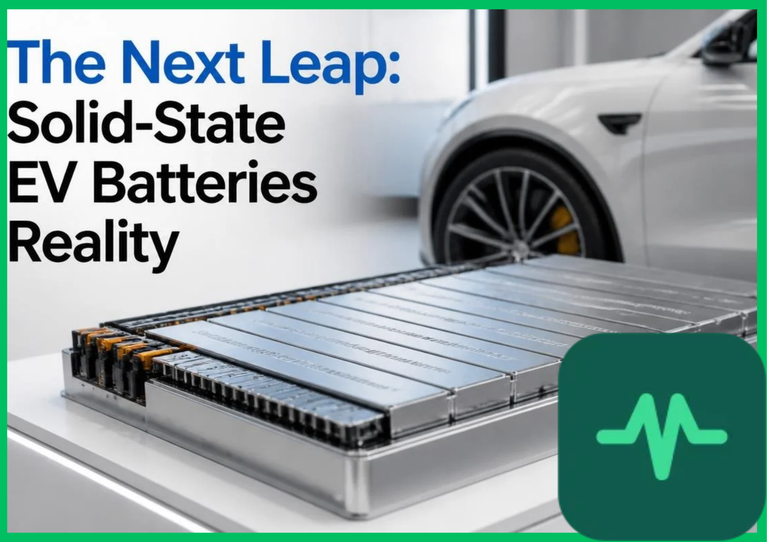
A solid-state EV battery is an advanced energy storage cell that replaces the flammable liquid electrolyte of traditional batteries with a solid material—such as special ceramics, glass, or solid polymers.
Instead of swimming through a wet chemical soup, lithium ions slide directly through a solid crystal lattice.
That single change alters the entire architecture of energy storage.
Without flammable liquids inside, the fire hazard drops to nearly zero.
Without the risk of internal short circuits caused by liquid boiling, engineers can pack solid-state cells much tighter together.
Furthermore, solid-state cells allow the use of pure lithium metal anodes.
That upgrade supercharges energy density.
A solid-state battery can pack twice as much energy into the exact same physical space and weight as a traditional liquid lithium-ion pack.
The Science of High Energy Density and Fast Charging
How does a solid structure unlock such dramatic performance leaps?
It comes down to atomic-level resistance and voltage stability.
Academic electrochemistry research shows that solid electrolytes resist the formation of microscopic metal needles called dendrites.
In traditional liquid batteries, dendrites grow slowly over hundreds of charge cycles, eventually piercing the separator sheet and causing short circuits.
Solid-state materials block those dendrites physically.
Because solid electrolytes handle high voltage without breaking down, electricity can flood into the battery at blistering speeds.
Imagine plugging your car in, walking away to grab a cup of coffee, and returning ten minutes later to a completely full battery that delivers 800 kilometers or 500 miles of range.
According to ENERGY STAR and international appliance efficiency evaluations, faster charging and higher energy density eliminate the dead weight that drains vehicle efficiency.
You carry less battery mass, use fewer raw materials, and travel twice as far.
Overcoming Manufacturing Hurdles and Material Realities
If solid-state batteries are so revolutionary, why aren't they powering every new car on showroom floors today?
The answer lies in the brutal realities of industrial manufacturing.
Making solid ceramic electrolyte layers that are paper-thin, completely free of microscopic cracks, and cheap to produce at scale is one of the hardest engineering challenges of our time.
Ceramic materials are brittle. When a battery charges and discharges, the electrodes expand and contract slightly.
In a liquid battery, the liquid absorbs that shifting movement. In a solid battery, constant expansion can crack the brittle solid electrolyte, destroying the cell.
Material scientists spend years developing flexible solid polymers and elastic ceramic composites that breathe with the battery.
According to IEA clean transport roadmaps, pilot production lines are scaling up rapidly across multiple continents, bringing commercial automotive integration closer every day.
UNEP resource circularity frameworks highlight that solid-state packs will use fewer critical minerals per kilowatt-hour, making battery supply chains cleaner and easier to recycle at end-of-life.
Driving Toward a Solid-State Future
Solid-state EV batteries prove that human ingenuity continues to push clean technology past its perceived limits.
We no longer have to accept that driving an electric vehicle requires compromises in range, charging speed, or safety.
By replacing volatile liquid solvents with stable solid electrolytes, we unlock twice the energy density, lightning-fast charging speeds, and absolute peace of mind.
We step away from old chemical limits, embracing a safer, lighter, and more powerful standard of electric mobility.
Through brilliant electrochemical research, advanced material manufacturing, and steadfast dedication to sustainability, solid-state batteries power our next great leap forward.

Comments (0)
Login to leave a comment.
No comments yet. Be the first to share your thoughts!