If your phone is two or three years old, you already know the frustrating truth. The charge drains fast. You have to plug it into the wall constantly just to make it through the afternoon.
When people think about buying an electric car, that phone battery worry sits right at the front of their minds.
A common myth whispers through online forums and casual conversations. People claim that electric vehicle batteries wear out rapidly, forcing car owners to buy expensive replacements just a few years down the road.
That fear stops many people from making the switch to clean transport.
It is time to separate automotive myth from scientific reality.
According to large-scale fleet tracking data, vehicle health reports from the International Energy Agency (IEA), and academic battery research, modern electric car batteries last far longer than most people ever imagined.
Here is what real-world data reveals about battery longevity, how thermal management protects cell chemistry, and why your car's battery will likely outlive the vehicle itself.
The Smartphone Battery Misconception
To understand why the "fast degradation" myth persists, you have to look at consumer electronics.
Your smartphone battery lives a brutal life. It is tiny, exposed to constant pocket heat, and cycles from zero to 100 percent charge nearly every single day.
Cell phones are built for compact convenience, not long-term chemical preservation.
An electric car battery is an entirely different animal.
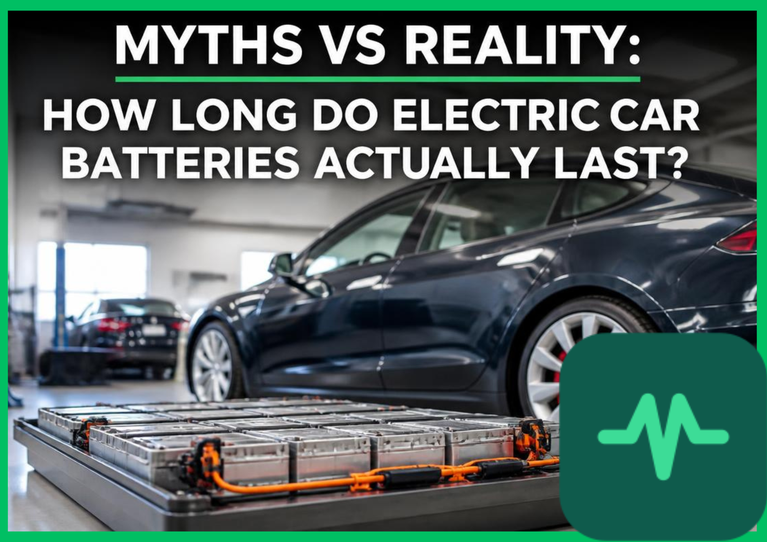
High-voltage EV battery packs are massive assemblies composed of hundreds or thousands of individual lithium-ion cells. Crucially, they do not operate unprotected.
Advanced liquid cooling systems, smart battery management software, and built-in capacity buffers shield the cells from extreme stress.
The battery management system never lets the pack truly drain to zero or charge to a raw 100% maximum, protecting the internal chemistry from accelerated wear.
What Real-World Fleet Data Actually Shows
We do not have to guess how well electric car batteries hold up over time. Real-world data gives us a clear picture.
Extensive fleet studies analyzing tens of thousands of electric vehicles across diverse operating conditions reveal an average battery capacity degradation rate of roughly 2.3% per year.
Let that number sink in.
If an electric car leaves the factory with a driving range of 480 kilometers (approx. 300 miles) on a single charge, losing just over 2% of capacity annually means the car still retains roughly 80% to 90% of its original range after nearly a decade of regular driving.
Academic longevity studies and field evaluations confirm that even after vehicles travel 160,000 kilometers (approx. 100,000 miles) or more, most battery packs retain between 88% and 95% of their initial capacity.
The mechanical components of a car—suspension systems, brakes, and electrical accessories—frequently require maintenance or replacement long before the battery pack fails.
The Role of Thermal Management and Smart Software
Why do modern EV batteries age so gracefully? The answer lies in engineering and thermal management.
Inside a modern electric car, active liquid cooling circuits circulate fluid around the battery modules, keeping internal temperatures stable whether you are driving fast on a scorching summer afternoon or charging rapidly at a highway station.
Furthermore, academic materials research highlights how smart battery management software continuously monitors cell health.
By balancing electrical loads evenly across every cell group, the software prevents localized strain and slows down natural chemical aging.
Manufacturers are so confident in these protective systems that industry-standard warranties guarantee battery capacity will remain at or above 70% for at least 8 years or 160,000 kilometers (approx. 100,000 miles).
In practice, data shows that most packs perform well above those warranty thresholds long after the coverage period ends.
Outliving the Vehicle
When you look past the myths and examine empirical data, the narrative shifts completely.
Electric car batteries do not degrade into sudden obsolescence. They age slowly, predictably, and gracefully.
By the time an EV battery finally reaches a point where its reduced range no longer suits long-distance driving, the rest of the car has typically completed its active lifecycle.
Even then, retired EV batteries find a valuable second life. They are repurposed for stationary energy storage, buffering solar and wind power in residential and commercial buildings before heading to closed-loop recycling facilities.
We can let go of the battery anxiety.
Modern engineering and rigorous science ensure that electric vehicle power sources are built to endure, supporting a durable, sustainable future for global transport.

Comments (0)
Login to leave a comment.
No comments yet. Be the first to share your thoughts!