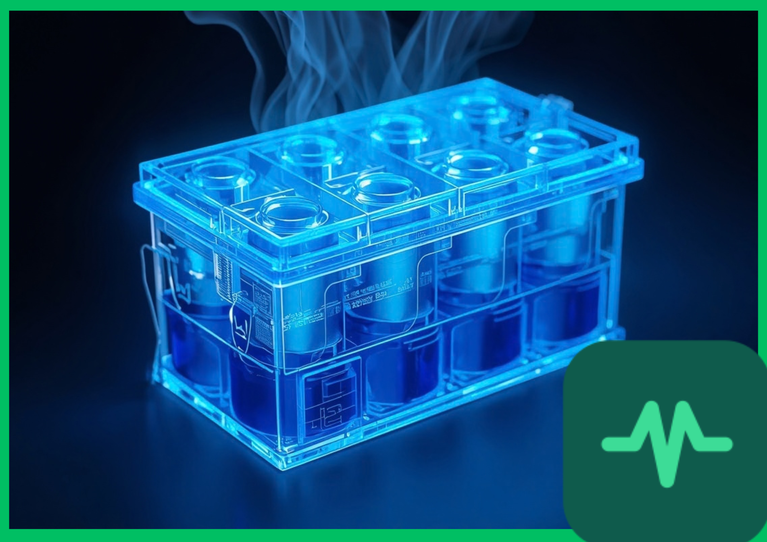
The ambient temperature outside is 35 degrees Celsius (95 degrees Fahrenheit).
Electricity surges into your car's battery pack at a massive rate. Inside those lithium-ion cells, millions of ions rush back and forth.
That rapid energy transfer generates intense internal heat.
If that heat is allowed to build unchecked, it will damage the battery cells permanently, degrade your driving range, and trigger emergency safety shutdowns.
Yet, your car charges safely, keeping temperatures tightly regulated.
How does it pull that off?
Behind the floorboards of every modern electric vehicle lies a sophisticated engineering marvel: the EV battery thermal management system.
Here is how advanced liquid cooling loops protect your car's battery health and enable blazing-fast charging speeds.
The Enemy of Lithium-Ion Batteries: Extreme Heat and Cold
Lithium-ion batteries are a lot like humans: they perform best at comfortable room temperatures.
If a battery gets too hot, its chemical reactions accelerate too quickly, causing permanent capacity degradation, faster aging, and in extreme cases, thermal runaway.
If a battery gets too freezing cold, internal electrical resistance spikes, chemical mobility grinds to a halt, and the battery refuses to accept charge or deliver power efficiently.
Managing temperature is the single most important factor in determining an electric vehicle's battery lifespan, daily driving range, and charging performance.
Relying on passive air cooling—like early electric cars did—fails completely during extreme summer heatwaves or freezing winter road trips.
Modern EVs require active, precision thermal management.
How Liquid Cooling Loops Work
The gold standard in modern electric vehicle engineering is the active liquid cooling loop.
Woven tightly between the individual battery cells inside the sealed battery pack are intricate networks of aluminum cooling channels.
A specialized coolant—typically a mixture of water and glycol—circulates continuously through these channels, pumped by an electric water pump.
When you drive hard or fast-charge your vehicle, sensors detect rising cell temperatures. The cooling pump ramps up, pushing the warm coolant away from the battery pack to a front radiator or an integrated heat exchanger.
There, the heat is dissipated safely into the outside air.
In freezing weather, that exact same liquid loop reverses its role, using a specialized electric heater or heat pump system to warm the battery up to its ideal operating temperature before you start driving or fast charging.
Thermal Management and Fast Charging Curves
Understanding thermal management explains why fast charging speeds change over the course of a charging session.
When you pull up to a fast charger with a cold battery in winter, your car's thermal management system steps in immediately.
Instead of accepting high-voltage power right away, the car routes energy into heating the battery pack up to roughly 25 degrees Celsius (77 degrees Fahrenheit).
Only once the optimal temperature is reached does the car unlock maximum charging speed.
Conversely, during a long summer road trip, if consecutive fast-charging stops begin heating the battery pack past safe thresholds, the thermal management system automatically throttles charging speeds downward to let the liquid cooling loop dissipate the heat.
The Unsung Hero of Electric Mobility
Drivers rarely think about battery thermal management systems. They sit hidden beneath floor panels, silently humming away in the background.
Yet, they are the unsung heroes of the electric vehicle revolution.
By keeping battery cells within a tight, optimal temperature window through freezing winters and scorching summers, thermal management guarantees long battery life, reliable range, and safe, rapid charging every single day.

Comments (0)
Login to leave a comment.
No comments yet. Be the first to share your thoughts!