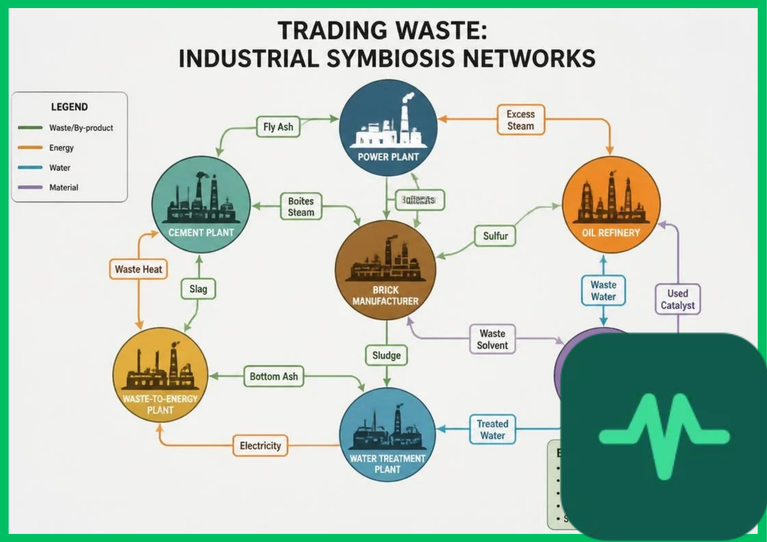
Trading Waste: The Thermodynamics and Economics of Industrial Symbiosis Networks
Within classical industrial paradigms, manufacturing facilities operate as isolated linear entities. This "take-make-dispose" framework extracts raw feedstocks, consumes primary energy, and discards lower-grade byproducts, high-volume wastewater streams, and low-grade thermal energy directly into regional environments.
Industrial Symbiosis represents a structural pivot toward industrial ecology. By establishing collaborative commercial networks among geographically clustered manufacturing plants, the outputs of one process serve as the direct inputs for another. This inter-firm resource trading transforms structural industrial liabilities into low-cost secondary raw materials. It drastically reduces primary resource extraction, minimizes localized wastewater loading, and lowers overall carbon emissions.
The Thermodynamic Inefficiency of Isolated Manufacturing
The operational limitations of unlinked industrial clusters can be analyzed through exergy destruction and material degradation. Under isolated configurations, a chemical refinery or a thermal power station might vent high volumes of flue gas at temperatures under 200°C simply because it lacks an internal application for low-grade heat. Concurrently, an adjacent agricultural greenhouse or a municipal aquaculture facility consumes fossil fuels to run boiler systems to maintain a stable 30°C baseline.
This thermal and material mismatch wastes billions of kilowatt-hours of kinetic energy globally while driving up operational expenditure (OpEx) for individual businesses. Early skeptics argued that the varying quality, chemical purity, and supply reliability of industrial byproducts made cross-company supply chains economically unfeasible. However, data from mature eco-industrial clusters reveals that integrating localized pipelines and processing loops yields high resource efficiency and significant cost savings.
The Core Resource Exchanges of an Eco-Industrial Network
Successful industrial symbiosis structures focus on three primary resource vectors:
Exergy and Thermal Cascading
Mechanics: High-temperature steam generated by heavy utility infrastructure is utilized sequentially. High-grade heat (above 500°C) powers primary industrial turbines; medium-grade exhaust steam (200°C–400°C) is piped to adjacent manufacturing plants for chemical processing; low-grade thermal water (under 100°C) is routed through district heating networks or commercial aquaculture facilities.
Inorganic Byproduct Co-Processing
Mechanics: Solid metallurgical and chemical byproducts are repurposed as high-purity construction minerals. Blast furnace slag and fly ash from steel mills displace virgin limestone aggregates in cement manufacturing. Concurrently, calcium sulfate (synthetic gypsum) derived from desulfurizing gas refinery emissions is captured and routed directly to drywall production lines.
Industrial Water Cascading
Mechanics: Instead of discharging industrial effluent immediately to municipal treatment facilities, water loops are cascaded through diminishing purity levels. High-quality treated output from food or beverage processing lines is captured and re-used as cooling water in heavy mechanical metal fabrication setups.
The Kalundborg Benchmark: Quantitative Material Flow Reductions
The primary validation for scaling integrated eco-parks stems from the world’s pioneer symbiosis network in Kalundborg, Denmark. Within this system, a public power station, an oil refinery, a plasterboard factory, an enzyme production plant, and municipal utilities share over 30 distinct material and energy streams.
According to industrial efficiency data tracked by the International Energy Agency (IEA), cascading waste streams within a structured eco-industrial network can yield a 20% to 30% reduction in total primary energy demand across all participating facilities. At Kalundborg, this continuous looping prevents the consumption of roughly 45,000 tons of oil and 2.5 million cubic meters of groundwater annually. This demonstrates that co-location effectively insulates industrial zones from volatile resource scarcity and escalating utility costs.
Overcoming Regulatory Red Tape and Logistical Boundaries
Transitioning from isolated manufacturing zones to highly collaborative industrial networks requires addressing entrenched logistical and legal hurdles.
The primary systemic barriers include:
Proximity Logistics: Connecting existing factories with extensive water, gas, or steam distribution networks demands significant initial capital expenditure (CapEx) if the facilities were not intentionally zoned near one another.
Hazardous Waste Legislation: International resource governance frameworks under the United Nations Environment Programme (UNEP) note that rigid environmental laws often classify harmless industrial byproducts broadly as toxic waste. This legal designation creates heavy administrative compliance burdens for companies attempting to trade materials across corporate boundaries.
To streamline these networks, industrial planners are establishing specialized digital byproduct marketplaces. These software platforms leverage automated algorithms to audit regional factory inputs and outputs, matching surplus thermal or material assets with local entities that require them. Simultaneously, updated municipal zoning codes are incentivizing the development of pre-engineered eco-industrial parks that feature ready-made pipe layouts and shared water filtration grids.
The Future of Regenerative Manufacturing
Industrial symbiosis networks demonstrate that manufacturing can operate in harmony with planetary boundaries. By mimicking natural ecological cycles, where the metabolic waste of one organism sustains another, industrial symbiosis shifts heavy commerce away from volatile linear economics. As advanced modeling tools simplify the configuration of complex material-exchange loops, closed-loop industrial ecosystems will evolve into a foundational requirement for sustainable global manufacturing.




Comments (0)
Login to leave a comment.
No comments yet. Be the first to share your thoughts!