That trash truck comes and takes it away to a landfill.
Out of sight, out of mind.
For generations, industrial manufacturing has followed a straight line: extract raw minerals from the earth, assemble them into products, sell them to consumers, and discard them when they break.
That linear extract-and-discard model is rapidly reaching its physical limits. Earth has finite resources, and our landfills are overflowing.
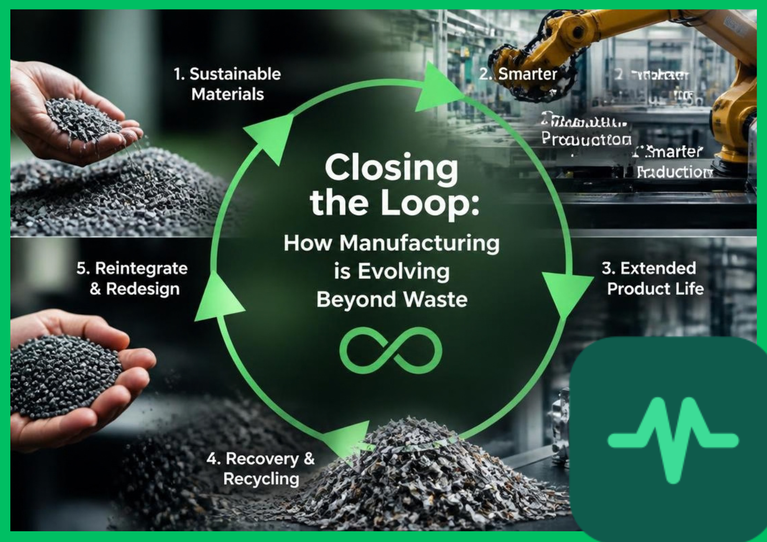
A profound transformation is sweeping across global industries. By adopting closed-loop manufacturing principles, forward-thinking companies are eliminating industrial waste and redesigning production from the ground up.
The Flaw in the Linear Industrial Model
To understand the power of circular production, you have to look closely at the traditional industrial system.
Traditional factories take raw materials, consume massive amounts of energy to process them, and pump out finished goods.
At every single step of that process, waste is generated. Scraps are discarded, chemicals are vented, and energy is lost.
When the final consumer finishes using the product, the entire item—containing valuable metals, complex plastics, and rare minerals—goes straight into the trash.
This linear flow ignores basic physics. We cannot mine virgin earth forever to fuel disposable consumer habits.
Resource scarcity and rising raw material costs are forcing manufacturers to rethink how products are made.
What Is Closed-Loop Manufacturing?
A closed-loop manufacturing system mimics nature.
In a natural forest, there is no such thing as waste. A fallen leaf decays, providing rich nutrients that nourish the soil and feed new plant growth. Everything is reused in an endless cycle.
Closed-loop manufacturing applies that exact principle to human industry.
Instead of throwing away old products, factories design them from the start to be disassembled, sorted, and remanufactured into brand-new goods.
Old components become raw materials. Waste streams from one industrial process become the fuel for another.
Nothing is lost, and nothing goes to a landfill.
Redesigning Products for Disassembly
Achieving a true circular economy requires rethinking product design on the drawing board.
For decades, manufacturers glued, welded, and sealed products shut to make them cheap to assemble and impossible for consumers to open.
Closed-loop design flips that philosophy.
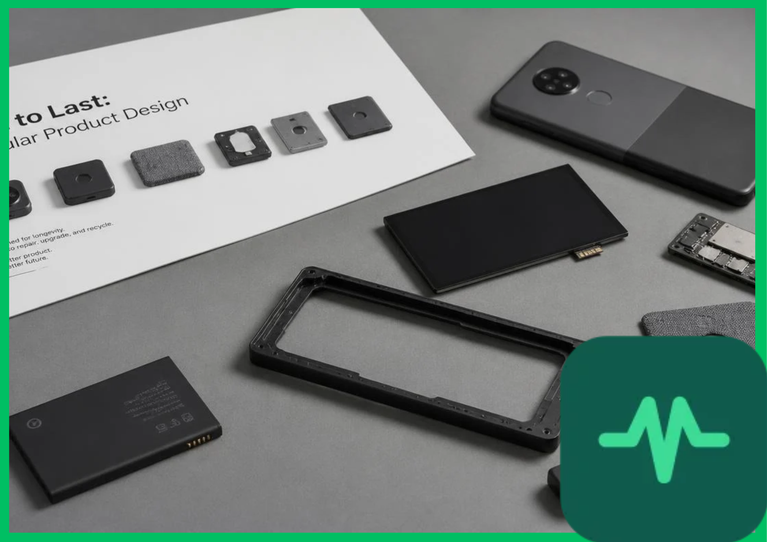
Engineers now use standard fasteners, modular snap-fit connections, and easily separable materials. They choose polymers and metals that can be melted down and reformed repeatedly without losing their structural integrity.
When a washing machine, smartphone, or electric motor reaches the end of its working life, workers can take it apart in minutes.
Every screw, circuit board, and plastic housing is sorted and sent back into the supply chain to build the next generation of products.
The Economic and Environmental Rewards
Transitioning to closed-loop manufacturing is not just an environmental ideal. It is a brilliant economic strategy.
When companies own or recover their materials, they stop relying on volatile global markets for virgin mineral extraction.
They insulate themselves from supply chain shocks, lower their production costs significantly, and drastically shrink their industrial carbon footprint.
Consumers also benefit through durable, repairable products designed to last for decades rather than seasons.
Building a World Without Waste
We are standing at the threshold of a new industrial revolution.
The era of disposable manufacturing is coming to an end. By embracing closed-loop production, we can build a thriving global economy that respects planetary limits.
Waste is simply a design flaw. When we redesign our products to live forever in a continuous loop, we build a future that works for everyone.



Comments (0)
Login to leave a comment.
No comments yet. Be the first to share your thoughts!