
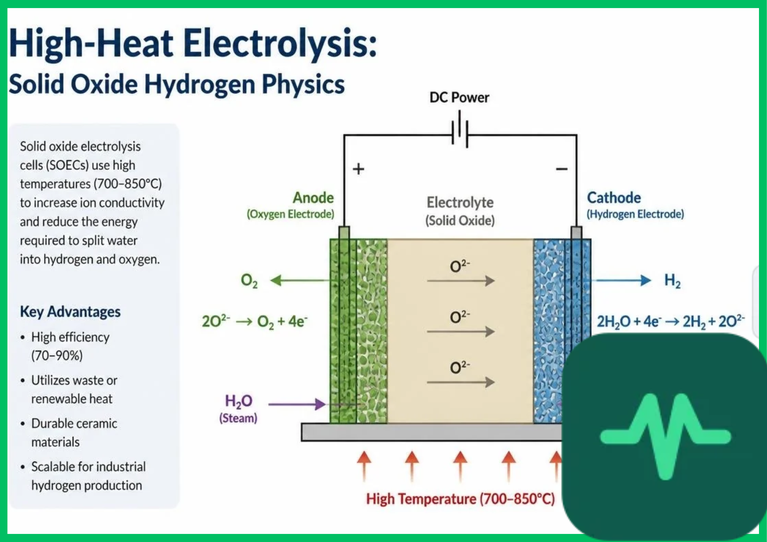
 to
 (
 to
 )—rely predominantly on electrical energy to split liquid water, typically requiring roughly
 at stack or system scales. A solid oxide electrolyzer high-temperature steam electrolysis system operates at elevated temperatures (
 to
 [
 to
 ]) using vaporized steam rather than liquid water, shifting part of the total splitting enthalpy from electrical work to thermal heat and achieving electrical efficiencies above
 to
 (lower heating value basis) when paired with high-temperature heat. Evaluating yttria-stabilized zirconia electrolyte transport, high-temperature steam thermodynamics, thermal integration waste heat, and reversible solid oxide cells is essential for analyzing solid oxide hydrogen physics.
Steam Thermodynamics and High-Temperature Electrolysis Physics
Splitting water (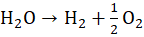 ) requires a total enthalpy change (
 ) divided between electrical work (Gibbs free energy,
 ) and thermal energy (
 , where
 is absolute temperature in kelvin and
 is reaction entropy change):

As temperature rises from ambient conditions toward  to
 (
 to
 ), entropy (
 ) increases while Gibbs free energy (
 ) decreases—especially once water vaporizes into steam, eliminating the latent heat of vaporization from the electrical requirement.
Lower Gibbs free energy reduces the reversible cell voltage (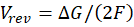 , where
 is Faraday's constant,
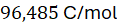 ), dropping from roughly
 at
 (
 ) to below
 at
 (
 ). Simultaneously, higher operating temperatures accelerate electrode reaction kinetics and lower ohmic resistance across ceramic layers, reducing overpotentials and enabling high current densities without noble-metal iridium or platinum catalysts.
Yttria-Stabilized Zirconia Electrolyte and Cell Architecture
A solid oxide electrolysis cell (SOEC) uses a dense ceramic ion conductor rather than a liquid alkaline bath or polymer membrane. Yttria-stabilized zirconia ( , zirconium dioxide doped with roughly
 yttrium oxide,
 ) or doped ceria (
 ) is a standard oxygen-ion (
 ) conducting solid electrolyte. Doping
 with trivalent
 creates oxygen vacancies in the fluorite crystal lattice to preserve charge neutrality, allowing
 ions to hop thermally across vacancies at high temperatures.
In a typical planar or tubular SOEC architecture:
- Fuel Electrode (Cathode): Porous nickel-YSZ (
 ) cermet reduces steam (
 ), delivering hydrogen mixed with unreacted steam that is subsequently condensed and dried.
- Electrolyte: Dense gas-tight
 conducts
 ions from the fuel electrode to the oxygen electrode while blocking electronic conduction and gas crossover.
- Oxygen Electrode (Anode): Mixed ionic-electronic conducting perovskite oxides—such as lanthanum strontium manganite (
 ) or lanthanum strontium cobalt ferrite (
 )—oxidize oxygen ions into molecular oxygen (
 ).
Ionic conductivity in  rises exponentially with temperature, requiring thermal management so ceramic stacks stay hot during operation without suffering thermal gradients that induce mechanical stress or delamination across brittle ceramic-metal interfaces.
Technical Data Specifications of Solid Oxide Electrolyzers
| SOEC Parameter | Engineering & Operational Specification Standard |
|---|---|
| Operating Temperature Envelope |  to  (  to  ) |
| Specific Electrical Energy (System) |  (LHV basis, heat-assisted) |
| Electrolyte Material Chemistry | Yttria-stabilized zirconia ( ) / doped ceria (  ) |
| Module / Plant Power Scale |  stacks to multi-  (  ) modules |
| Thermal Startup / Ramp Dynamics | Slower warm-up than PEM; hot-standby or modular operation |
| Reversible Mode Capability | Dual electrolysis ( ) and power generation (  ) |
| Primary Degradation Mechanisms | Nickel coarsening/migration, Cr poisoning, delamination |
Thermal Integration Waste Heat and System Balance
Because SOECs require steam and operate at high temperatures, system efficiency depends heavily on thermal integration waste heat and heat recuperation. Generating steam from liquid water requires sensible heating and latent heat of vaporization, which can consume substantial energy if supplied solely by electric resistance heaters.
Coupling an SOEC plant with external thermal sources—such as industrial waste heat, concentrated solar thermal loops, nuclear reactors, or high-temperature process streams—alongside high-effectiveness recuperative heat exchangers that preheat incoming steam using hot outlet  and
 streams lowers net electrical input per kilogram of hydrogen. When operated slightly above thermoneutral voltage (
 , roughly
 to
 at high temperature where ohmic and activation overpotentials balance the endothermic reaction heat
 ), internal Joule heating can sustain stack temperature autothermally during steady operation.
Reversible Solid Oxide Cells and Mechanical Durability
The same ceramic cell stack can operate in reverse as a solid oxide fuel cell (SOFC), converting hydrogen, natural gas, or renewable fuels into electricity and heat—a dual configuration known as reversible solid oxide cells (rSOC). In grid-connected microgrids or industrial hubs with variable renewable power ( ;
 ), rSOC units can electrolyze hydrogen during periods of surplus low-cost electricity and switch to fuel-cell discharge during generation deficits.
Achieving multi-year commercial durability requires managing long-term degradation mechanisms. Over thousands of operating hours, nickel particles in the fuel electrode can sinter or migrate away from triple-phase boundaries, chromium species from metallic interconnects can poison oxygen electrodes, and repeated thermal cycling or redox excursions can induce micro-cracking in ceramic layers. Advances in barrier coatings, graded composite electrodes, and controlled ramp profiles continue to improve stack lifetimes and lower levelized cost of hydrogen.


Comments (0)
Login to leave a comment.
No comments yet. Be the first to share your thoughts!