
 ) relies on high hydraulic pressure (
 to
 , or
 to
 for seawater at
 total dissolved solids) to force water against its natural osmotic pressure gradient (
 to
 or
 to
 ), driving high pumping energy demand and severe membrane fouling on impaired feedwaters. Forward osmosis (
 ) reverses that driving force by placing a concentrated draw solution on the permeate side of a semipermeable membrane, pulling water spontaneously from a lower-salinity feed stream under minimal hydraulic pressure (
 or
 ). Evaluating draw solution osmotic pressure, semipermeable membrane flux, reverse solute diffusion, concentration polarization, and thermal draw regeneration is essential for analyzing forward osmosis desalination physics.
Draw Solution Osmotic Pressure and Mass Transport
Osmotic pressure ( ) quantifies the chemical potential difference of water across a semipermeable barrier separating two solutions of differing solute activity. For dilute or moderately ideal solutions, van 't Hoff's relation approximates osmotic pressure:

where  is the dimensionless van 't Hoff dissociation factor,
 is molar solute concentration (
 ),
 is the universal gas constant, and
 is absolute temperature (
 ). Real concentrated draw solutions—such as sodium chloride (
 ), magnesium chloride (
 ), ammonium bicarbonate (
 ), or thermosensitive ionic/organic draws—exhibit non-ideal osmotic coefficients that must be modeled via osmotic virial or electrolyte activity equations.
In an idealized solution-diffusion transport model without internal or external boundary-layer resistance, volumetric water flux ( , expressed in
 , or
 , and equivalent to
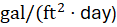 or
 via
 ) is governed by water permeability coefficient (
 ), net osmotic pressure difference (
 ), and applied hydraulic pressure difference (
 ):

In forward osmosis,  is near zero or modest, while
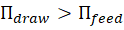 drives water permeation across the active skin layer of a thin-film composite (
 ) or cellulose triacetate (
 ) semipermeable membrane.
Concentration Polarization and Reverse Solute Diffusion
Real membrane modules fall short of ideal flux predictions because solute accumulation and depletion distort concentration profiles right at the membrane surfaces—a phenomenon known as concentration polarization. Because forward osmosis membranes have a porous support layer alongside a dense selective skin layer, concentration polarization occurs on both sides of the membrane:
- Dilutive External & Internal Concentration Polarization (
 /
 ): Permeating water dilutes the draw solute right at the active/support interface and within the tortuous pores of the porous support layer, lowering effective local osmotic pressure (
 ) below bulk draw osmotic pressure (
 ).
- Concentrative Concentration Polarization: Rejecting solutes from the feed stream concentrates dissolved salts at the feed-side boundary layer, elevating local feed osmotic pressure (
 ) and increasing scaling propensity.
Simultaneously, reverse solute diffusion ( ) occurs when draw solutes back-diffuse across the selective layer into the feed stream due to the concentration gradient. Specific reverse solute flux (
 , typically measured in
 or
 ) depletes expensive draw solutes, elevates feed salinity, and can accelerate scaling or biological fouling on the feed side. Membrane structural parameter (
 , combining support thickness
 , tortuosity
 , and porosity
 ) strongly governs internal concentration polarization; lower
 values reduce diffusion path length through the support and improve semipermeable membrane flux.
Technical Data Specifications of Forward Osmosis Desalination
| FO Process Parameter | Engineering & Separation Specification Standard |
|---|---|
| Applied Hydraulic Pressure | Low ( to  , or  to  ) |
| Primary Driving Force | Osmotic pressure gradient (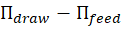 ) |
| Typical Water Flux Envelope |  to  (  to  ) |
| Operating Temperature Span |  to  (  to  ) membrane/loop range |
| Key Transport Resistances |  ,  , reverse solute diffusion (  ) |
| Secondary Regeneration Step | Thermal draw regeneration,  , or precipitation |
| Primary Application Niches | High-fouling brines, impaired feedwater, hybrid loops |
Thermal Draw Regeneration and Hybrid System Energetics
Forward osmosis dilutes the draw solution while extracting freshwater from the feed; producing pure product water and restoring draw concentration therefore requires a downstream regeneration or reconcentration stage. In standalone  without regeneration, diluted draw can serve directly as fertigation water, industrial process make-up, or pre-diluted feed to a subsequent desalination unit.
When regeneration is required, thermal draw regeneration uses low-grade thermal energy—such as industrial waste heat, solar thermal collectors, or geothermal streams ( to
 [
 to
 ] depending on draw chemistry)—to separate water from the diluted draw. Thermally responsive draw solutes, volatile ammonium bicarbonate (
 decomposing upon mild heating into ammonia and carbon dioxide gases), or phase-separating thermoresponsive polymers allow water recovery and draw reconcentration using thermal heat rather than high-voltage electrical pumping alone.
Hybrid  configurations also leverage low-pressure
 pre-treatment to remove fouling constituents from challenging feedwaters before high-pressure
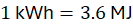
 polishing, though total system energy consumption depends closely on regeneration efficiency, membrane fouling control, and thermal-to-electrical energy integration (
 ;
 ).
Fouling Behavior and Practical Scaling Constraints
Compared with pressure-driven reverse osmosis, forward osmosis exhibits lower irreversible fouling compaction because hydraulic pressure does not press foulants tightly into membrane pores. When fouling occurs on the feed surface, hydraulic flushing or osmotic backwashing—reversing osmotic flow briefly by increasing feed salinity or adjusting draw concentration—can lift loose cake layers without harsh chemical cleaning.
Nevertheless, forward osmosis faces practical constraints in large-scale desalination: internal concentration polarization limits water flux on thick or high-tortuosity supports, reverse solute loss adds ongoing chemical make-up cost, and draw reconcentration can introduce substantial thermal or electrical demand if waste heat is unavailable. Matching draw chemistry, membrane structural parameter, and regeneration heat sources determines where forward osmosis provides tangible operational advantages over conventional membrane separation.

Comments (0)
Login to leave a comment.
No comments yet. Be the first to share your thoughts!