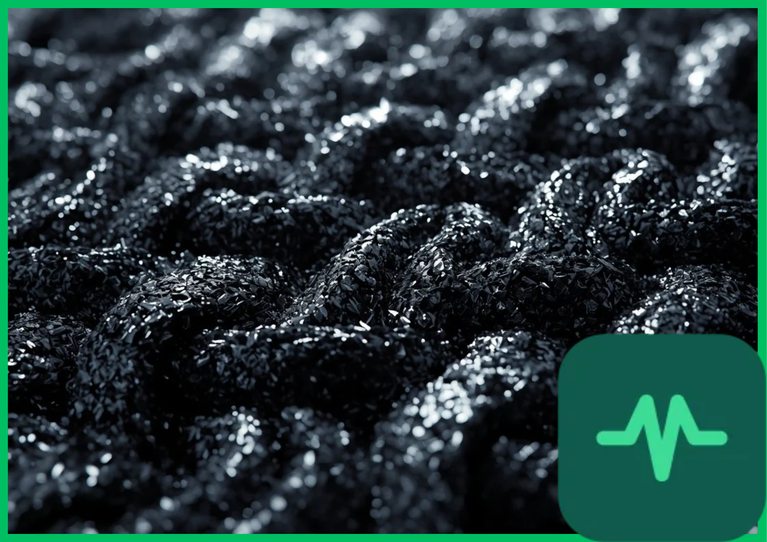
 ) annually, while manufacturing scrap rates and decommissioned parts generate thousands of tons of composite waste. Virgin carbon fiber production is highly energy-intensive, requiring carbonization temperatures exceeding
 (
 ) and emitting up to
 of
 per kilogram of finished fiber (
 per
 ). Reclaiming these high-value filaments via thermal pyrolysis, solvolysis, and fluidized bed recovery preserves up to 90% of virgin mechanical properties while reducing embodied energy by over 70%.
Thermal Pyrolysis and Matrix Decomposition Chemistry
Recovering carbon fibers from thermoset polymer matrix composites—such as epoxy, bismaleimide, or vinyl ester resins—requires thermal pyrolysis to decompose the cross-linked polymer network without oxidizing or degrading the underlying carbon filaments.
Industrial pyrolysis reactors operate in oxygen-depleted atmospheres at temperatures ranging between  and
 (
 to
 ). Under these thermal conditions, the covalent cross-links within the thermoset epoxy matrix undergo thermal cracking and scission:
- Volatilization: The polymer chains break down into low-molecular-weight condensable organic oils and non-condensable hydrocarbon gases (such as methane, ethylene, and carbon monoxide).
- Char Deposition: A thin carbonaceous char layer frequently deposits on the fiber surface during initial resin decomposition, requiring secondary oxidative cleaning.
- Surface Cleaning: Passing reclaimed fibers through a secondary thermal oxidation zone at
 (
 ) burns off residual surface char without damaging the graphitic crystal structure of the carbon fibers.
While thermal pyrolysis is industrially mature and capable of handling high-volume scrap streams, minor surface oxidation can reduce interlaminar shear strength if temperature profiles are not precisely controlled.
Solvolysis and Chemical Matrix Dissolution
Solvolysis offers an alternative chemical recovery route that dissolves the thermoset polymer matrix rather than burning it, preserving clean fiber surfaces and preventing thermal degradation. Solvolysis utilizes subcritical or supercritical fluids—such as water, methanol, acetone, or glycol—catalyzed by acids, bases, or metal ions.
Supercritical water solvolysis operates at temperatures between  and
 (
 to
 ) under high pressures exceeding
 (
 ). At these thermodynamic states, water exhibits low dielectric constant and high diffusivity, acting as an aggressive organic solvent that hydrolyzes the ester and ether bonds within the epoxy resin network.
The polymer matrix dissolves completely into liquid oligomers and monomers, leaving pristine carbon fibers floating free in solution. Recovered fibers maintain over 95% of their original tensile strength and retain active surface sizing functional groups, ensuring superior interfacial adhesion when re-impregnated into secondary composite matrices.
Fluidized Bed Thermal Recovery
Fluidized bed reactors utilize high-velocity streams of heated air passing upward through a bed of inert silica sand particles maintained at temperatures between  and
 (
 to
 ). Shredded composite scrap fed into the fluidized bed undergoes rapid thermal decomposition as the turbulent sand particles transfer heat efficiently to the material.
The polymer matrix burns off instantly, and the lightweight reclaimed carbon fibers are carried upward by the gas stream, separating automatically from the heavy sand bed. A cyclone separator and baghouse filter collect the clean carbon fibers. While fluidized bed recovery yields randomly oriented, chopped short fibers rather than continuous filaments, the process is highly tolerant of contaminated scrap streams containing metal inserts, adhesives, and sandwich core materials.
Technical Data Specifications of Recycled Carbon Fiber Parameters
| Reclaiming & Material Parameter | Engineering Specification Range |
|---|---|
| Pyrolysis Operating Temperature |  to  (  to  ) |
| Supercritical Water Solvolysis Pressure |  to  (  ) |
| Tensile Strength Retention (Recycled) | 85% to 95% of virgin carbon fiber baseline |
| Elastic Modulus Retention | 98% to 100% of virgin fiber stiffness |
| Embodied Energy Reduction | 70% to 85% energy savings vs. virgin PAN production |
| Fiber Length Distribution |  to  chopped or non-woven formats |
Fiber Architecture Transformation and Manufacturing Integration
Reclaimed carbon fibers typically emerge from pyrolytic or solvolytic recycling as loose, short, or non-continuous filaments, breaking the continuous tow architecture characteristic of virgin aerospace material. Transforming these random short fibers into high-performance engineering intermediates requires specialized textile manufacturing techniques:
- Carding and Wet-Laided Non-Wovens: Short fibers are processed through carding machines or wet-laid paper-making processes to form uniform, isotropic carbon fiber mats (veils) bonded with thermoplastic polymer binders.
- Aligned Short-Fiber Preforms: Advanced alignment technologies utilize electrostatic fields or aerodynamic fluid drafting to orient discontinuous fibers uniaxially or bidirectionally, recovering high tensile mechanical properties approaching continuous-fiber laminates.
- Compression Molding: Reclaimed mats are impregnated with epoxy or thermoplastic resins (such as polyamide or polypropylene) and compression-molded under high hydraulic pressures (
 to
 or
 to
 ) to fabricate lightweight automotive structural brackets, consumer electronics enclosures, and industrial machine components.
Life-Cycle Assessments and Circular Economy Realities
Quantitative life-cycle assessments (LCAs) published by the UNEP and academic materials research consortia confirm that utilizing recycled carbon fiber composites reduces cumulative energy demand and greenhouse gas emissions by up to 80% compared to virgin polyacrylonitrile-based manufacturing. As global environmental regulations restrict industrial landfill disposal of composite waste and aerospace manufacturers commit to net-zero supply chain targets, chemical and thermal reclamation technologies establish a closed-loop material economy. By converting high-performance structural waste into high-value secondary engineering inputs, recycled carbon fiber composites decouple advanced lightweight design from virgin fossil resource extraction.

Comments (0)
Login to leave a comment.
No comments yet. Be the first to share your thoughts!