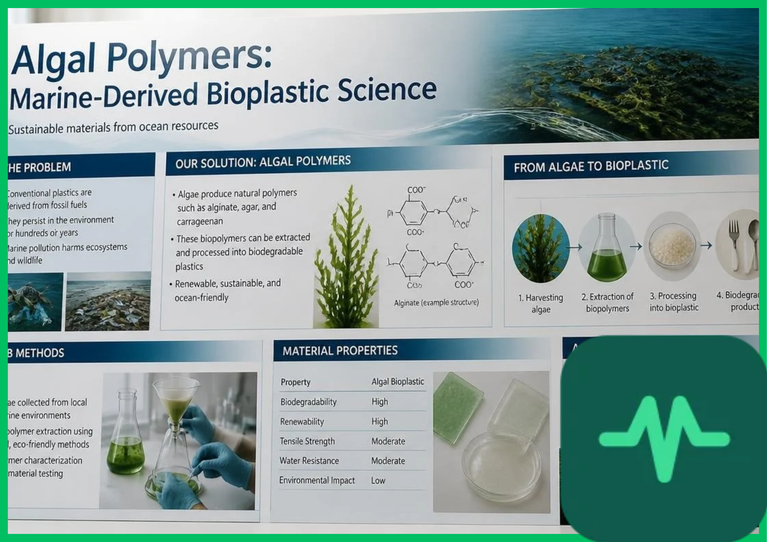
 ), while conventional synthetic polymers exhibit multi-century persistence. Extracting structural polysaccharides—such as agar, carrageenan, and alginate—from macroalgae (seaweeds) alongside intracellular polyhydroxyalkanoates (PHAs) from microalgae provides a scalable bio-based feedstock. Synthesizing durable algal bioplastics requires rigorous control over polysaccharide extraction chemistry, plasticizer integration, polymer chain cross-linking, and aqueous degradation kinetics.
Macroalgal Polysaccharide Extraction and Chemical Structure
Macroalgae biomass—comprising brown, red, and green seaweed species—contains complex structural polysaccharides that form the foundational matrix of algal bioplastics. Extracting these macromolecules requires targeted chemical processing to isolate specific polymer fractions from cellular cell walls.
Primary macroalgal polymer families utilize distinct extraction pathways:
- Alginate Extraction from Brown Algae (Phaeophyceae): Brown seaweeds (such as Laminaria and Macrocystis) are treated with warm aqueous sodium carbonate (
 ) solutions to solubilize insoluble alginic acid into soluble sodium alginate. Subsequent calcium chloride (
 ) cross-linking precipitates rigid hydrogel matrices. Alginate consists of linear copolymers of
 -D-mannuronic acid (
 ) and
 -L-guluronic acid (
 ) linked via 1,4-glycosidic bonds.
- Carrageenan Extraction from Red Algae (Rhodophyta): Red seaweeds yield sulfated galactans (kappa, iota, and lambda carrageenans) extracted via hot alkaline aqueous digestion (
 to
 or
 to
 ). The repeating galactose units feature ester sulfate groups that impart strong ionic interaction capabilities and thermoreversible gelation properties.
- Agar Extraction: Extracted via hydrothermal pressure cooking of red algal cell walls, producing agarose chains that form resilient, transparent film networks upon cooling.
Microalgal Polyhydroxyalkanoates (PHAs)
Beyond macroalgal polysaccharides, microalgae strains (such as Chlorella, Spirulina, and various diatom species) synthesize intracellular polyhydroxyalkanoates when subjected to nutrient-depleted stress growth regimes (such as nitrogen starvation combined with carbon excess). Microalgae accumulate PHAs as energy reserve granules comprising up to 40% to 60% of their dry cellular weight.
Extracting microalgal PHAs requires disrupting rigid cell walls via mechanical bead milling, enzymatic lysis, or organic solvent extraction using chloroform or ethyl acetate. These bio-polyesters exhibit thermoplastic properties identical to petrochemical polypropylene, including high crystallinity, tensile strength, and complete marine biodegradability, dissolving safely into microbial biomass and carbon dioxide without toxic environmental residues.
Plasticizer Mechanics and Tensile Modulus Optimization
Native algal polysaccharides form brittle, rigid films due to extensive intra-molecular and inter-molecular hydrogen bonding networks across their hydroxyl-rich polymer backbones. To achieve flexible, stretchable packaging films, industrial processing incorporates hydrophilic plasticizers—such as glycerol, sorbitol, or low-molecular-weight polyethylene glycol.
Plasticizer molecules penetrate the algal polymer matrix, inserting themselves between adjacent macromolecular chains. This intercalation disrupts hydrogen bonding, increases free volume, and lowers the glass transition temperature ( ), transforming brittle films into flexible elastomers. However, excessive plasticizer loading causes phase separation, plasticizer migration, and a sharp reduction in tensile strength.
Optimizing tensile modulus requires balancing plasticizer concentration with cross-linking agents. Cross-linking divalent cations (such as  or
 ) with alginate carboxyl groups forms ionic bridges that reinforce the polymer network, increasing tensile strength from
 to over
 (
 to
 ).
Technical Data Specifications of Algal Biopolymer Parameters
| Algal Polymer Type | Extraction / Synthesis Method | Tensile Strength Range | Glass Transition (Tg) | Marine Degradation Timeline |
|---|---|---|---|---|
| Sodium Alginate | Alkaline extraction from brown seaweed |  to  |  to  (  to  ) | 14 to 30 days in seawater |
| Kappa-Carrageenan | Hot alkaline extraction from red algae |  to  |  to  (  to  ) | 10 to 21 days in aqueous media |
| Microalgal PHA | Intracellular accumulation & solvent extraction |  to  |  to  (  to  ) | 60 to 120 days in marine silt |
| Petroleum LDPE (Benchmark) | Petrochemical polymerization |  to  |  (  ) | Non-biodegradable synthetic |
Water Vapor Transmission Rates (WVTR) and Hydrophilic Challenges
A major technical hurdle facing algal biopolymer packaging is its inherent high hydrophilic affinity, which results in elevated water vapor transmission rates (WVTR) and high water solubility compared to hydrophobic polyolefins like low-density polyethylene (LDPE).
Because algal polymer chains contain abundant hydroxyl ( ) and carboxyl (
 ) groups, water molecules adsorb rapidly into the film matrix via hydrogen bonding. In high-humidity environments (
 relative humidity), un-modified algal films absorb moisture, swell, lose mechanical rigidity, and undergo premature dissolution.
To overcome moisture sensitivity, industrial material engineers apply hydrophobic surface treatments and barrier coatings:
- Bio-Wax Lamination: Applying thin layers of carnauba wax, beeswax, or plant-derived lipid coatings reduces water vapor permeability by up to 70%.
- Blending with Hydrophobic Biopolymers: Compounding algal extracts with biodegradable polyesters like polybutylene succinate (PBS) or polylactic acid (PLA) creates immiscible or semi-miscible blend morphologies that block moisture diffusion pathways.
Degradation Kinetics in Marine and Terrestrial Ecosystems
The environmental end-of-life profile of algal bioplastics represents their primary ecological advantage over conventional plastics. Biodegradation in aquatic environments proceeds via enzymatic hydrolysis, where marine microorganisms secrete extracellular alginases, cellulases, and carrageenases that cleave the glycosidic linkages of the polymer backbone.
Microbial assimilation converts the resulting oligosaccharides and monomers into cellular biomass, water, and carbon dioxide. Quantitative studies published in academic polymer degradation literature demonstrate that un-crosslinked algal films disintegrate completely in ambient seawater ( to
 or
 to
 ) within 14 to 30 days, leaving zero persistent microplastic particulates or chemical toxins.
Life-Cycle Assessments and Global Scalability
Quantitative life-cycle assessments (LCAs) published by the UNEP and academic marine research institutions confirm that cultivating macroalgae and microalgae for biopolymer production generates net-positive ecological benefits. Algae farming requires zero arable land, freshwater irrigation, or synthetic chemical fertilizers, absorbing dissolved carbon dioxide and excess nitrogen from coastal waters during growth. As industrial extraction techniques scale and barrier modification technologies advance, marine-derived bioplastics deliver high-performance packaging alternatives while regenerating coastal aquatic ecosystems.
Comments (0)
Login to leave a comment.
No comments yet. Be the first to share your thoughts!