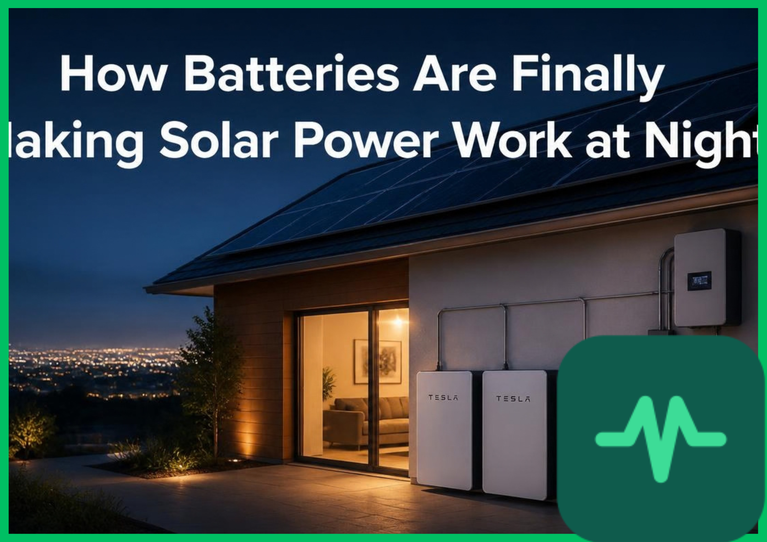
Not anymore. A quiet shift is genuinely changing this picture, and it's worth understanding what's actually happening.
The old problem, honestly stated
Solar panels only generate electricity while the sun shines. Once evening arrives, that generation stops completely, right around the time many households actually use the most electricity, cooking dinner, running appliances, settling in for the evening.
This mismatch between when solar produces and when people actually need power has been solar energy's most persistent, honest limitation.
What's genuinely changing this
Batteries paired with solar panels solve this mismatch directly. Instead of using solar electricity only the moment it's generated, homes and grids can now store that daytime energy and release it later, exactly when it's actually needed.
Energy analysts have started calling this the era of anytime solar, and it's a genuinely fitting description. Solar energy is no longer confined to daylight hours alone.
The scale of this shift, honestly
This isn't a small, experimental trend. Real-world data from multiple regions now shows batteries delivering a meaningful share of evening electricity demand, energy that originally came from solar panels earlier that same day, simply stored and released later.
In some markets, this shift has moved remarkably fast, going from almost no evening battery contribution just a few years ago to genuinely significant levels today.
Why this matters beyond convenience
This shift changes the entire logic of solar energy. Previously, solar's usefulness was limited by daylight hours. Now, stored solar energy can genuinely compete with traditional evening power sources, reducing reliance on other electricity generation methods precisely when demand peaks.
For households specifically, this means solar panels paired with a home battery can realistically cover a much larger share of daily electricity needs, not just the portion used during actual sunlight hours.
The honest technology behind it
Modern home battery systems have become considerably more capable and more affordable than earlier generations. Newer battery chemistries are also emerging, offering longer lifespans and, in some cases, using more abundant, less costly materials than earlier battery technology relied upon.
This ongoing improvement matters because battery cost has historically been the main barrier preventing more households from pairing solar with meaningful storage capacity.
What this actually means for someone considering solar
If you're weighing whether solar panels genuinely make sense for your situation, this shift is worth factoring into your thinking. Solar paired with a battery offers a meaningfully more complete energy solution than solar panels alone.
Without a battery, any excess solar energy generated during the day either gets sent back to the grid for a modest credit, or in some situations, goes unused entirely. With a battery, that same energy becomes genuinely usable later, when you actually need it most.
The honest tradeoffs still worth knowing
Adding battery storage increases the upfront cost of a solar installation. This is a real, honest consideration, not something to gloss over.
The payback timeline depends on your specific electricity costs, your typical usage pattern, and local conditions. For some households, the improved self-sufficiency and reduced reliance on the grid justify the investment. For others, solar panels alone, without battery storage, may still make more practical sense right now.
Why this trend will likely keep accelerating
As battery technology continues improving and costs continue trending downward, the economics of pairing solar with storage keep becoming more favorable. This isn't a one-time shift that's already finished. It's an ongoing trend that's still gaining genuine momentum.
Grid operators and energy planners have taken notice too, since widespread battery adoption changes how entire electricity systems can be designed and operated, not just individual households.
A genuinely hopeful shift worth understanding
For years, skeptics of solar energy pointed to its dependence on daylight as a fundamental limitation. That criticism, while historically fair, is becoming considerably less relevant as battery storage continues maturing alongside it.
This represents genuine, meaningful progress, not marketing spin. The fundamental physics of solar panels hasn't changed. What's changed is our ability to capture and use that energy on our own schedule, rather than being limited entirely to whenever the sun happens to be shining.
The honest bottom line
Solar power's biggest historical limitation, disappearing the moment the sun sets, is genuinely being solved through battery storage. This shift is already measurably underway in multiple regions, not just a future possibility being discussed at conferences.
If solar has ever seemed limited to you because of this exact concern, it's genuinely worth revisiting that assumption. The era of anytime solar isn't a distant promise. It's already quietly arriving.



Comments (0)
Login to leave a comment.
No comments yet. Be the first to share your thoughts!